While the 2020 COVID-19 pandemic was a global pandemic of huge proportions which wrought havoc across global businesses and economies, it did, in fact, also have some positive spin-offs. A case in point was the establishment of Afri Readymix, a business that came into being in 2021 following the purchase of a readymix plant from a major construction materials supplier.
As part of a rationalisation strategy to sidestep the tough market conditions brought about by the pandemic, the leading construction materials supplier mothballed some 23 readymix plants across its national footprint, of which the Rustenburg plant was one.
Having worked for the company for 20 years at the time, Gerhard Maree, who is now the MD and founder of Afri Readymix, grabbed the opportunity to acquire the plant from his previous employer, in partnership with fellow directors Werner Weiss and Christie van der Mescht. The acquisition went through in March 2021, marking the birth of Afri Readymix, a company that has been on a positive growth trajectory for the past four years.

Quick growth
Within a year of its formation, Afri Readymix quickly expanded its horizons with the addition of the Afri Readymix Boshoek plant in 2022. This was followed by the establishment of Afri Hardware and Building Supplies, a hardware store which officially opened its doors on August 3, 2024.
“From the onset, we had a vision to become a one-stop construction materials supplier, offering our customers anything from concrete to hardware, and this became reality when we successfully invested in our hardware store, which is also located in Rustenburg,” explains Maree.
“When customers build a house, for example, they also need bricks, plumping, electrical and roofing materials. Given that we are the customer’s first point of contact for the concrete for foundations, we realised that we could also talk to them about the rest of the materials they need to build, from the foundation to the roof, and this was central to the hardware store venture,” says Maree, adding that, if successful, the hardware model will be replicated across the company’s readymix plant footprint.
The hardware store was soon followed by the establishment of Afri Readymix Limpopo – a plant based in Northam – in December 2024, bringing to three the number of readymix plants owned and operated by Afri Readymix.
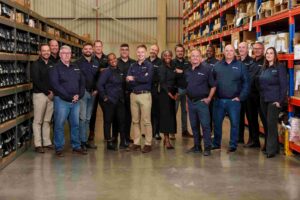
To date, the company has a workforce of 40 permanent employees and 20 contractors across these sites. In terms of capacity, Afri Readymix Rustenburg has the capacity to produce 800 m³ of concrete per day, while the Boshoek and Northam plants are both rated at 400 m³ per day. To service clients across the three plants, the company currently operates a total of 26 readymix trucks, of which 18 are owned by Afri Readymix and the rest by contractors.
In addition, the company also provides mobile concrete batching plant services. These are particularly useful for projects requiring on-site concrete production, such as road construction, solar farms or those in remote locations. By reducing the need for concrete transport, these plants minimise carbon emissions and waste.

Competitive edge
Commenting on the company’s quick growth, Weiss tells Quarrying Africa that one of the key success factors is the consistent, high-quality service to all customers, regardless of size, which has been central to building a positive business reputation. Diversifying the customer base with both large and small clients, adds Weiss, also reduces reliance on a few large clients, which has led to a more stable and resilient business.
“In the face of a constantly changing construction market, the corporate approach to customer service has lost relevance. That is why we have a face-to-face approach to every deal. It does not matter whether the customer is buying 4 m³ or 100 m³ of concrete from us – we always seek to establish personal relationships with our customers. This fosters deeper connections, trust and personalisation of service, leading to increased customer satisfaction and loyalty,” explains Weiss.
While mines constitute about 60% of the company’s readymix concrete business to date, Maree says that some 30% still comes from the cash-on-delivery (COD) clients, which provides a balanced customer base to the business. The market is diverse, and includes civil projects, property developers, private home developers, chicken houses for the food industry and solar farms, amongst others.
According to Maree, one of the early success drivers has been the relentless focus on providing top quality readymix concrete at the best rate possible. Working closely with suppliers allows Afri Readymix to negotiate better input pricing and reduce overall procurement costs. This, in turn, allows the company to offer competitive rates to the market.
“Collaborative relationships with suppliers can lead to joint identification of cost-saving opportunities. On the cement side of things, which is a crucial input in what we do, we commend Sephaku Cement for walking the journey with us in the quest to reduce costs and ultimately put back better rates into the market,” says Maree.
“We also get our aggregates from third-party suppliers who source from Sibanye Stillwater and Glencore, where legacy material is processed. This process is a win-win situation for both the mine and Afri Readymix – we help them get rid of excess material as part of their rehabilitation efforts, while we also get access to cost-effective, quality aggregates and also drive our own sustainability agenda in the process,” adds Maree.
In addition, Afri Readymix is not just about selling readymix concrete – the business prides itself on being an active citizen in communities in which it operates. Community engagement and social responsibility are at the core of the company’s values, embodied in its ‘Giving Back Drive’. This initiative reflects the commitment to empowering and enriching the communities of which the company is an important part.
“Key aspects of our ‘Giving Back Drive’ include building stronger community connections, encouraging active participation from customers and employees, nurturing a positive image, promoting economic progress and tackling local issues. These endeavours are geared towards making a substantial difference, nurturing ethos of empathy and communal responsibility within our company,” says Maree.

Key trends
Commenting on some key trends in the market, Maree believes that, like any other sector of the economy, the readymix concrete business is seeing a technological shift, starting with the concrete batching plants themselves. The technological revolution in concrete batching plants is characterised by increased automation, digitalisation and the use of advanced sensors and control systems. This, he says, leads to improved efficiency, quality control and output capacity in concrete production.
“Concrete batching plants are increasingly becoming technologically advanced. For example, we make use of advanced systems such as Command CE Systems, which helps optimise mix designs, ensures raw materials meet specifications and streamlines quality control processes. Additionally, Command CE provides real-time insights into material performance and mix efficiency, enabling better decision-making and greater operational control,” explains Maree.
The adoption of technology also extends to concrete properties themselves. The advent of new admixtures has been a key trend in readymix concrete production. Afri Readymix works closely with CHRYSO Southern Africa to continuously introduce new admixtures in its designs. The addition of these admixtures has been instrumental in reducing the water/cement ratio, which leads to several benefits, primarily increasing the strength and durability of the concrete. It also improves the long-term performance of the concrete, reduces costs of production and the environmental impact.
Technology, adds Maree, has also allowed flexibility in concrete mix designs. Through its partnership with concrete specialist, Go Consult, Afri Readymix offers in excess of 300 mix designs. “Through our partnership with Go Consult, a reputable name in concrete consulting services, we can offer a full suite of mix designs and special mix designs such as durability W-mixes, self-levelling, high strength and pool, amongst others,” says Maree.

Outlook
As part of its growth strategy, Afri Readymix has plans to expand its readymix concrete footprint, particularly into smaller towns with high demand and minimal competition. At the start of this year, plans were underway to establish a plant each in Potchefstroom and Marikana, a decision that has been put on hold due to the prevailing economic conditions and a projected reduction in construction activity.
In addition to constrained economic conditions as a result of a generally weak business environment and political uncertainty around the Government of National Unity (GNU), Maree is wary of the strained relations with the United States, which he says could negatively impact economic growth this year and beyond.
“We had several plans in the pipeline, but these have been put on hold. We will maintain what we have at the moment and wait to see what will happen with the South African economy in the near future,” concludes Maree.