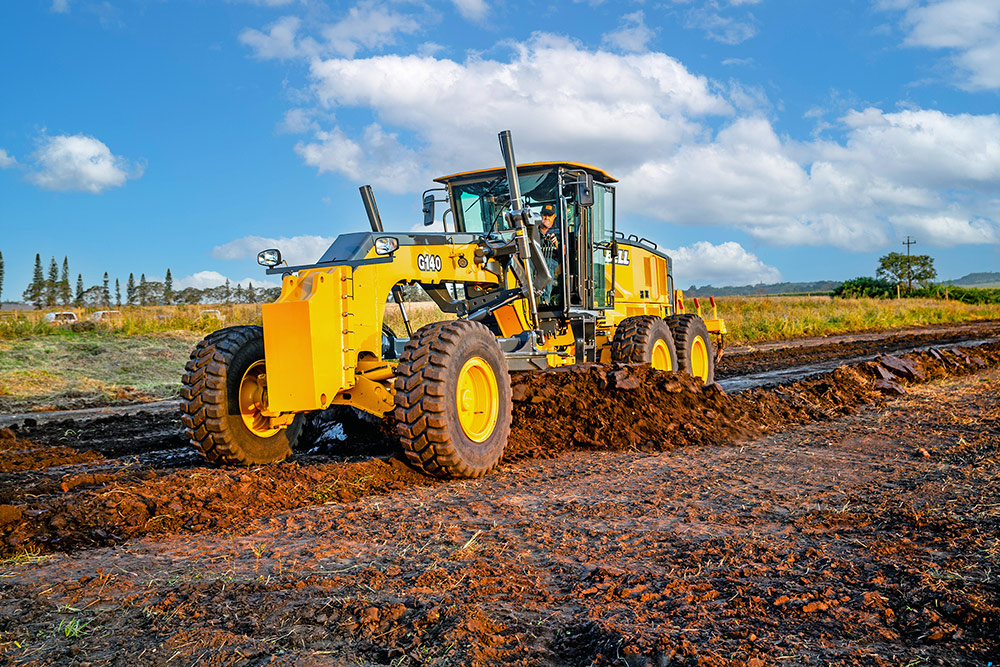
To meet the emerging needs of the evolving global earthmoving industry, Bell Equipment has expanded its OEM product range with the official launch of its own motor graders. In an exclusive interview with Quarrying Africa last year, Ashley Bell, CEO of Bell Equipment, noted that the Bell motor grader development inarguably represented the largest research and development (R&D) project in recent years.
Following a nearly three-year rigorous testing regime, which initially entailed prototype units and ultimately pre-production units, across various applications in all major grader markets such as southern Africa, North America and Australia, the range is now available for a staged commercial rollout, initially in Stage 3 markets such as Africa, Australia and South East Asia.
Why motor graders?
The ongoing development and enhancement of OEM products is a major growth strategy for Bell Equipment. This is currently anchored by the Bell motor grader range which, according to Stephen McNeill, Head of Group Marketing at Bell Equipment, is expected to roll off the Richards Bay production line during August 2025.
Why motor graders? The decision to venture into the design and manufacture of motor graders, explains McNeill, was largely informed by market fundamentals – the size and potential of the global motor grader market. The Richards Bay-headquartered OEM is strategically positioning motor graders as a core earthmoving product to complement its staple articulated dump truck (ADT) offering, especially given the fact that the global motor grader market is comparable in size to the ADT market, making it a crucial area for growth and diversification for Bell.
“Based on our market research, we have found most major ADT markets in the world to be key motor grader markets as well. Developing our own motor grader range was therefore a natural step in our quest to provide a comprehensive OEM product offering to both our dealers and customers operating in these major markets,” explains McNeill.
Engineering prowess and proven expertise in supporting motor graders were also key factors behind the decision to venture into this market, stresses McNeill. A motor grader, he adds, is a highly complex machine from an engineering perspective, largely due to its unique design features and the precision required for operation. Additionally, the advanced hydraulic systems – with up to 15 hydraulic functions needed – add to the manufacturing complexity.
“Our ADT is to date one of the most innovative machines in the global market. Leveraging that skill set behind such a globally renowned product – enabled by over 70 top-class engineers at our Richards Bay factory – we realised that we had the necessary engineering capability and resources to build our own motor grader,” says McNeill, adding that all the 3 000 employees and over 1 000 suppliers at the Richards Bay factory can be proud of this locally manufactured Bell motor grader range, which consists of 70% local content.
With over 20 years of experience in distributing, maintaining and repairing motor graders, along with insights from local and international experts, McNeill says Bell also has a clear understanding of what is important to make this product work optimally.
Range in detail
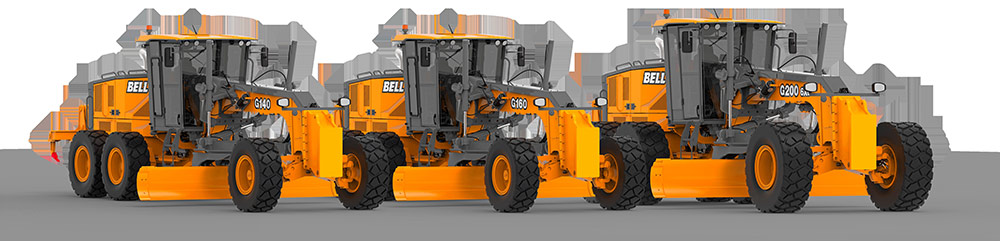
Bell Equipment is initially introducing three base models – each with the option of a four- or six-wheel drive configuration. The G140 – a 21-tonne (t) machine powered by a 6,7-litre Cummins QSB6.7 engine delivering 179 kW of power (both in 6×4 and 6×6 configurations) – is well suited to all maintenance and light to medium construction tasks.
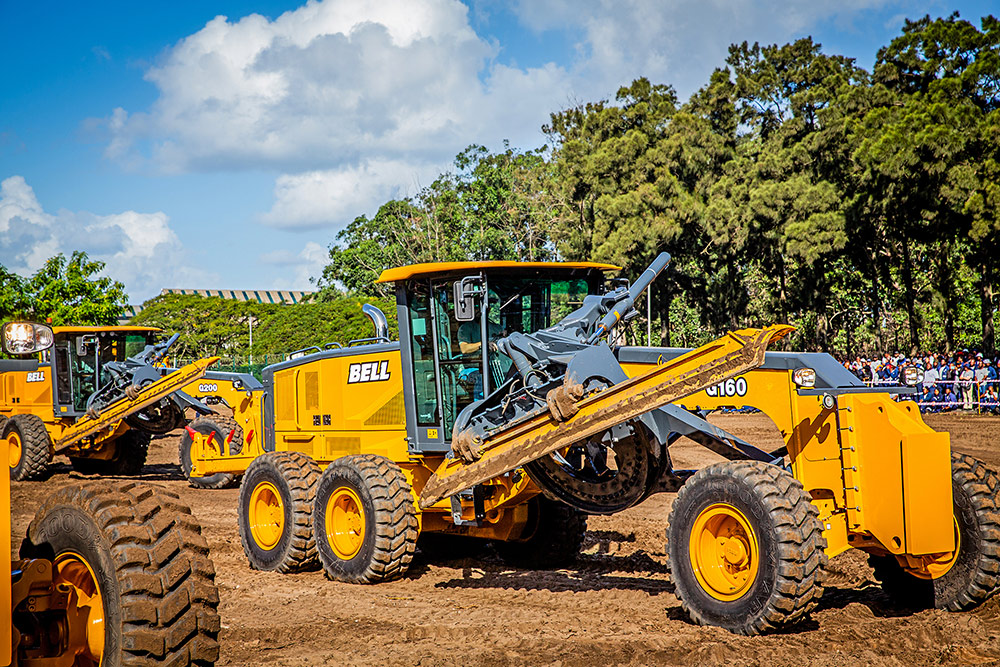
Powered by a 9-litre Cummins QSL9 delivering 209 kW in a 6×4 configuration and 229 kW in a 6×6 configuration, the G160 packs increased power and performance to handle heavy construction applications. Designed for bulk earthworks and the mining industry, the G200 is powered by a 9-litre Cummins QSL9 engine delivering 231 kW (6×4) and 245 kW (6×6) of power to undertake arduous grading operations.
The range is driven by ZF transmissions. According to Jeremiah Mokhomo, product manager at Bell Equipment, the G140 uses the Ergopower transmission, which is well respected in the grading application for entry level units. The larger G160 and G200 use the cPower hydromechanical transmission, which offers significant benefits in terms of fuel efficiency, driving comfort and productivity. It achieves this through continuously variable speed control, hydrostatic-mechanical power splitting and the ability to operate at lower engine speeds while maintaining high efficiency.
Durability in focus
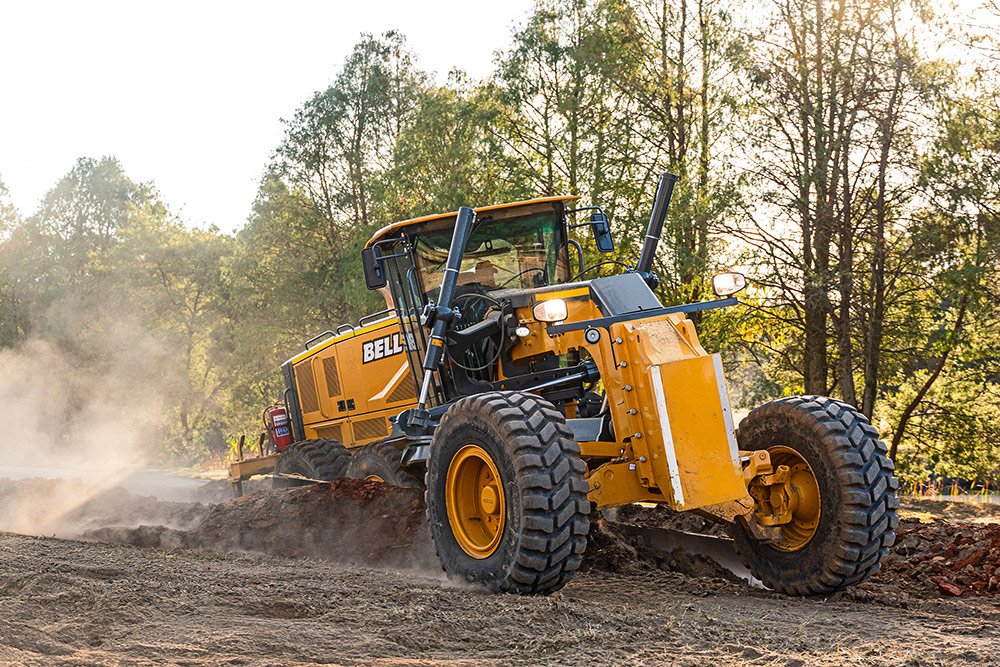
One of the special design focus areas for the Bell motor grader range is durability – giving the machines the ability to withstand the toughest operating conditions, while maximising productivity and uptime. Several features speak directly to this, with Mokhomo making special mention of the sealed slew bearing, which comes as standard across the range to maintain precision.
The sealed slew bearing delivers consistent mouldboard accuracy due to minimal wear and requires less maintenance compared to open gear designs. Furthermore, adjustable mouldboard inserts can be adjusted in five minutes and are designed to maximise the life of the wear inserts.
“Open gear designs found on some competitor offerings come with brass inserts, which tend to be expensive because they wear quite quickly due to the blade’s movement. To provide context, the brass inserts found on some competitor offerings are generally replaced at every 400 hours, costing clients up to R15 000 per each replacement. With the sealed slew bearing, there are no brass inserts required – just greasing at 500-hour intervals, thus reducing both maintenance and costs,” says Mokhomo.
One of the features that is directly related to durability is the main frame’s single piece construction approach, which is designed to eliminate fatigue on fabricated joints. “The single plate gooseneck, from the front to the rear, does away with welded joints. The absence of fabricated joints eliminates potential weak points and reduces the risk of failure,” continues Mokhomo.
The parallelogram design of the two-cylinder, cantilevered ripper maintains an efficient ripping angle regardless of depth. The consistent tooth angle ensures optimal performance throughout the working range. The tilting ripper beam provides a better departure angle when retracted, and the high lift design improves transport clearance.
The optional blade impact absorption accumulator (standard on the G200) acts like a shock absorber, minimising the impact on the blade during accidental contact with curbs, rocks, or other obstacles. The Bell-made tandem axle is designed with long distance operation in mind. This is supported by enhanced trunnion bearing life and integrated axle cooling for extended brake life.
Maximum control and flexibility
The Bell motor grader range offers advanced design features that give operators maximum control and flexibility to tackle a variety of tasks with precision. Whether it is adjusting blade positioning for fine grading, enhancing manoeuvrability in tight spaces, or maintaining alignment on uneven surfaces, the grader’s adaptable functionality ensures performance is tailored to each task’s needs.
The two-position drawbar, with two mounting positions, allows operators to adjust the drawbar height depending on the tyre size. This ensures the drawbar remains level, preventing the mouldboard corners from digging or lifting as one rotates the circle during grading.
For enhanced manoeuvrability, the front wheels can lean left or right, enhancing traction and stability on slopes or tough surfaces. This feature reduces side pull, ensuring precise and efficient grading. The crab walk feature allows the grader’s front and rear wheels to steer in the same direction, allowing diagonal movement without changing orientation. This is especially useful when working around windrows, ensuring continuous grading without disturbing material placement.
Easy operation
Given that the motor grader is often considered one of the most challenging pieces of heavy equipment to operate due to the complexity of its controls and the precision required for many tasks, the Bell motor grader range places a special design focus on ergonomically engineered controls and exceptional visibility, allowing operators to work with ease and confidence. Equally, the range is designed with ultimate operator comfort in mind, ensuring reduced fatigue and thus increased productivity.
“Control is always crucial on motor graders and the Bell range has intuitive controls with a 30-button sealed switch module (SSM), and a sealed 6WD selection controller for applicable models. The 7” colour display is multifunctional for monitoring machine operation, including diagnostics and easily navigated using the automotive mouse (B-drive),” explains Mokhomo.
The advanced speed control allows precise control for optimal grading performance. An analogue high-definition (AHD) camera system affords enhanced situational awareness ensuring clear visibility through the 7” monitor.
The Bell motor grader range offers operators the flexibility to select their preferred control configuration, with the option of traditional antler controls or advanced joystick controls. This allows for alignment with operator familiarity and comfort, whether favouring antler controls or joystick controls, ultimately enhancing productivity on the job.
“When it comes to grade control technology, we have adopted a technology-agnostic approach. Customers are able to incorporate Leica, Topcon and Trimble grade control technology, depending on their preference. The technology-agnostic approach offers numerous benefits, including increased flexibility and allowing organisations to choose the best tools for the job,” concludes Mokhomo.