In recent years, the mining sector – particularly in South Africa and southern Africa at large – has witnessed increased participation from small, emerging junior miners across various commodities. The growing number of small, locally owned companies and individual entrepreneurs entering the sector is largely driven by government policies aimed at promoting emerging miners by helping them access marginal deposits and play a greater role in the industry.
However, limited access to capital remains a major hurdle. These operators still need quality equipment solutions that can offer long-term value and productivity without breaking the bank. Reliable comminution equipment is an important investment in the contracting business, but finding the balance between durability and cost remains a challenge for small-scale miners.
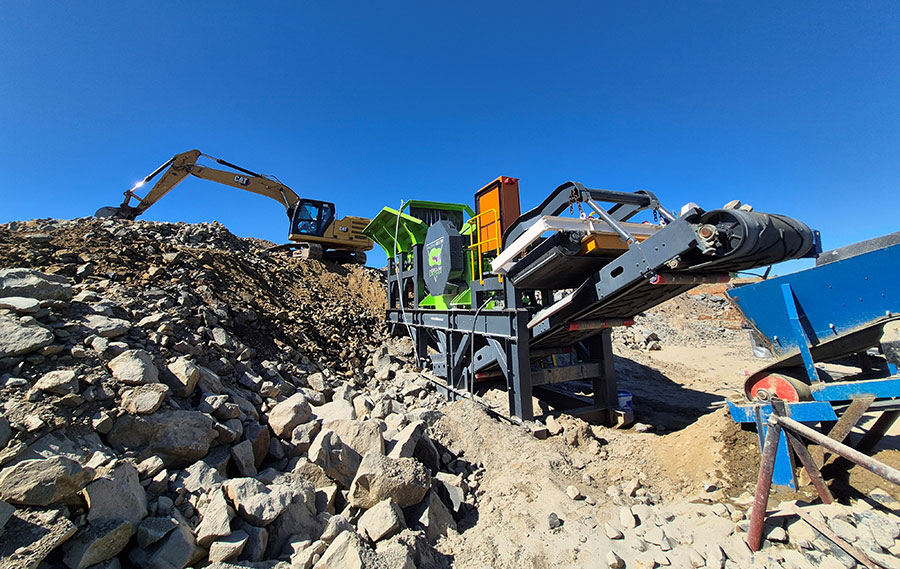
To help close this gap, Caldas brought its own range of comminution equipment to market three years ago, specifically in response to the growing number of small-scale miners coming to the fore.
“We recognised that many contractors needed durable crushing plants at a lower capital investment. Our focus has been on keeping the designs simple, straightforward and easy to maintain,” says Michael Da Camara, Chief Operating Officer at Caldas.
Founder Rui Caldas adds that these plants offer immediate availability, are simple to transport and operate, and require low skill levels. Customers can also feel confident knowing they have support from a team that has built experience over nearly three decades.
Julius Mokuwe, Head of the Technical Department, says immediate availability is a game-changer not only for small-scale miners but for the industry as a whole. “Because mining projects are often fast-tracked, immediate availability matters. That is why we keep a healthy inventory of crushers that are ready to go,” says Mokuwe.
High inventory levels, adds Miles Mulder, Head of Sales at Caldas for Crushers Wears Spares, ensure product availability to meet customer demand and improve customer satisfaction. They also act as a buffer against supply chain disruptions and seasonal demand spikes as commodity prices improve. “Our inventory approach helps us deliver faster and support smoother, more continuous production for our customers,” says Mulder.
One of the emerging trends in the mining market, adds Mulder, is the demand for second-hand crushers from different sources, including auctions and mothballed operations.
“With our in-house range, we aim to offer customers new equipment at a cost closer to premium second-hand options, supported by strong aftermarket service and technical support,” adds Da Camara.
Size and model range
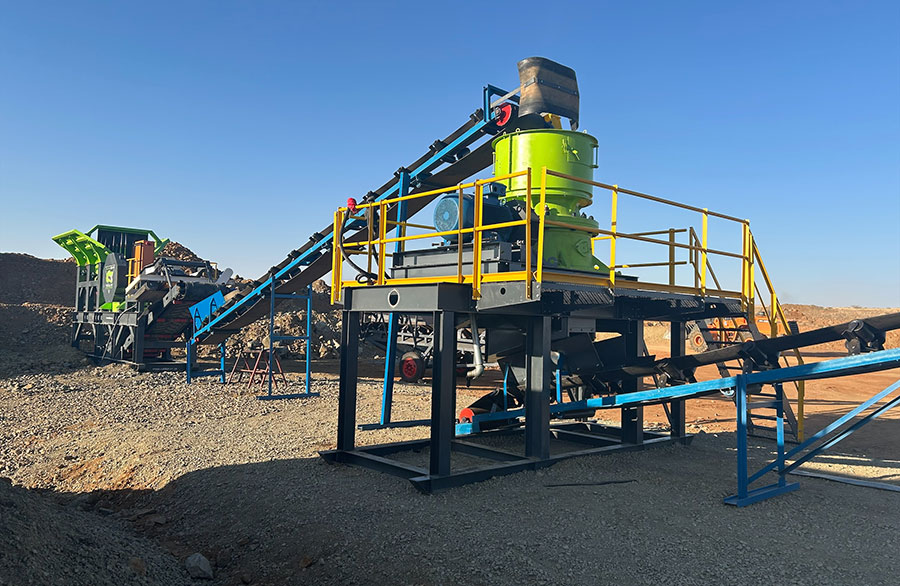
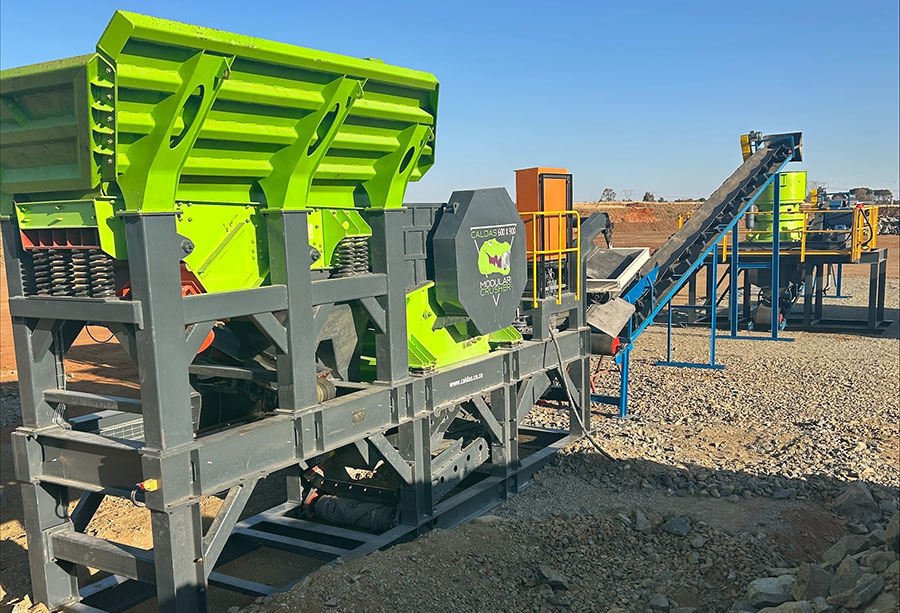
In just three years since establishing its equipment business, Caldas for Crushers Wears Spares already offers a broad range of crushers – 11 in total – including seven jaw crushers, two cone crushers and two horizontal shaft impactors, highlighting the rapid pace of development in response to market needs. These units cover a broad capital cost range, from R250 000 up to R5-million, catering to various customer requirements.
The focus, explains Caldas, is on plug-and-play, modular or skid-mounted electric-driven crushing equipment in the up to 150 tonnes per hour (tph) capacity range. “Because of our cost-effective capital cost and immediate availability, we are seeing growing interest in the range even from larger customers. We will probably, in the near future, be challenged to make bigger equipment to cater for higher tonnage requirements, but at the moment the focus is on the up to 150 tph market,” says Caldas.
Since the launch of the first units three years ago, the installed base has grown significantly, with chrome and aggregates at the forefront of uptake. The company, confirms Mulder, has also supplied a unit to a gold mine in Scotland, highlighting the growing interest in this equipment range across commodities and regions.
While the majority of units are currently operating in South Africa, Caldas notes a growing number of enquiries from neighbouring markets such as Zimbabwe, Zambia, the Democratic Republic of Congo, Mozambique and Tanzania.
“The equipment portion now constitutes about 20% of our overall business, and based on our projections, this is still a major growth area. We forecast it to reach 30% of our business in the near future. However, it is important to note that alternative crusher wears and spares will remain the core of our business. We have been involved in this market for the past 29 years, and we have built valuable experience, which has earned us trust in several regions,” says Caldas.

Key investments
To support the successful rollout of its crushing equipment range, Caldas for Crushers Wears Spares has made significant investments in facilities and people. According to Da Camara, the investment in a new warehouse next door has created more space for assembly and testing of crushers. The new facility has also allowed the company to hold more stock on the ground in terms of spares and wears.
“We have also expanded our lifting capacity significantly to cater for larger crushing units. The expanded space not only allows us to store more equipment and spares, but also provides ample room for research and development (R&D). While this was a capital-intensive investment, it was necessary to support the growth of our equipment business,” says Da Camara.
According to Caldas, the investment in a new facility has doubled the company’s warehousing area while quadrupling the covered area. “Having bought the new warehouse some three years ago, we have only fully utilised it in the past two years following the installation of overhead cranage,” explains Caldas.
Apart from facilities, Mokuwe says there has been a major focus on people, particularly technical skills. “In the past two years, we have expanded our technical capacity to develop and support our equipment range. We will continue to grow our technical expertise as the business grows,” says Mokuwe.
“We are proud to have created opportunities for many individuals who were previously unemployed, helping them grow with us along the way,” says Caldas.
Mokuwe also notes a strong focus on R&D, with the company partnering with external laboratories to conduct crusher performance analysis, among other tests. “We make use of several laboratories for instances such as non-conformances and predictive analysis. Working closely with these external facilities ensures product quality,” says Mokuwe.
Commenting on quality management systems, Caldas highlights that the company is ISO 9001 accredited and strives to consistently provide products and services that meet customer and regulatory requirements, enhancing customer satisfaction through continuous improvement.
State of the market
Commenting on the state of affairs, Da Camara says the mining market is currently under pressure, with commodity prices presenting a mixed picture amid recent volatility: precious metals have surged, while PGM prices are falling due to reduced demand from the automotive sector caused by the shift to electric vehicles and increased supply from recycling.
Caldas also notes that the local aggregates market is seeing an uptick in certain regions of South Africa, with provinces such as KwaZulu-Natal, Eastern Cape and Western Cape experiencing strong infrastructure rollout, particularly in road projects. However, some regions, such as Gauteng, remain under pressure with limited construction projects currently underway.
“The absence of mega infrastructure projects paints a bleak picture for the aggregates market. What really drives volumes are significant projects such as dams, stadia and major national highways, which have not been coming to market for a while. It is, however, encouraging to see the South African National Roads Agency (SANRAL) bringing some meaningful road projects such as the N2 and N3 to market,” concludes Caldas.