Having first set up shop in South Africa back in 2006, SANY Southern Africa has traditionally placed a major focus on the yellow metal equipment sector, establishing itself as one of the formidable construction and mining equipment suppliers, not only in South Africa, but also in the southern African region at large.
In its quest to provide practical solutions that speak directly to the needs of an evolving African market, the company has established a commercial vehicle division with a special focus on EVs. This comes at a time when businesses in Africa, particularly those in the extractive industry, stand at a significant moment in their journey towards sustainability – a journey that is as complex as the continent itself.
While Africa stands on a treasure trove of minerals, including those critical ones vital for the global transition to a low-carbon economy, the environmental impact of mining activities casts a grim shadow on the economic promise of the industry. While mining’s inherent environmental impact raises concerns about sustainability, it is not entirely true that mining and sustainability cannot coexist. With the advent of new technologies such as electromobility, mining operations can adopt sustainable practices to minimise their environmental footprint and contribute to a more sustainable future.
Speaking to Quarrying Africa on the sidelines of a recent working visit to China, Avinash Singh, Sales & Marketing Director – EV & Hydrogen Trucks, South Africa Business Unit, SANY Group, said the recent decision to enter the EV truck market enables the mining industry, and many other sectors of the African economy, to successfully drive their Environmental, Social and Governance (ESG) agendas and ensure long-term sustainability.
At the forefront
Over the years, says Singh, SANY has “paid its school fees” in the development and rollout of EVs in China and the global market at large. In fact, the company is one of the pioneers in the electric truck sector in China. SANY is recognised for its massive investments in research and development (R&D) and manufacturing capabilities, anchored by the SANY Intelligent Heavy-duty Truck Industrial Park, a large-scale industrial park dedicated to the production of heavy-duty trucks and which was recently visited by Quarrying Africa in Changsha, China.
Said to be the most automated heavy truck factory in the world, the facility is designed to produce 300 000 units per year. Fully equipped with 5G communications, the information efficiency is said to be ten times higher than that of traditional factories, allowing SANY to roll a truck off the production line every four minutes. Set up in 2022, the smart factory represents a significant investment of RMB 22-billion (approximately US$3,1-billion).
“SANY is one of the leading manufacturers of EV heavy-duty trucks globally. With over 35 000 units sold to date, we have definitely ‘paid our school fees’ in electromobility, running a large population of trucks in real-life EV applications in varying conditions all over the world. Given the advanced nature of the technology, we felt it was the right time to bring EV trucks to the South African market,” says Singh.
Why South Africa? According to Singh, despite the absence of legislation to support the move to low-carbon trucking solutions, several South African customers are forging ahead with the adoption of new technologies such as electric vehicles to meet their sustainability agendas.
However, the obstacle has been the astronomical cost associated with switching to EVs. Having been involved with EVs for the past five years himself, Singh says available solutions to date have proven to be pricey, with some coming at four to five times the capital cost of conventional offerings.
“Given the advanced, intelligent manufacturing methods at our facilities in China, the progressive state of our technology, the massive numbers we are putting into the market, we have the economies of scale to bring a cost-competitive solution to the market, and we believe this is a game changer,” says Singh.
Low-hanging fruits
While there are still application and infrastructure limitations to enable the effective mass-rollout of EV trucks in the local market, Singh believes that there are low-hanging fruits in short- to medium-haul environments, particularly in what he terms a “return to base” scenario, a charging strategy where EVs are charged at a central depot or location, typically at the end of each workday, rather than relying on public charging infrastructure or on en-route charging.
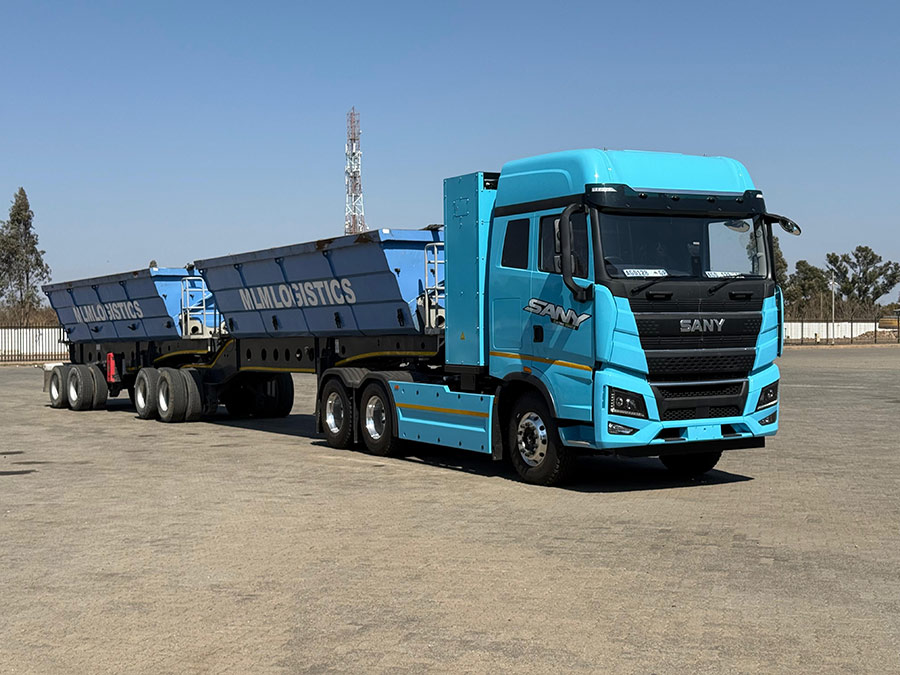
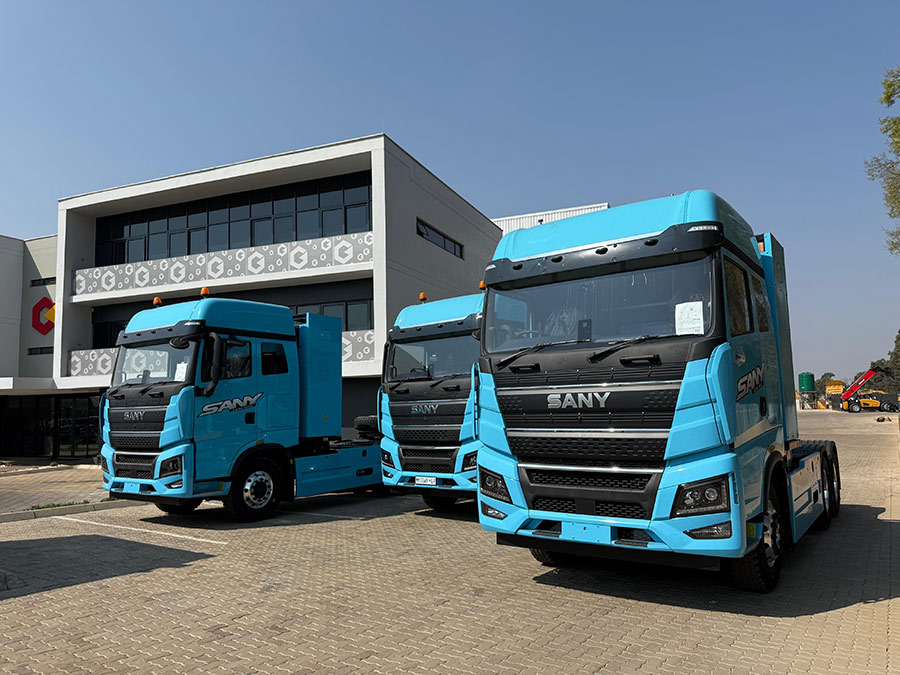
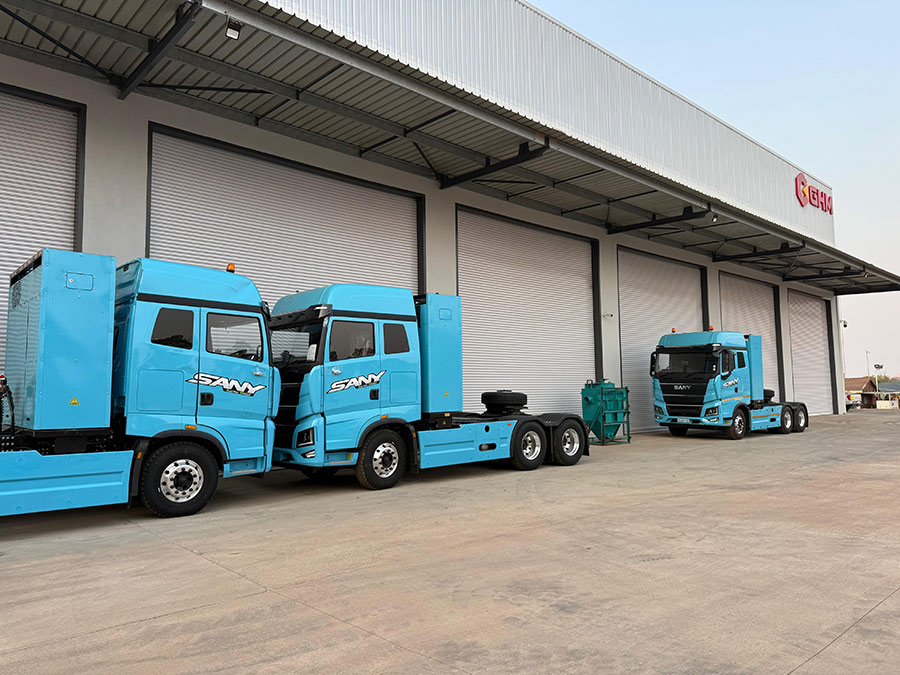
Since March this year, SANY Southern Africa has successfully been running the first fully electric SANY EV490 6×4 truck tractor in a short- to medium-haul application. With an 80-t gross combination mass (GCM), the vehicle is designed for semi-off road conditions such as mining and side-tipping applications.
Of note, says Singh, is that SANY not only debuted its first EV truck, but also brought about the first battery swapping system in the country. Battery swapping allows for rapid battery replacement in under five minutes, which minimises downtime compared to traditional charging. This is ideally suited for uptime sensitive environments such as mining, where downtime is out of the question.
“While various other OEMs are chasing the Megawatt Charging System (MCS), a high-power charging standard for heavy-duty electric vehicles, which enables charging at significantly higher power levels, it is important to note that our electric infrastructure in Africa is not typically able to supply that type of power,” he explains.
“We therefore believe that battery swapping is the ideal technology for the successful rollout of EV trucks in Africa. With our technology, one can swap the depleted battery for a fully charged one in less than five minutes. This is ideal for customers running 24/7 operations, especially in mining environments,” he adds.
Following its homologation, the first SANY EV490 6×4 truck tractor in South Africa has proven its mettle in several super link side-tipping applications. Several highly reputable premium side-tipper operators in South Africa have typically reported around a 70% reduction in energy costs, translating into a whopping saving of over R1-million per year, per truck, compared with a similar diesel-powered truck. The saving, says Singh, could be even more, especially in a scenario where the customer could switch from grid electricity to renewable energy.
Equipped with a 350 kWh battery, the truck is achieving a 200-km range at 56 t GCM, which is ideal for the short- to medium-haul application in which it is deployed. A longer range, says Singh, could still be achieved by adding more batteries. However, more batteries in electric trucks reduce payload capacity because batteries are heavy, and there is a legal limit to how much a truck can weigh. Adding more batteries increases the truck’s overall weight, leaving less room for payload within the weight limit.
More to come
Having successfully demonstrated the capabilities of the first unit, Singh, at the time of writing, expected the arrival of more units by the end of June or the start of July 2025. After the introduction of the SANY EV490 6×4 truck tractor, focus will turn to a lighter 3 tonner, 4×2 truck for light distribution applications. The vehicle will have a 240-km range, which is ideal for in-city distribution.
After the introduction of the 3-t truck, SANY Southern Africa will bring additional LDT and MDT trucks in the form of a 4-tonner (8-t GVM) and an 8-tonner (16-t GVM), as well as the much anticipated medium haul truck tractor, the SE588, which is a 6×4 truck tractor with a 350-km range, thanks to its 588-kwh battery, said to be the largest swappable battery in the industry.
More solutions
Apart from electric vehicles, SANY is globally recognised as one of the leading OEMs in the hydrogen truck space. Its first hydrogen-powered heavy duty truck rolled off the production line in 2021, and since then, the company has established itself as a global leader in that market.
One of the challenges related to hydrogen as a fuel source is the cost of transporting hydrogen to refuelling stations. SANY, says Singh, has solved that by building a complete hydrogen energy ecosystem that includes production, storage and refuelling. Equipped with that complete hydrogen ecosystem, the company is currently in discussions with local customers and has already earmarked the introduction of hydrogen-powered trucks in South Africa in the near future.
In the world of new energy vehicles, Singh believes that both electric and hydrogen trucks will have a place in the future of the market, but their specific roles will depend on various factors, including use case, infrastructure and cost. EVs are well-suited for shorter routes and urban delivery, while hydrogen vehicles may be better for long-haul, heavy-duty applications where longer ranges and faster refuelling are needed.
“While EVs are currently leading the transition to zero-emission trucks, hydrogen vehicles are also gaining traction, especially in specific niche markets. The development of a robust hydrogen infrastructure – including production, storage and refuelling stations – is crucial for the widespread adoption of hydrogen-powered vehicles. The total cost of ownership for both solutions will be a key factor in their market successes. While EVs may have lower operating costs, hydrogen solutions may offer advantages in specific applications and as the cost of hydrogen production decreases,” concludes Singh.