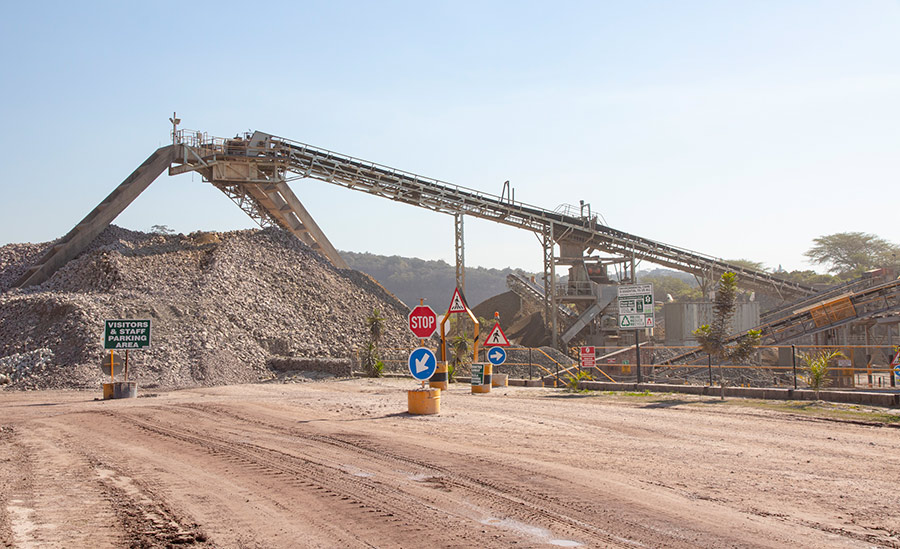
While there is a general notion that quarrying is a simple process – essentially just removing rock from the ground and breaking it down to required sizes – it is actually a complex industrial, economic and engineering challenge. Beyond these challenges lies yet another complex reality – the fact that the industry generally produces a high-volume, low-margin material, which makes it critical for quarries to be located close to markets.
According to Glenn Johnson, Executive: Construction Materials, Operations at AfriSam, the zone of competitiveness for aggregates supply is generally up to 50 km due to the high cost of transportation relative to the low value of the material. For readymix, he adds, the zone of competitiveness is even less, down to 25 km, largely due to the usability factor, rather than the cost.
As a major producer of construction materials in South Africa for over 90 years, with significant capacity in not only the aggregates, but also in the cement and readymix concrete markets, AfriSam’s strategy has, over the years, been underpinned by strategically locating its operations close to major construction hotspots.
The company’s 12 aggregate quarries, with a capacity to produce over 10-million tonnes of aggregate per annum, as well as 19 readymix plants, are located on the outskirts of major cities and towns in major growth hubs such as Gauteng, KwaZulu-Natal and Western Cape, thus directly serving urban demand while minimising logistical costs.
The urbanisation conundrum
As urbanisation continues apace, quarries are, in fact, the foundational source of raw materials necessary for modern building and for the infrastructure central to the development of these urban centres. Beyond aggregates (sand, gravel and crushed rock) for concrete, asphalt, road bases and railway ballast, amongst others, quarries provide minerals used in manufacturing steel, glass and chemicals, and, as such, play a significant role in economic development.
Despite their economic necessity to urbanisation, says Johnson, quarries are often regarded as major sources of disruption. The conundrum is that while urban areas cannot function without the materials from local quarries, they cannot easily tolerate the environmental and social costs. Yet, in many instances, cities have encroached upon historically isolated quarries.
“With the expansion of cities, quarries that were once located in remote areas are now increasingly surrounded by communities. A case in point is AfriSam’s Midrand, Gauteng-based, Jukskei Quarry. When first established in the late 1950s, the quarry was considered to be far flung from any meaningful construction development. However, due to rapid urbanisation in its vicinity over the past decade, the quarry finds itself in the middle of high-end residential neighbourhoods, commercial districts and industrial zones, calling for sound community engagement and partnership,” says Johnson.
Community relations
While urbanisation drives significant demand for construction materials, providing quarries with increased business, it simultaneously forces them to operate in close proximity to residential and commercial areas. Amit Dawneerangen, AfriSam Construction Materials Executive – Sales & Product Technical, says this proximity makes robust community relations essential for maintaining a “social licence to operate”.
“The ability to co-exist with communities should be a major focus for any quarry operator. Maintaining good relations is crucial for long-term viability, as poor community perception can lead to legal challenges, protests, or refusal of operating licences,” says Dawneerangen.
Community relations, adds Johnson, have become an increasingly important component of mining and quarrying companies’ strategic thinking. Given quarries’ close proximity to communities, they are often at the receiving end of all community grievances, even when the complaints are not related to their activities. In some cases, it could be the lack of service delivery, which in the end, is misdirected at these operations.
“Therefore, the growing significance of community relations calls for companies to adopt resilient company-community relationships. This is no longer optional, or something to be disregarded by construction material suppliers,” says Johnson.

Regulatory compliance
One of the key factors in the success of the quarrying industry is regulatory compliance. While South Africa’s mining compliance system is generally deemed complex, both Johnson and Dawneerangen agree that companies that adopt a proactive, integrated legal strategy save time, reduce risk and secure long-term operations.
However, it is important to note that regulatory compliance is indeed not cheap, representing a significant and often rising cost for quarrying organisations. One of the major challenges, says Johnson, is the fact that the quarrying sector, which supplies its material to the construction industry, (one of the least growing, and often shrinking, sectors of the economy for over a decade in South Africa), is governed under the same legislation as the mainstream mining sector, which is often dollar-based in terms of its produce.
To provide context, although quarries differ significantly from traditional mines in terms of risk profile, operational scale and performance, they are legislated under the Mine Health and Safety Act (MHSA). While they share some risks, such as machinery hazards and dust exposure, many quarries are smaller, lower-risk, or transient operations that require a risk-based safety management system that is aligned with the activities and nature of the business undertaken – as opposed to being encumbered by large scale mining.
High administrative burdens and shifting legal interpretations create high costs and risks of shutdown. “As a result, we have a big cost push for the quarrying sector, yet the construction sector, upon which the industry depends, is not growing. As an industry, we do not necessarily have a problem with the regulatory framework under the DMPR, but there need to be certain considerations, such as the fact that we beneficiate and sell 100% of products locally and we operate in a Rand-based construction sector,” says Johnson.
To sidestep the cost challenges, Johnson advises that quarries must learn to convert their cost pressures into variable costs. Quarries can convert fixed costs into variable costs by adopting flexible operational models, outsourcing non-core activities and utilising technology that ties energy or maintenance expenses directly to production volume. Converting fixed costs into variable costs allows operators to align expenses directly with production volume, which is crucial for surviving market volatility and maintaining profitability during low-demand periods.
Planning matters
Effective planning is another major attribute of a successful quarrying operation. Proper planning in quarrying is a strategic tool that turns the purported ‘hole in the ground’ narrative into a safe, profitable and sustainable enterprise.
Planning is a broad exercise in quarrying, says Johnson, and begins right before the blast. For example, it starts by ensuring that the operation has the right material reserves to cater for the available market demand.
“Within the design and planning of the operation, we need to make sure that we have sufficient reserves to cater for the three most important aggregate categories – base material, concrete aggregates and road stone. After considering resources, then comes planning around blast times in line with community frameworks, as well as issues related to the transportation of materials to site,” says Johnson.
“At every project, customers have unique requirements in terms of type of product and when they need it. Sometimes, this clashes with, for instance, a quarry’s Environmental Management Plans (EMPs), and we therefore have to make alternative plans to make sure that the client’s project is not impacted,” says Dawneerangen, adding that this calls for a close collaboration between the operation and the client.
Speaking of planning to avoid disruptions to projects, Johnson highlights AfriSam’s ability to have multiple supply backup sources (reinforced by its large footprint of quarry and readymix plant operations within all the major urban hubs), as a major competitive edge in today’s evolving construction landscape. For example, at the pressing N3 highway project in KwaZulu-Natal, AfriSam was able to pull resources from several of its operations within the area – Umlaas Road Quarry, Pietermaritzburg Quarry and Coedmore Quarry – ensuring security of supply.

Ensuring quality
However, security of supply is one thing, but ensuring that products supplied to projects are of the right quality is quite another. Armed with a stringent quality control regime, AfriSam ensures that all products supplied to customers meet the relevant specifications well before they leave the quarry gate. Dawneerangen cautions that there are serious ramifications for out-of-specification material on projects, which can result in reworking of projects, time delays and heavy penalties. Based on this understanding, AfriSam employs a stringent testing regime to ensure ongoing conformity to standards and product specifications.
To comply with standards and specifications, AfriSam performs various aggregate tests – both internally and externally. Internal tests, which are conducted in an AfriSam laboratory, include Grading, Flakiness Index, Apparent Relative Density (ARD) and Average Least Dimension (ALD), amongst others, and these are considered to be part of process control.
External tests, undertaken by independent South African National Accreditation System- (SANAS-) accredited labs, include Petrographic Examination, X-ray Diffraction Analysis (XRD), Aggregate Crushing Value (ACV) and 10% FACT (Fines Aggregate Crushing Test), and these form part of the quality control process. AfriSam acknowledges the need for accurate and relevant testing to meet and surpass industry requirements, and as a result, the company has embarked on process enhancement by seeking SANAS accreditation for the process control testing currently in place.
When it comes to quality, Dawneerangen says AfriSam closely engages with contractors on evolving project requirements. For example, he says, the industry is witnessing a slight specification adjustment to gravel materials such as G1, G4 and G5, and based on these new grading requirements, AfriSam is able to adjust its plants accordingly.
“A lot of these new products come with stringent specifications which, in most cases, slows down plant throughput, yet contractors still want their required tonnages to execute their projects on time. This calls for a combination of constant engagement between us and the contractor, good planning and technical capability, in order to ensure reliable supply of correct materials for the duration of the project,” concludes Dawneerangen.