Martin Engineering is introducing the next generation of safe and effective transfer point dust control equipment. After rigorous testing across many applications, the Martin ApronSeal Urethane Skirting, GravitySeal Self-Adjusting Urethane Skirting, and the A.I.R. Control Dust Curtain outperformed similar products in tackling fugitive dust and spillage.
Retrofitted onto existing transfer points, the system uses no energy to control airborne dust. With safety features for fast external servicing, the designs deliver greater performance at a lower operating cost.
“When designing these, our focus was safety, performance and longevity,” says Bert Erdmann, Global Engineering Manager of Conveyor Products at Martin Engineering. “Compliance and ease of maintenance are top-of-mind for our customers. We have discovered that passive dust and spillage control at the point of emission with safe maintenance built in is the most effective and economical method of containment.”
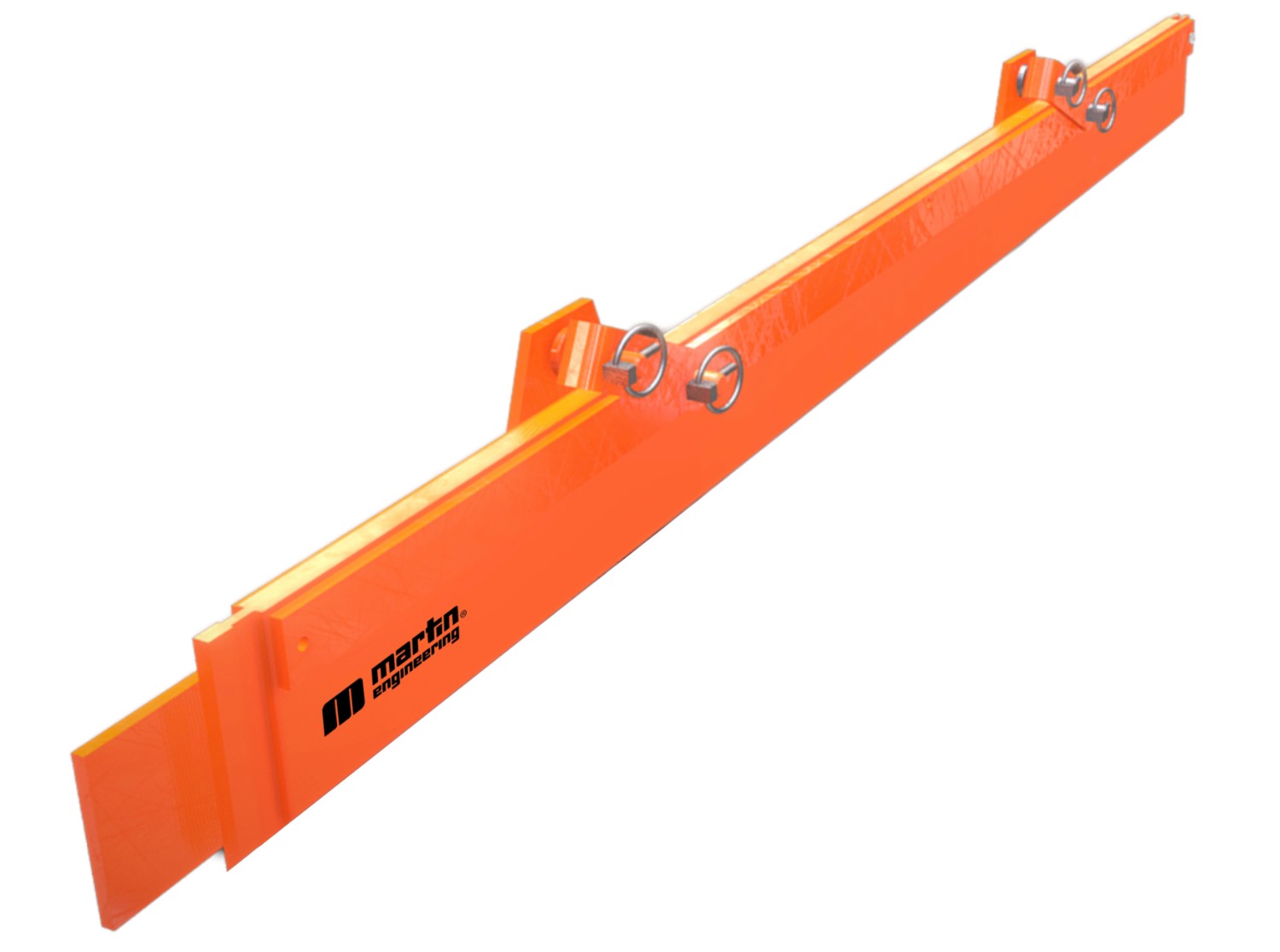
Extending along the length of the skirtboard, this skirting’s unique design provides multiple “pieces” of reliable containment for material fines. A primary strip is shaped to match the trough angle, creating a tight seal. The optional self-adjusting secondary outer flap covers slight variations in the belt’s profile, trapping air and dust.
The ApronSeal Urethane Skirting requires only two inches (50 mm) of free belt area, and the self-adjusting secondary seal can be easily trimmed to match the available free belt area. Supplied in 1 524 mm strips, it features convenient T‑slot end connections for longer chutes. It is designed for external maintenance, improving safety and minimizing service time.
Made for belt speeds up to 4,5 m/s, the 90‑durometer urethane is chemical-resistant and low-abrasion – also available in a high‑temperature option. With less friction than standard skirting, the ApronSeal offers a longer wear life.
Using torsion arms that allow the low-friction urethane skirting to smoothly ride the vertical fluctuations in the belt, GravitySeal delivers a reliable skirtboard seal that prevents spillage and reduces dust emissions. The automatic corrections eliminate the need for downtime to adjust the skirting level due to wear.
Featuring a seal and clamp assembly, GravitySeal is designed for conveyor speeds up to 6,5 m/s with minimal free edge space, providing an effective seal with as little as 32 mm of free area on each side of the belt.
The unit’s urethane sealing strip is available in continuous lengths up to 91,4 m and provides 51 mm of wear life. Replacement involves quickly and easily removing the linchpins and installing the new pre-punched strip.
Engineered for enclosed conveyor transfer points, these dust‑control solutions are modular urethane curtains with handles that allow a single worker to safely adjust or replace them from outside the enclosure. The safety features eliminate the need for confined‑space entry and reduce service time to just minutes.
Each unit is a slide-in cartridge with individual urethane flaps that can be machine-cut to match the load’s angle of surcharge. Positioning the curtains close to the material load allows the A.I.R. Control Dust Curtain to create controlled recirculation zones. This allows dust particles to agglomerate and settle out, enhancing overall transfer‑point performance, significantly reducing respirable and nuisance dust emissions compared to conventional slit‑rubber curtains.
When installed on an existing transfer point, ApronSeal Urethane Skirting, GravitySeal Self-Adjusting Urethane Skirting, and A.I.R. Control Dust Curtains provide a highly effective passive dust control solution. They enhance compliance with air quality and workplace safety regulations without relying on expensive, high-maintenance, power-consuming dust capture systems like HVAC filtration or air cleaners.
“We have found urethane to be a versatile and lasting material that can withstand the rigorous demands of the bulk handling industry,” Erdmann concludes. “Martin has risen to the challenge of stringent dust standards by innovating more efficient and safer solutions.”