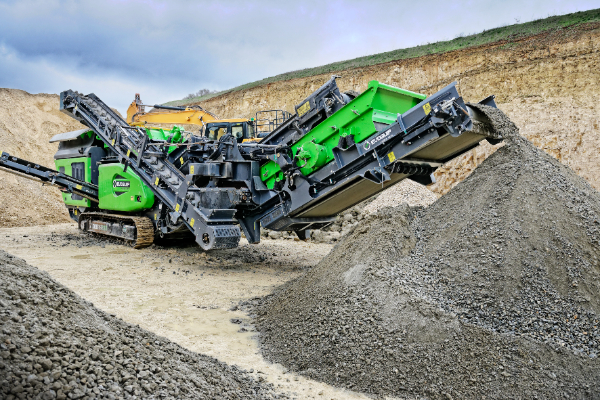
At Hillhead 2016, EvoQuip, a manufacturer of compact crushing, screening, shredding and conveying equipment, arrived with a single machine, a clear idea, and a bold ambition. Fast-forward a decade, and the brand returned to the same show not just to celebrate its 10th anniversary, but to mark its transformation into one of the most dynamic forces in the compact crushing and screening sector.
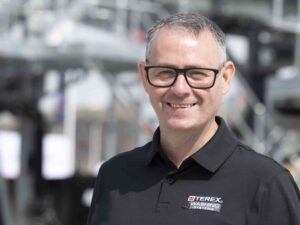
For Barry O’Hare, EvoQuip Business Line Director, the moment carries a sense of full-circle satisfaction. “In 2016, we were here with a Bison 120, our very first machine,” he recalls. “Now, 10 years on, that same machine is one of the smallest in our range.” The comment neatly captures the speed and scale of EvoQuip’s growth – from a single, compact crusher to a global product line spanning multiple categories, applications and markets.
Joined by Andrew Armstrong, EvoQuip Product Manager, O’Hare reflects on a journey defined by evolution – appropriately, given the brand’s name itself stems from “the evolution of equipment”.
Filling the gap
EvoQuip’s origins lie in a clear strategic insight. While Terex-owned brands such as Powerscreen and Finlay were well established in crushing and screening, their focus sat largely above the compact segment. Meanwhile, competitors were building strong positions in the smaller, mobile machine segment.
“There was a clear opportunity,” says O’Hare. “The compact environment was growing – the urbanisation of machines, getting into inner-city jobsites, tighter spaces.”
EvoQuip was created specifically to address that gap, targeting machines from around 3,5 tonnes to 20 tonnes at launch, and now stretching to approximately 35 tonnes. The founding principles were simple but powerful: machines that are intuitive, easy to move, and accessible to a broader customer base.
That focus on simplicity remains central today, even as technology has evolved. “We are still holding onto those values,” O’Hare explains. “But technology has allowed us to give machines more life, more opportunities, and reach more applications.”
Scaling the product line
From its single Bison 120 starting point, EvoQuip now offers a comprehensive portfolio covering jaws, impactors, screens, conveyors, and – most recently – cone crushers.
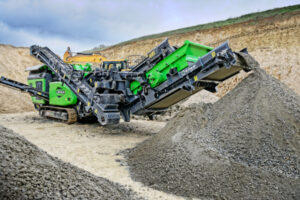
The jaw crusher range now includes five models, from the compact 3,5-tonne Bison 35 to larger units up to 35 tonnes. Production capacities have expanded dramatically, from around 20-80 tonnes per hour for entry-level machines to up to 300 tonnes per hour on flagship models like the Cobra 290.
Impactors, screens, and stackers round out a line-up that today exceeds 15 core machine types, supported by multiple variants and configurations.
One of the most significant additions comes in the form of EvoQuip’s first cone crusher, the Boa 950. The newest addition to the EvoQuip range has been designed to meet the needs of customers in India and neighbouring markets, including Nepal and Bhutan. The machine will also be available in select international regions where Tier 3 emission standards apply, including South America, Australia and New Zealand.
“The cone was the missing link,” says O’Hare. “In a typical crushing train, you have jaw, cone, and screen. We had everything except the cone. Now we can offer a complete solution.”
This step is about more than completing the product range – it opens doors into new applications and markets. Cone crushers allow EvoQuip to compete more effectively in small- to medium-sized quarry operations, complementing its existing strength in recycling.
“It takes us beyond just recycling and into broader aggregates,” O’Hare adds. “And importantly, it makes us a one-stop shop for customers.”
Building a global footprint
In just 10 years, EvoQuip has sold machines in around 75 countries, built a network of more than 50 distributors, and delivered over 2 000 machines globally.
Early growth was closely tied to existing Powerscreen and Finlay distribution networks, particularly in North America, where brand recognition helped EvoQuip establish itself quickly.
However, the strategy has evolved elsewhere. “Outside North America, we realised we were better served by building our own independent distribution,” O’Hare explains. In these regions, EvoQuip has focused on building a strong network of dedicated distribution partners aligned with the compact equipment market.
This shift has enabled the brand to tailor its approach more directly to the compact segment, aligning with distributors who already serve customers in adjacent markets such as construction equipment, mini-excavators, and compact machinery.
“The synergies are strong,” O’Hare notes. “If a distributor is selling Kubota or Bobcat, the same customer base is often feeding material into an EvoQuip machine.”
Entering new growth markets
Looking ahead, EvoQuip has identified Latin America and Southeast Asia as key growth regions.
In Latin America, the brand has established a dedicated business development presence and is actively building distribution networks in countries including Mexico, Brazil, Peru, Argentina, and Chile.
“People often associate Latin America with big mining equipment,” O’Hare says. “But there’s a massive market for compact equipment as well – especially in smaller quarries and recycling.”
Southeast Asia offers a different opportunity. Here, the shift from static to mobile crushing is the key driver. “There has been a lot of static equipment historically,” Armstrong explains. “Now we are seeing customers moving towards more mobile solutions for flexibility.”
Recent wins, such as a new distributor in the Philippines securing orders for a Falcon 820 screen and a Bison 120 crusher, highlight the early traction.
The role of digital and telematics
As the product range has expanded, so too has EvoQuip’s digital capability.
Telematics, delivered through the Terex T-Link system, is now standard across EvoQuip crushers and screens. Introduced around 2017-2018, it enables both distributors and end-users to monitor machine performance, usage, and health.
“Telematics is particularly valuable for rental,” O’Hare says. “It gives customers and fleet owners control over their assets, even when machines are out on hire.
Further developments are underway through Terex’s INNEX digital platform, which provides additional tools for distributors – including potential features like visual parts identification. One emerging capability allows users to photograph a component and automatically identify it, linking directly to parts ordering systems.
“It speeds everything up,” O’Hare explains. “Customers can order parts directly if they want, or distributors can manage it for them.”
Sustainability: Practical over theoretical
Sustainability remains a central topic across the industry, but EvoQuip’s approach is grounded in practical realities.
A significant proportion of its machines – around 45% – are used in recycling applications, including concrete and asphalt processing. This fundamental use case supports sustainability by reducing the need to transport waste materials and enabling on-site reuse.
“The real benefit is doing the job on site,” says O’Hare. “You are not trucking material back and forth – you are recycling it right there.”
On the technology side, EvoQuip offers dual-power (diesel and electric) configurations across roughly half its product range. However, Armstrong is pragmatic about the limitations of current “green” solutions.
“There is a lot of talk about electric machines,” he says. “But many are still running off diesel gensets.”
The challenge in the compact segment is even greater. Space constraints limit the feasibility of large battery systems or alternative power sources, while customers still demand versatility and mobility.
“Contractors need machines that can run anywhere,” Armstrong explains. “Fully electric is not always practical.”
As a result, EvoQuip continues to monitor developments in electrification, batteries, and even hydrogen, but remains cautious about adopting solutions that do not yet deliver real-world value.
The distribution-centric model
A core pillar of EvoQuip’s success is its distribution-first approach. Rather than dealing directly with end customers, EvoQuip focuses on empowering its distribution network through training, technical support and resources.
“We train service teams across three levels,” O’Hare explains. “The highest level is an accredited trainer, who can then train others within their region.”
This approach ensures fast, localised support – a critical factor when machine downtime directly impacts customer revenue.
“If a crusher goes down, production stops,” Armstrong says. “So having capable distributors on the ground is essential.”
Enabling new entrants
One of EvoQuip’s most notable impacts is its expansion of the customer base for crushing and screening equipment.
“Our machines allow new types of customers to enter the market,” says O’Hare.
Examples include agricultural contractors or small civil operators who previously had no involvement in crushing. With a small, affordable machine, they can begin processing materials during off-seasons, generating new revenue streams. Over time, many scale up, adding more machines and capabilities.
“In five years, they have gone from a farmer with a small crusher to a full crushing and screening contractor,” O’Hare explains.
This “entry-point strategy” has been particularly successful in markets like Ireland, the UK and the United States – and is expected to replicate globally.
Listening and evolving
Customer feedback plays a critical role in EvoQuip’s ongoing development.
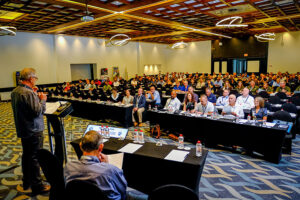
The brand hosts regular global forums – alternating between North America and the rest of the world – to gather insights from distributors and end-users. These sessions, combined with continuous day-to-day feedback from distributors, feed directly into product development.
“If you are not listening, you are going the wrong direction,” O’Hare says.
This iterative approach has driven continuous improvements, as seen in machines like the Bison 120, now in its third generation.
Backed by Terex
While EvoQuip operates as a young, agile brand, it benefits from Terex’s scale and heritage.
“It has been huge,” O’Hare says. “We are 10 years old, but we can tap into 50 or 60 years of engineering experience, parts support and infrastructure.”
The Terex name also opens doors in new markets, providing reassurance to customers and distributors alike.
The next decade
Having exceeded its own expectations over the first decade, EvoQuip is now firmly focused on the next phase.
“We had a vision to be number one by 2030,” O’Hare says. “And we can see a clear pathway to achieve that.”
That pathway rests on three main pillars: product expansion, people, and distribution. Adding new machines like the Boa 950 cone, refreshing existing models, and expanding into “white space” markets will all play a role.
Equally important is maintaining the culture that has defined the brand so far.
“There is a real energy around EvoQuip,” O’Hare reflects. “We are a close-knit team, and we all believe in what we’re building.”
It is that combination – entrepreneurial spirit backed by global resources – that underpins the brand’s confidence.
“Ten years might sound like a long time,” O’Hare concludes. “But for us, it feels like we are only getting started.”