The efficient movement of bulk materials, including those used to build South Africa’s infrastructure, depends on more than roads, railways and trucks. This Transport Month, Astec Industries highlights the important role of on-site material handling in improving the logistics efficiency and competitiveness of mines, quarries, ports and processing plants worldwide.
“The journey doesn’t start when the truck leaves the gate,” Astec explains. “What happens at loading, stockpiling and transfer points influences the efficiency, cost-effectiveness and environmental sustainability of supply chains.”
Mobile conveying and stacking solutions can reduce unnecessary material handling, improve stockpile management and optimise available space. They can also help lower fuel consumption, labour requirements and maintenance costs.
Astec Telestack equipment is designed to improve flexibility and efficiency in handling dry bulk materials, from the pit to the port and processing plant. By replacing traditional fixed infrastructure with mobile, high-capacity material handling systems, operators can reduce operating costs by up to 80% in certain applications, increase production rates and benefit from greater operational flexibility.
“By replacing traditional fixed infrastructure with mobile, high-capacity and versatile bulk material handling systems from Astec Telestack, customers can reduce operational costs by up to 80% in some applications, maximise production rates and reap the benefits of superior flexibility,” says Casper Booyse, Astec Industries product sales manager: Material Handling & Breaker Technologies.
Astec Telestack’s tracked, wheeled and rail-mounted conveyors, hoppers and stackers enable material to be transferred efficiently, often eliminating the need for wheel loaders and trucks. In quarrying applications, the equipment handles materials ranging from road base to limestone, reducing double handling and improving productivity. It also allows different material grades to be moved and stockpiled quickly and efficiently.
Among the available solutions, Astec Telestack’s radial telescopic stackers, including the Agg Stack TS 36-140, and lattice radial stackers, such as the RS-L30, offer flexible and efficient stockpiling options.
The TS 36-140 is designed for material handling applications across the quarrying, mining and rail sectors. It is also used at ports and inland terminals for ship and barge loading and unloading. Its radial, telescopic and luffing capabilities give operators greater control over stockpile formation while helping to minimise segregation, degradation, contamination and material compaction.
The RS-L30 has a capacity of 450 tph and is designed to stockpile material from secondary equipment. An optional integrated radial function helps maximise stockpile volumes. Its flexibility makes it suitable for both short- and long-term applications, while its versatility can enhance resale potential by allowing it to serve different markets once a project is complete, Booyse explains.
With a production capacity of 800 tph, the Agg Stack TS 36-140 offers up to 30% greater stockpile capacity within the same footprint compared with standard stackers. By reducing reliance on wheel loaders, it can lower site traffic and emissions while delivering savings on fuel and labour. An automated stockpiling option can further reduce staffing requirements and operating costs.
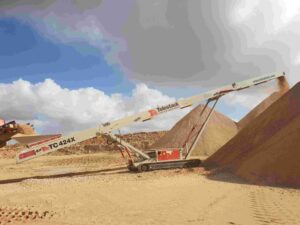
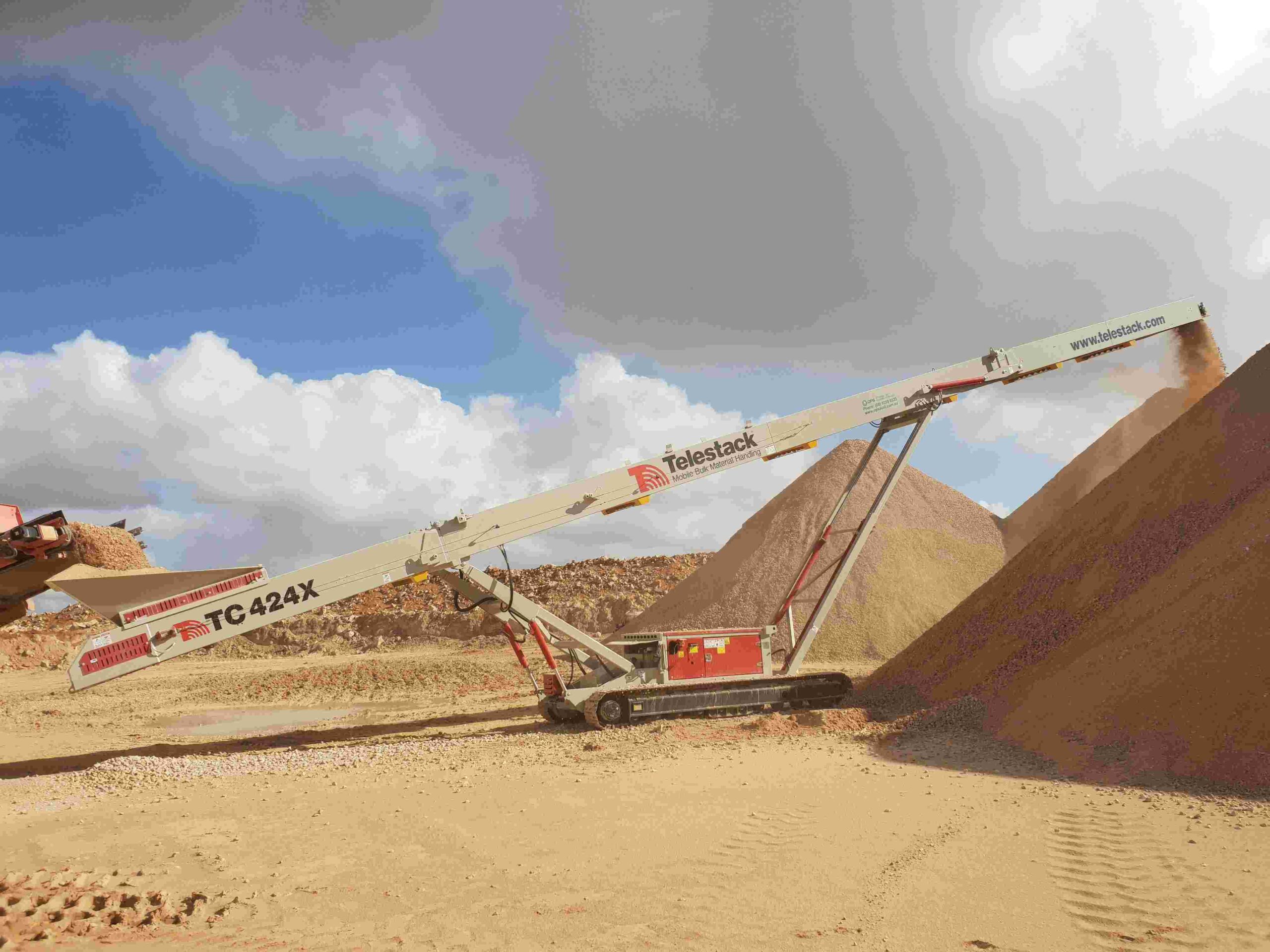
Astec Telestack also offers a broad range of mobile conveyors designed to meet varying site requirements. The TC 424XR radial mobile stacker, for example, is a fully mobile, track-mounted conveyor capable of operating at production rates of up to 400 tph. Its mobility allows it to be deployed quickly across different areas of a site.
As mobile crushers and screens increase in size and throughput, transport restrictions can limit the dimensions of their onboard conveyors. Track-mounted conveyors help address this challenge by providing greater stockpiling capacity while improving overall plant mobility through the efficient removal of material from processing equipment.
For applications requiring an economical and highly mobile solution, Astec Telestack’s Origin Wheeled conveyor range includes the C2000W. Designed for short- to medium-term applications, this wheeled stacker combines portability with established Telestack technology. Its versatility makes it particularly suitable for confined spaces and operations requiring frequent equipment relocation. A widened wheelbase with pinned radial wheel positions also enhances its stockpiling capabilities compared with conventional conical stockpilers.
The efficiencies delivered by Astec Telestack equipment demonstrate how the right on-site material handling solutions can optimise supply chains across mines, quarries, ports and processing plants.
“Transport Month usually focuses on what happens on South Africa’s roads and railways, but this is just part of the journey for many bulk materials. It starts where the material is extracted, processed and moved. The equipment that prepares, transfers and positions material before it ever reaches a truck plays a critical role in logistics efficiency,” Booyse concludes.
Astec confirms that the following Astec Telestack equipment is currently in stock and available through Astec South Africa, giving local operators access to these material handling solutions without unnecessary procurement delays:
- C2000W mobile conveyors
- TC 424XR mobile radial stacker
- TS 36-140 telescopic radial stacker
- RS-L30 radial stacker