This Women’s Month, Astec Industries is celebrating women who are challenging stereotypes and forging careers in traditionally male-dominated trades.
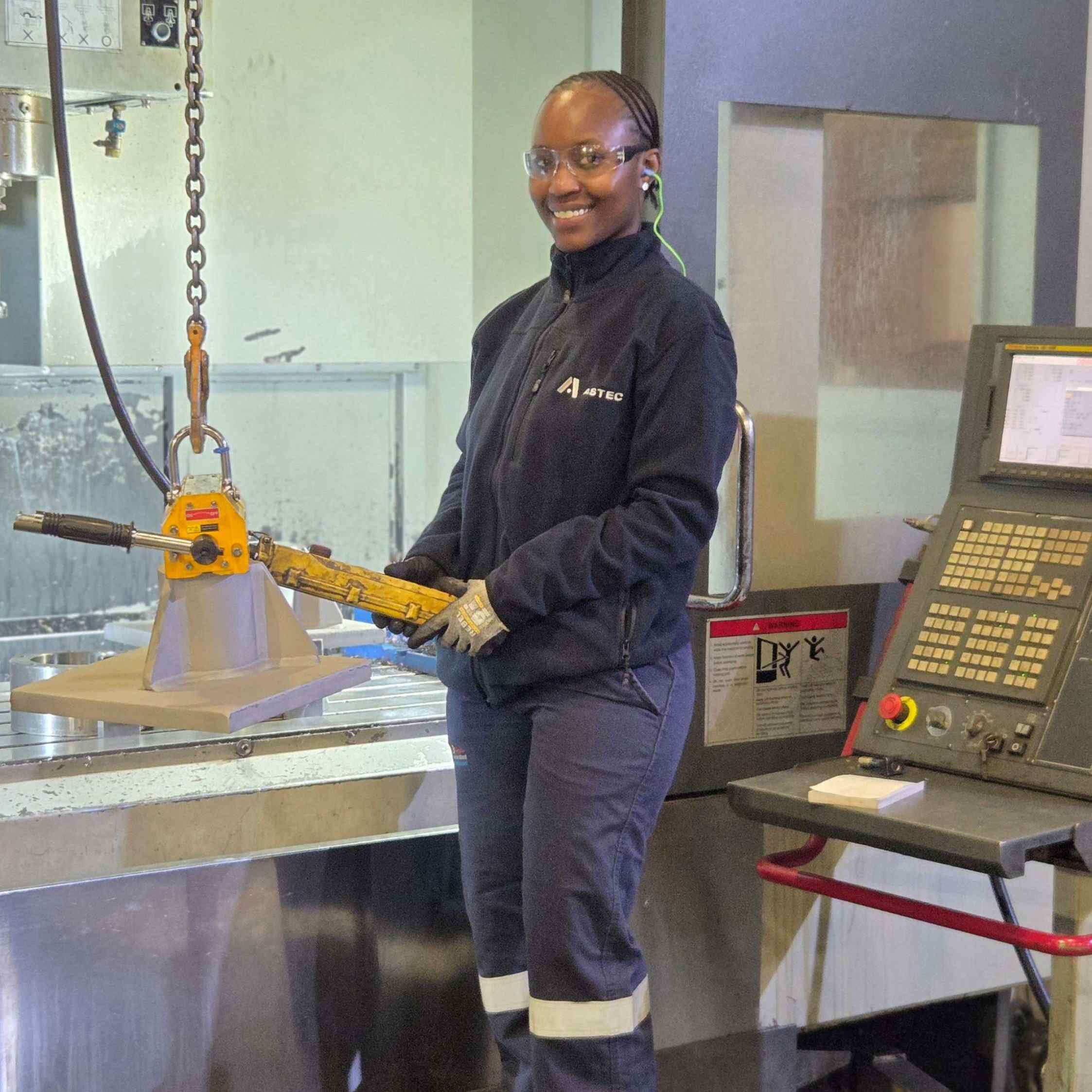
Karin Sibiya is welder apprentice in the Fabrication Department at Astec’s Johannesburg manufacturing facility. Mantsha Mamotheti is a turner machinist. Malebo Bontle Makota is a turner who has been part of the Astec team for seven years. They are all proud to be proving that skill and dedication are not determined by gender, even in the heavy manufacturing sector.
The creative aspect of welding is what drew Karin to this field. “I have always loved that I could take raw steel and blueprints and create something permanent with my own two hands.” What attracted her to heavy equipment manufacturing was the responsibility that comes with the work.
“A bad weld on a machine is not just a mistake, it is a safety issue. That responsibility makes me want to get it right every single time.” That commitment to excellence continues to drive her. “Welding gives you instant feedback; there is no hiding a bad bead. I love that it forces me to get a little better every single day and I can literally see my progress in the welds I laid yesterday versus today.”
Her journey has not been without obstacles. “I have been underestimated at times because I was the first female welder apprentice in Fabrication. But I told myself that I would be the best welder and prove them all wrong.” She did exactly that, earning recognition as the Best Welder Apprentice at her training centre.
One of her proudest moments came when she was entrusted to weld a pan feeder on her own for the first time. “I was very nervous. I did everything possible to remain calm and not overthink. I welded it perfectly and it passed Magnetic Particles Inspection.”
For Karin, her success is important because it widens the path for others. “The future changes when ‘female welder’ stops being a headline and starts being normal.” Looking ahead, she hopes to encourage the next generation. “I cannot be what I could not see. If one girl sees me running tungsten inert gas and thinks ‘I could do that,’ then I have helped shape the future.”
Malebo says her fascination with machinery inspired her career from the beginning. “I have always been fascinated by how machines work and how different components come together to create something useful.” Today, that curiosity is matched by a desire to keep improving. “Every day brings new tasks that require precision, focus and creativity. Knowing that the work I do contributes to the quality and reliability of our machines motivates me.”
She also understands what it feels like to be underestimated. “I proved myself through my dedication, consistency and the quality of my work. I learned that skills, commitment and a willingness to grow speak louder than assumptions.”
Malebo believes that every woman who succeeds in a technical role helps inspire others. “I believe my presence shows that women belong in this industry and can succeed in technical roles.”
While she has seen encouraging progress, she believes the journey continues. “There are more opportunities for women now, and more recognition of the value women bring to engineering and manufacturing. Although there is still progress to be made, the industry is becoming more inclusive.”
Her message to young girls is simple: “Do not limit yourself because of your gender. If you have the passion and determination, you can achieve anything.”
For turner machinist Mantsha, entering heavy manufacturing was about challenging expectations. “My inspiration for pursuing a career in the heavy manufacturing industry stems from a desire to challenge stereotypes.” She says that she wanted to prove that women can excel in demanding technical careers and that they are not limited to any particular roles.
The greatest reward comes from seeing the tangible results of her work. “Nothing beats the pride of seeing the components I’ve worked on leave the shop floor as part of a fully functioning machine.”
Although she says she has often been underestimated because of her stature, she has answered those doubts with action. “I have proven my capabilities countless times by independently operating heavy machinery and successfully executing high-stakes tasks that many hesitated to face.”
Her biggest personal challenge was learning to find her voice. “I had to step out of my comfort zone, stand my ground and address issues respectfully.”
She believes that simply doing her job well sends a powerful message. “My presence proves that gender doesn’t define competency.”
As the industry evolves, she sees more women being trusted with work that was once considered exclusively for men. “We are turning the unusual into the standard,” quips this determined turner machinist.
Mantsha’s advice to future generations is: “You don’t need to alter yourselves to succeed in this industry. Be bold, resilient and keep on defying stereotypes.”