
Over the years, Afrimat’s growth strategy has been buoyed by strategic acquisitions of businesses in dire straits and turning them into formidable operations. As part of that strategy, in 2016, the company took control of Cape Lime’s two operations located at Vredendal and Robertson (Langvlei), in the Western Cape province of South Africa.
In a deal that became the company’s largest acquisition at the time (worth R276-million), this acquisition, which diversified the business with exposure to high-quality limestone and dolomite products, fortified Afrimat’s Industrial Minerals Division, which to date comprises Vredendal, Langvlei and Marble Hall operations.
The success of these operations has over the years hinged on Afrimat’s continuous improvement efforts. In line with that approach, the management team at Afrimat Vredendal is leaving no stone unturned in its quest to drive efficiencies. According to Andrew Wray, MD of Afrimat Industrial Minerals, the Vredendal team – under the capable leadership of mine manager Ruan Smit and quarry manager Robert Hurn – places a strong emphasis on ongoing and systematic enhancement of processes through a sustained effort to identify areas of improvement, implement changes and monitor results.
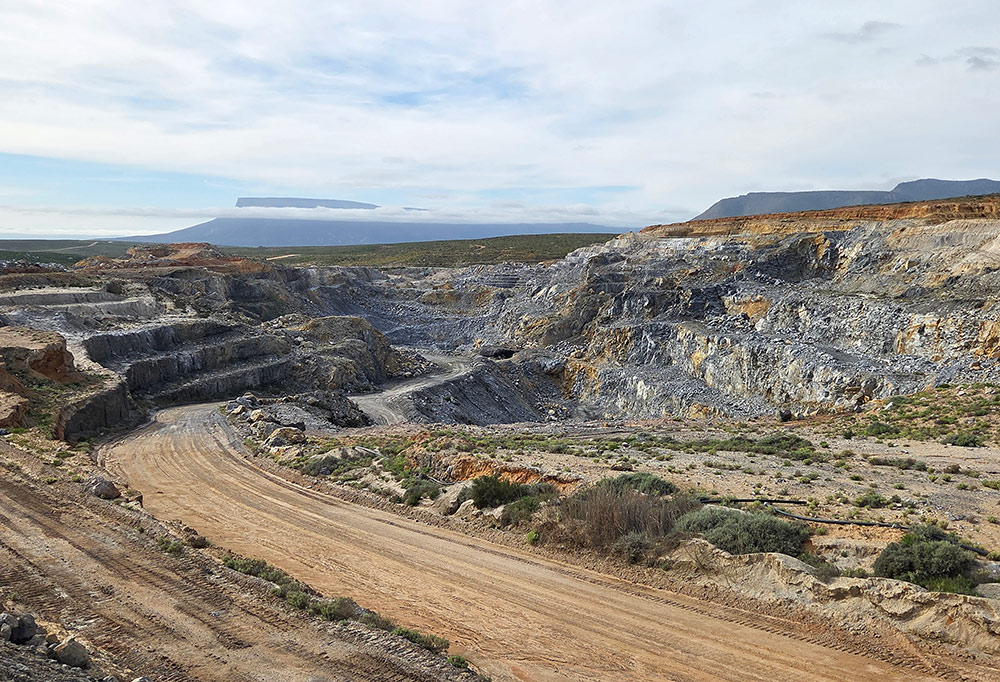
One function that has recently received greater attention is load and haul. Hauling run of mine material represents a significant component of the total operating costs of any quarry or surface mine. Consequently, the incentive to increase efficiency and reduce costs in this area is very high, especially for Afrimat Vredendal, where haul distances from the high-quality calcite pit to the primary plant are a whopping 7 km.
Because of these unusually longhaul distances, Afrimat Vredendal is one of the only two sites within the Afrimat Group that has always deployed conventional tipper trucks for its load and haul operations, while the rest of the operations run articulated dump trucks (ADTs), confirms Wray.
Upgrading hauling tools
In the quest to improve hauling efficiencies in the face of these long hauling distances, last year the management team recognised a need to change its hauling tools – in this case the four conventional 6×4 tipper trucks from one of the premium original equipment manufacturers. Having run these four trucks for nearly 15 years, Smit says the trucks, due to their age, had become uneconomical to run – both from an availability and maintenance perspective – especially in such a taxing load and haul application.
“In the early part of their life, these conventional tipper trucks were efficient to run in this application. As they became older, it was an ongoing challenge to maintain efficiencies. These particular ones had been on site for about 15 years, and had clocked between 340 000 and 360 000 km which, for a mining truck, is unheard of. We looked at replacing them with new equivalent units, but we realised that the capital outlay was going to be out of reach for the operation,” explains Wray.
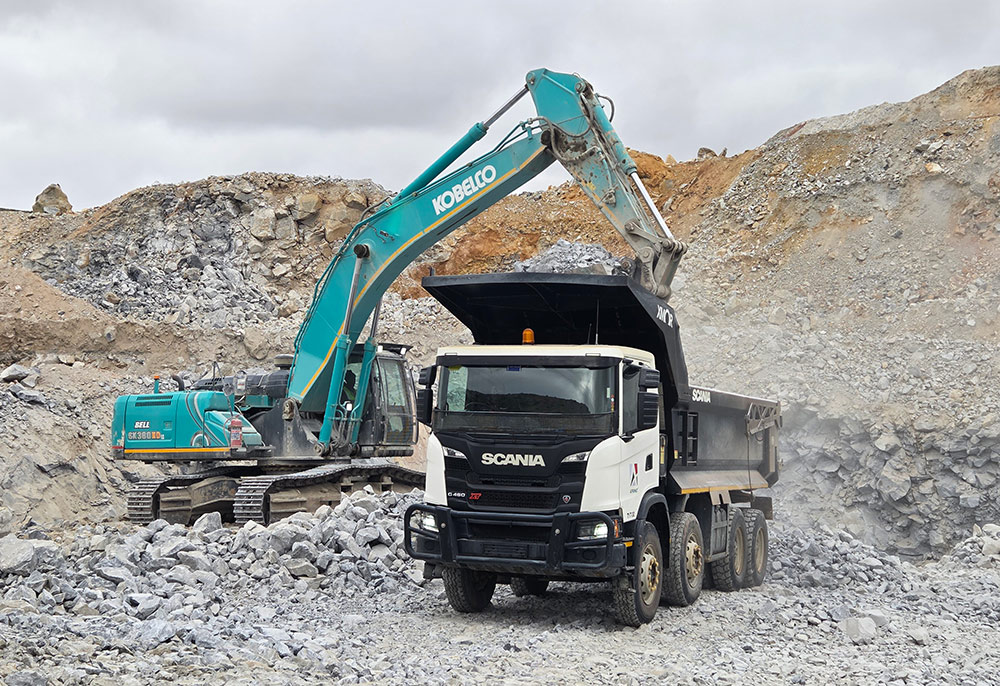
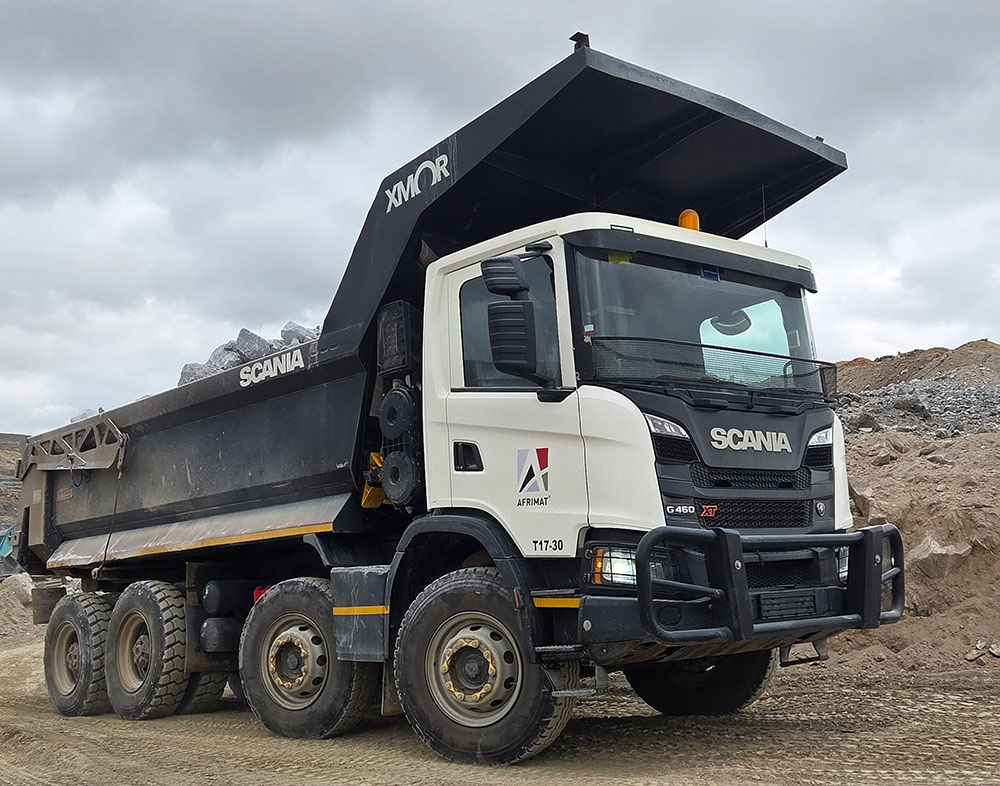
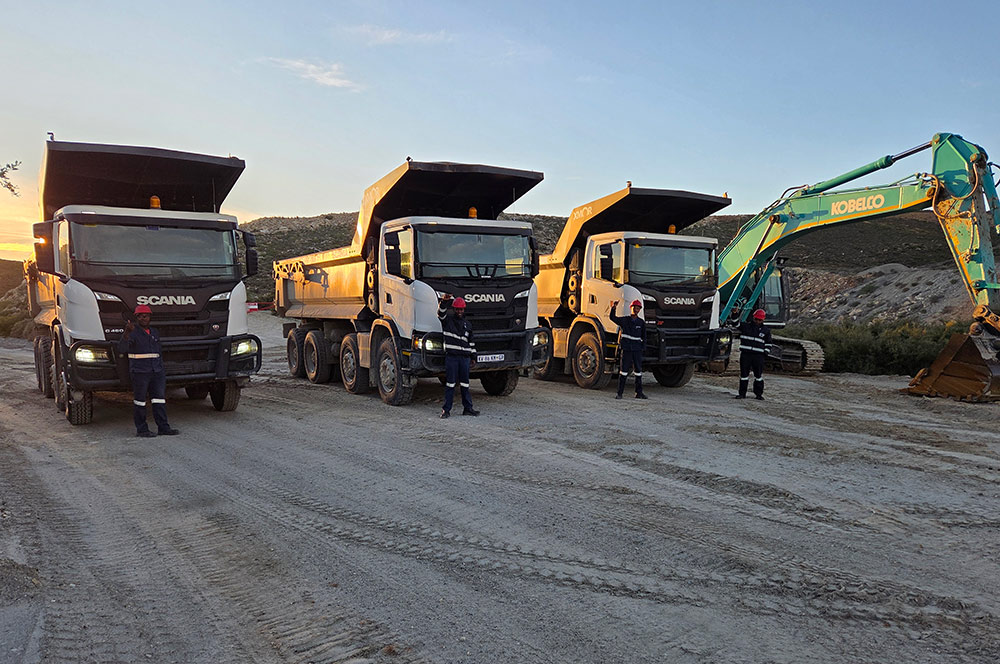
After careful consideration, a decision was taken to go the Scania mining tipper route, which saw the operation deploying three Scania G460 XT mining tipper units. The first two arrived in April 2024, before the third unit joined the fleet in November of the same year. These, however, were not new acquisitions, but existing assets redeployed from Afrimat’s Tygerberg Quarry.
“The Scania mining tippers came in at a conservative ticket price for the Vredendal operation. The good news is that we sat with these three machines at Tygerberg Quarry, which became part of Afrimat as part of the Lafarge deal. In fact, these trucks were not ideal for the Tygerberg operation and were swopped out for ADTs, allowing us to redeploy them at Vredendal, where they have proven to be ideal for the operating conditions here,” says Wray.
Immediate gains
As previously highlighted, one of the main challenges at Afrimat Vredendal are the long 7-km haul distances, which impact overall efficiencies through longer cycle times and generally higher fuel consumption.
“It is generally difficult to be efficient when loading and tipping activities are that far from each other. We therefore needed to pull every lever available to get our load and haul efficiencies right. The arrival of the Scania mining tippers has addressed this challenge. Firstly, we run these trucks at 60 km/hour speeds, on average, getting to a top speed of 70 km/hour on a straight stretch, which we could not achieve with the previous hauling tools. This has significantly improved our cycle times,” says Smit.
For this to be achievable, however, Smit reiterates the need to keep haul roads as smooth and debris-free as possible. This not only allows the trucks to achieve their top speeds, but also avoids possible costly tyre cuts, which are generally a big challenge when running this type of truck in a mining environment.
One of the immediate benefits of deploying the Scania mining tipper fleet has been the marked 20% increase in productivity. This has largely been through the trucks’ higher payload of 34 tonnes (t), which translates into a 10-t payload increase compared with the previous tipper range. Consequently, the increased payload on the Scania mining tippers has allowed the operation to replace the existing four trucks with three units.
“Given that our hauls at Vredendal are longer, switching to a larger truck means more material is being carried along that longer distance – and the costs come down, thus increasing efficiencies,” explains Smit. “In addition to increased payload, the Scania tippers are significantly more fuel efficient than the previous units we had on site.”
“With fewer trucks in the system comes another added benefit – bringing down our shift count, which means fewer heads on the haul road side of the operation. Going the Scania mining tipper route was therefore a single change with vast improvements – we saw it immediately through our efficiencies,” adds Wray.
Removing bottlenecks
The removal of the fourth truck from the hauling system has also translated into reduced traffic and standing time at both the loading tool and the tipping point, which previously caused significant cycle time and efficiency hurdles. In fact, one of the previous challenges that the team had to contend with was that the primary jaw crusher would often run empty due to these hauling bottlenecks, resulting in increased power consumption and wear.
The arrival of Scania trucks has since addressed the challenge of having the primary crusher running empty. In fact, due to the Scania mining tippers’ quick speed and increased payload, the bottleneck has shifted from feeding the primary plant to the crusher itself being too small for the available run-of-mine material capacity available. This, confirms Wray, has informed the need to replace the existing jaw crusher with a larger unit.
“What Ruan and team are doing here is creating a culture of efficiency. A big focus of the mine manager’s efforts is to create a culture of continuous improvement by always seeking to do things better, challenging the status quo, consistently measuring and analysing processes to identify areas for enhancement, as well as implementing data-driven changes,” says Wray.
Speaking of data-driven operations, to further improve its hauling efficiencies, Afrimat Vredendal has adopted the AVA Load & Haul monitoring system. The GPS-based system gives the management team instant access to real-time reporting tools, from daily production reports to live alerts and trend insights, allowing them to manage the operation smarter and faster.
“We have embraced AVA across all of our Afrimat sites. AVA’s Load & Haul system transforms GPS data from any device into a detailed, second-by-second performance model, categorising all activity to show exactly where time is lost. It breaks down every component of fleet performance to pinpoint exactly where improvements are possible, thus allowing for data-driven decision making,” concludes Smit.


