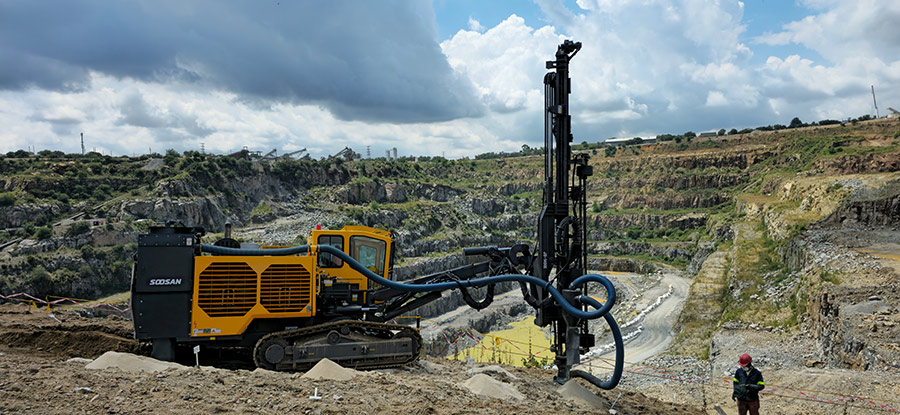
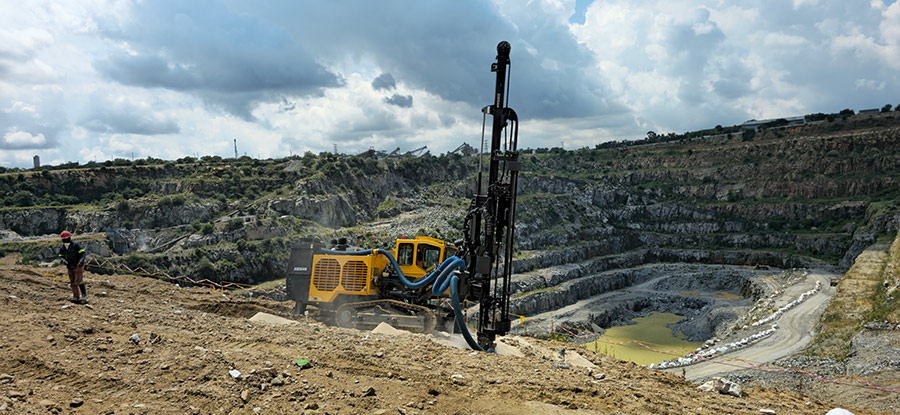
With a large installed base in southern Africa – particularly South Africa, Namibia and Botswana – the Soosan CSM, has proven its mettle across commodities, becoming a hit among major mining houses and their contracting counterparts.
Some of the established names that run this Korean-made range of hydraulic crawler drills include Botse Drill & Blast, Profrag Drill & Blast, Explo Energy and Surface Blasting Services, amongst others.
A significant portion of the range’s installed base currently operates in surface mining, particularly in the Rustenburg area, where a large population of opencast mines is present. Headquartered in Rustenburg, JMH Equipment has forged strong relationships with several mines and contractors operating in the area, hence the large population of Soosan drills in this mining town.
Into quarrying
Traditionally, quarrying has never been a major market of focus for JMH Equipment. However, in recent times, the company has started to make strong inroads, with five units supplied last year alone. At the time of writing, Holtzhausen was expecting to deliver another unit to a repeat customer, highlighting the growing uptake of the range in the aggregates sector.
“We are starting to see a lot more enquiries from quarrying customers who are increasingly becoming aware of the build quality and ease of maintenance of the Soosan CSM range of hydraulic crawler drills. In addition, quarries by their nature are cost-sensitive, and the Soosan range, a simple mechanical drill that is designed to get the job done with no extra ‘bells and whistles’, speaks directly to this group of customers with its competitive pricing,” says Holtzhausen.
To further grow its footprint into the sector, JMH Equipment will use the upcoming Institute of Quarrying Southern Africa (IQSA) Conference – taking place 3-4 April at the Elangeni Hotel in Durban – to interact with the quarrying community about the key benefits of going the Soosan route to meet their drilling needs.
The range
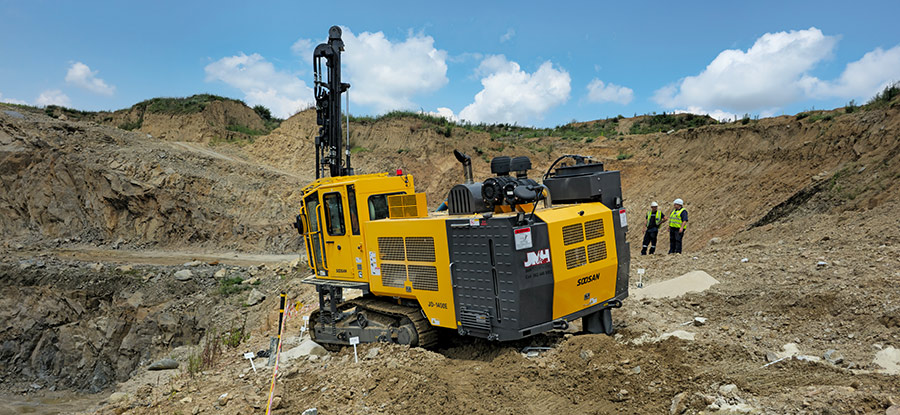
JMH Equipment offers three hydraulic crawler rig models – the JD-800E, JD-1300E and JD-1400E. The JD-800E, the smallest in the range, comes with a hole range of 64 mm to 102 mm. The mid-size JD-1300E offers a hole range of 76 mm to 115 mm.
The JD-1400E is the latest and most favoured model in the range with a 400-490 cubic feet per minute (cfm) Airplus compressor, Yamamoto YH135 drifter and a hole range of 89-127 mm. It is fitted with a Cummins CTAA8.3 or QSL9 engine, which is warranteed by Cummins Southern Africa, as well as Kawasaki hydraulic pumps.
Its powerful dust collector, fitted with six filters, has a suction capacity of 40 m³ per minute. The JD-1400E also comes with a Turnstile type auto-rod charger which can carry six rods with an auto-grease to lubricate the rods at the push of a button from inside the cab. The cabin can be certified with Roll-Over Protective Structure (ROPS) and Falling Object Protective Structure (FOPS) as optional, and also includes an air conditioner for maximum operator comfort.
Competitive edge
A key competitive edge of the Soosan CSM range is the favourable price point. The machines are competitively priced against some of the premium offerings in the market, yet they offer the same quality, durability and performance, if not better, according to Holtzhausen. The range comes at about 10- 15% less than some of the premium offerings in the market.
Another key selling point is that the Soosan CSM range is easy to maintain, which makes it ideal for companies grappling with the present scarcity of technical skills. In fact, most of JMH Equipment’s customers service their own machines. This is complemented by a strong aftersales support regime developed by the company over the past 18 years.
“With the mechanical layout and absence of computers, the drills are easy to maintain, ensuring minimum downtime for drilling operations,” explains Holtzhausen, adding that for ease of serviceability, the panel-type bonnet and vertical-type fuel tank make ample room for machine inspection and services.
Other key features include an anti-jamming system, collaring and automatic rod changer (ARC). The anti-jamming system stabilises operation of the rig across all kinds of rock, making the rig easy to operate for novice operators. Collaring makes it easy to take a correct position for drilling and for unskilled operators to drill holes correctly.
With ARC, the operator connects or disconnects the rods by controlling only one levers in the cabin, without an assistant. This automatic rod exchange can be performed by means of sequential hydraulic schematic. Five rods (including the first rod) can be equipped in the cartridge of the ARC.
Complementary offering
In addition, JMH Equipment supplies complementary aftermarket drifter spare parts for any make and model of both underground and top-hammer drill rigs, offering cost-sensitive customers a cost-effective, yet quality alternative. Over the years, the company has supplied these parts to some of the largest contract miners operating in the region.
Holtzhausen is aware of the disdain with which aftermarket parts have been viewed for many years. As a matter of fact, he says, the build quality of aftermarket parts has significantly improved during the last couple of years. Several equipment owners are therefore starting to choose these affordable, yet efficient options.
Advantages of aftermarket parts include cost, selection and quality. The main reason why there is a large preference for JMH Equipment’s aftermarket parts is that they are significantly more affordable than OEM parts. “In terms of price, our parts cost about 30-40% less than OEM parts, yet the quality is exactly the same,” he says.
Apart from price, these aftermarket parts have also proven themselves in terms of quality. “We have become well-known for the quality of our aftermarket drifter parts. Our parts are imported from Europe and the factory that we buy from is one of the biggest suppliers for reputable names such as Montabert in France, which is testimony to their good quality control and ability to manufacture parts to OEM specifications,” concludes Holtzhausen.