
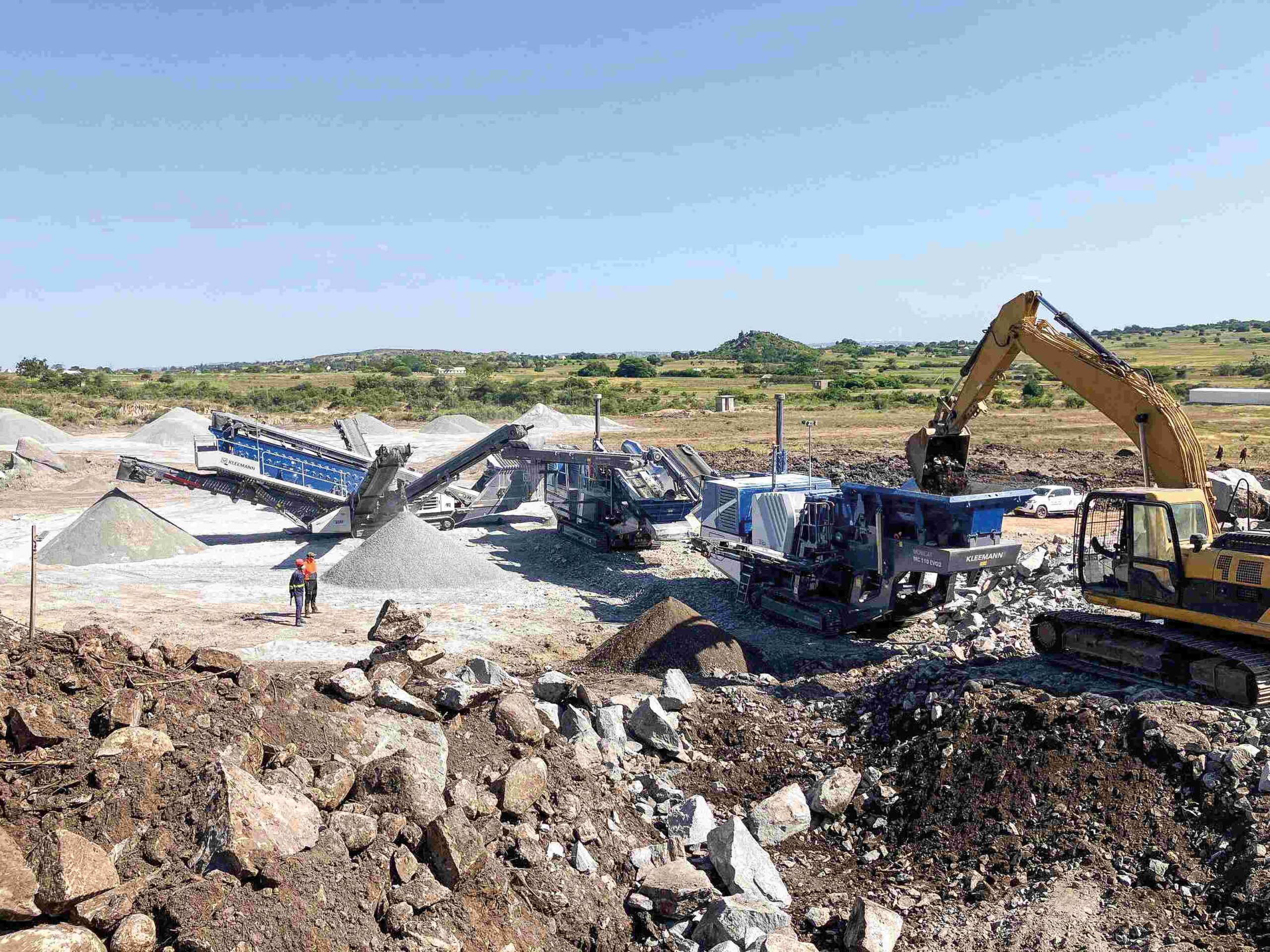
After an extraordinary journey, three Kleemann plants – a MOBICAT MC 110 EVO2 jaw crusher, a MOBICONE MCO 90 EVO2 cone crusher and a MOBISCREEN MSC 953 EVO classifying screen – are now hard at work as a line coupled plant at a Tanzanian granite quarry.
The Kleemann machines started their long journey to Africa on board a ship from Europe to the port of Dar es Salaam in Tanzania. After clearing customs, the journey continued on low-loaders, by rail and, finally, deep into the Tanzanian hinterland on 10 km of unmetalled roads. Their destination was a newly developed quarry around 40 km from Mwanza on the shore of Lake Victoria, in which granite is processed for the development of infrastructure projects.
“Transporting the plants was a truly unusual and arduous task that showed just how important compact mobile plants are,” says Markus Hofmann, Kleemann area sales manager Africa. “Thanks to their compact dimensions, all the machines were able to be loaded and transported relatively easily – that was a real advantage here.”
The jaw crusher MOBICAT MC 110 EVO2 handles the pre-crushing of the hard granite feed material with edge sizes of up to 500 mm. In the next step, the Kleemann cone crusher produces finer grain sizes and brings them into shape. A downstream classifying screen then produces three graded final products: 0-6 mm, 6-10 mm, 10-18 mm – whereby other variants can also be produced according to customer-requirements.
The three-plant train processes up to 150 tonnes of material per hour – and does it all with impressively low fuel consumption. On average, the MC 110 EVO2 needs only 12 litres of diesel per hour, and the MCO 90 EVO2 only 19. With a consumption of 16 litres per hour, the classifying screen is also extremely fuel-efficient.
Smart line coupling guarantees that all machines of the plant train maintain a smooth and seamless crushing and screening process. In the event of overfilling or malfunctions, each machine signals this to its upstream and/or downstream neighbours. Crusher utilisation is also optimised with the aid of the Continuous Feed System (CFS).
The use of this machine feeding concept reduces wear and maximises output. Smart line coupling also increases safety: all machines are stopped as a safety measure as soon as an emergency stop is initiated anywhere on the plant train.
“Smart line coupling is one of the important features of the plant train. Thanks to the automated processes, our customers can count on considerably higher production and significantly less maintenance,” explains Kleemann expert Jerry Muchiri, who looks after the project in Tanzania.
Thanks to the intuitive SPECTIVE operating system, getting started with the new plant train was quick and easy for all users. “Our employees found their bearings very easily,” says Sabasi Shirima, owner of Sasco Trading. “The training was intensive, but very easy to understand – and operating the plants afterwards was really straightforward.”
A Kleemann service technician spent 10 days at the quarry commissioning the plant train and providing intensive training for the operating crew. “We know that we will not be left alone with questions in the future, which is a very good feeling,” stresses Shirima, who knows and appreciates Kleemann and the Wirtgen Group as reliable partners who always fulfil their worldwide service promise.


