

Founded in 1988 by the late CJ Lewis, Lewcor Group has its roots in civil construction. A major oil exploration project contracted by the Overseas Petroleum and Investment Company (OPIC) Malaysia, marked the beginning of an era, and the rest is history. Over time, the family-owned and -operated business has expanded its portfolio to include other complementary divisions such as mining, plant hire and transport.
Under the stewardship of Helmuth Lewis, who joined the company in the late ‘90s and eventually took over from his father CJ Lewis, the company has become a formidable name in the Namibian mining sector. In fact, Helmuth was central to the formation of the mining division in 1999.
His passion for yellow metal equipment was unmatched from a very young age. And as they say, “once it is in the blood, it is for life”. However, Helmuth was not just into yellow metal, he liked his machines big, which influenced the formation of the mining division upon joining his father in the family business.
Into mining
In 2000, the company went on to execute its first small-scale mining project, before being awarded its first extensive mining project by a major global mining house in 2001. In the following years, the mining division grew significantly, becoming the core business for the company. With the growth of the mining arm of Lewcor Group came the expansion of services from just load and haul to include drilling and blasting, and eventually crushing and screening, establishing Lewcor as a one-stop mining services provider to the Namibian mining fraternity.
“During the following ten years to 2010, we achieved significant growth, mainly because of our unparalleled service delivery, staying close to our customers and the fact that we are a 100% Namibian corporation, with almost all our employees and managers being Namibian citizens. To date, we have about 2 000 people in our ranks, of which 99% are Namibians,” explains Lewis.
However, mining contracts are not always guaranteed, especially given the fact that mining by its nature is notoriously cyclical. To cushion the business against bust cycles, the company started considering buying its own mines, which would allow it to keep its 550 pieces of equipment and its 2 000 strong workforce busy during downward mining cycles. Based on that approach, the company is to date a shareholder in three mines, spread across gold, uranium and diamonds.
“The idea of investment in mines was purely a diversification strategy to keep our staff in jobs and our large fleet running when contracts were few and far between. By going this route, we have managed to keep ourselves busy during the past decade,” says Lewis.
Enter John Deere
In contract mining, success largely hinges on the reliability, productivity and efficiency of the fleet. With that in mind, Lewcor does not leave anything to chance when it comes to the selection of its mission-critical assets. Traditionally, the company used to predominantly run a single premium brand which, at the time, constituted almost 95% of its fleet. As years went by, a decision was made to diversify the fleet with four other premium offerings.
For any new brand, breaking into the Lewcor fleet is no easy feat. The company has a rigorous vetting process informed by a number of factors, including equipment pricing, cost per tonne of operating the equipment and, more importantly, aftermarket support, especially parts availability.
“Based on this model, John Deere, through its dealer AFGRI Equipment, made the cut into our fleet. It was not a decision taken lightly, especially given that our technicians and operators are already trained to work on certain brands and we already carry massive parts inventories for those brands,” explains Lewis. “Based on what AFGRI was putting on the table from a support perspective, we were convinced to bring John Deere on board, initially on a trial basis.”
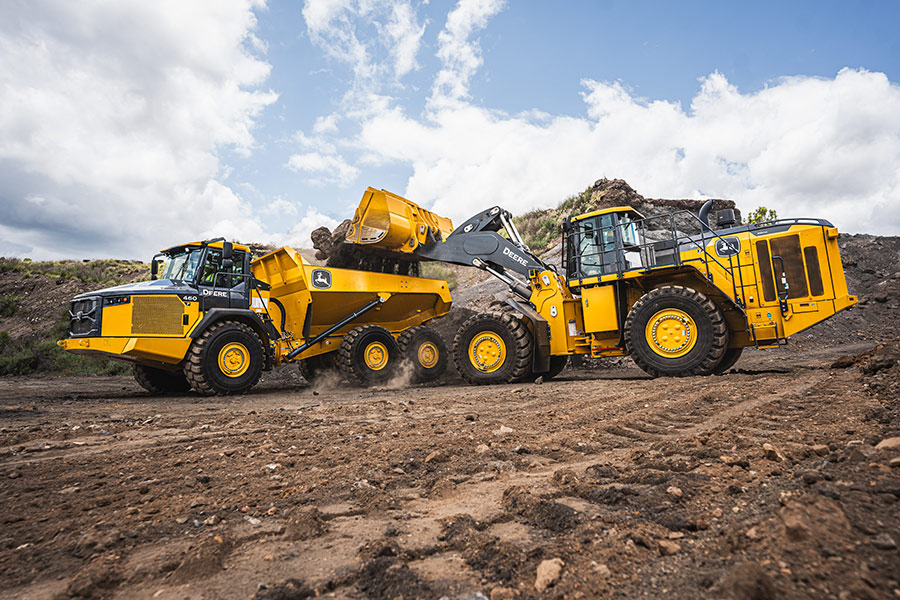
Following the local introduction of the John Deere production class equipment in July 2022, Lewcor became one of the first companies to demo the 460E-II, which has since been upgraded with the new 460P. After putting the unit through its paces for several months, the company eventually bought the demo unit, a decision Lewis says was supported by both AFGRI’s commitment to the relationship and the convincing operational performance of the machine. The demo unit purchase was immediately followed by the acquisition of a further four 460E-II units.
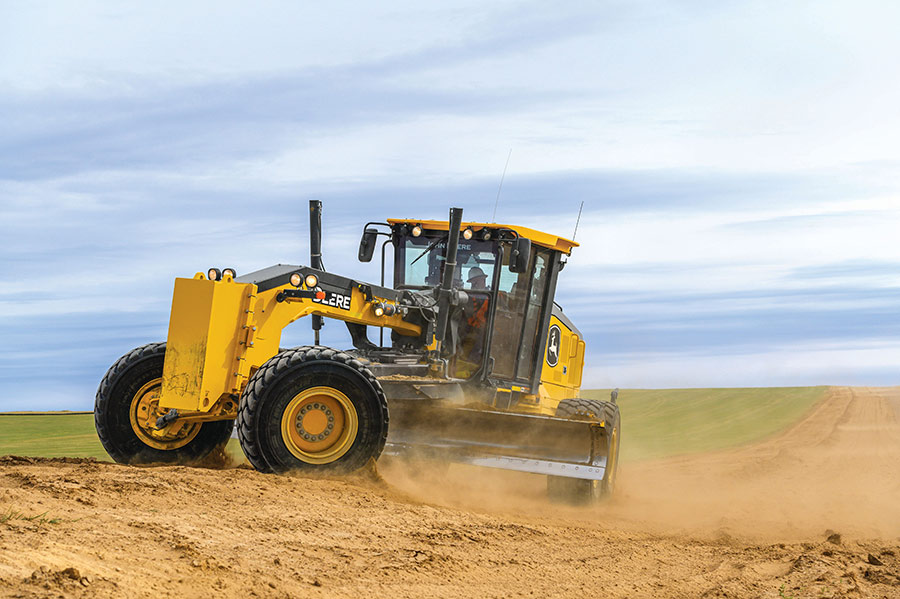
During the past two years, this fleet has been bolstered with 20 more units, bringing to 25 the total number of John Deere ADTs running in the Lewcor fleet to date. In addition, Lewcor has taken delivery of three John Deere 850L dozers and a John Deere 670 motor grader, bringing to 30 the total number of John Deere machines in the Lewcor fleet in just under two years.
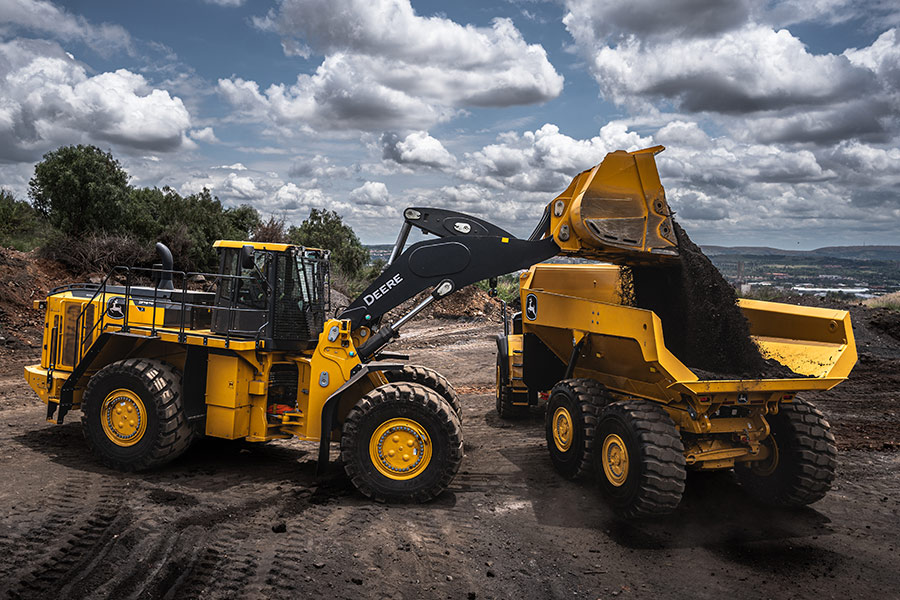
Recently, Lewcor became the first recipient of the first John Deere 944 X-Tier wheel loader in Africa. Introduced locally in February this year, the machine sets itself apart with its industry-exclusive E-Drive system, which combines a John Deere 13,5L engine with advanced electric drive components.
This hybrid-electric drivetrain not only delivers exceptional power but also enhances fuel efficiency. The E-Drive system allows the 944 X-Tier to burn 13-33% less fuel compared to conventional drive loaders in typical applications, significantly reducing operational costs and environmental impact.
Why John Deere?
Lewcor currently runs a total of 105 ADTs in its fleet, spread across three brands and size ranges. “In the 45-t category, the John Deere machine has done particularly well in terms of performance and reliability. We keep track of the various important parameters through JDLink™ Connect and Operations Centre, the John Deere connectivity service that allows us to view critical and timely information about our machines, and to move data wirelessly and effortlessly. From a fuel efficiency perspective, we find John Deere to be a fierce competitor and one of the cheaper machines to run,” says Lewis.
Contract mining is a fast-paced operating environment, stresses Lewis, and machine reliability is one of the principal keys to success. In fact, he says, a machine that passes the reliability test must be able to run at least 500-600 hours a month, which translates into 20 hours a day, “without much assistance”. However, if there is an issue, the supplier must be able to help rectify it timeously to minimise downtime.
“Not too many machines or brands in the market can achieve the 500-600 hours a month benchmark and there are even fewer brands that can do it without good aftermarket service. That is where we separate good suppliers from bad ones. In this instance, AFGRI has passed the test with flying colours. I also commend top management’s involvement, which is a key consideration for us. It puts us at ease that we are making a big financial commitment and we have the necessary backing for the long haul,” says Lewis.
Other factors
Commenting on other key considerations when making buying decisions, Lewis highlights financing as one of the principal ones. In fact, the availability of captive finance from the original equipment manufacturer (OEM) or supplier holds a 60% influence in the whole decision-making process.
Captive finance, says Lewis, eliminates the need to seek financing from external financial institutions, simplifying the purchase process. He also notes that mainstream banks’ appetite for risk, especially when it comes to financing yellow metal equipment, is at its lowest.
“Because we run a multi-brand fleet, we have adopted an internal audit and scoring system. Some of the factors to take into account include price of the machine, operator comfort, fuel efficiency, aftermarket support, tonnes per hour and trading values, amongst others,” he says.
Based on these factors, Lewis believes that John Deere has hit the mark, and given the commitment from both the OEM and the dealer, Lewcor will likely end up boosting its John Deere fleet to 100 machines in the near future.


