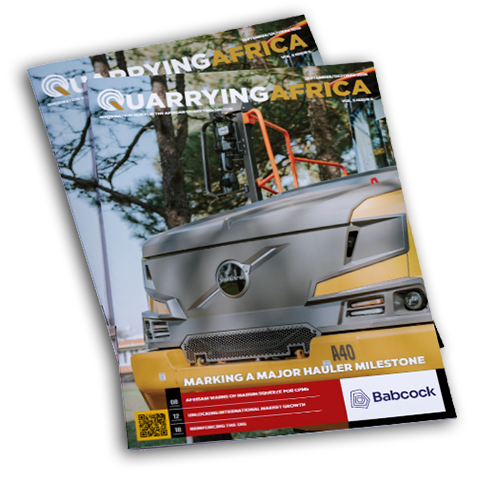
In a significant milestone, Babcock has delivered its 5 000th Volvo articulated hauler in southern Africa since taking on the dealership in 2000. More than just a landmark figure, the achievement highlights the proven performance of Volvo equipment in some of the region’s most demanding operating environments, along with Babcock’s 26 years of trusted customer relationships and dedicated support to keep machines productive throughout their working lives.
“We greatly value our long-standing partnership with the customer who took delivery of the 5 000th machine, marking their own 350th Volvo articulated hauler. We remain committed to investing in the support, training and product solutions that help our customers stay competitive,” says Tim Ward, MD Equipment at Babcock.
For Quintin O’Reilly, Head of Sales – Equipment at Babcock, the 5 000th machine, a new-generation Volvo A40, represents much more than just a number. “For Babcock and Volvo CE, this milestone reflects 26 years of partnership, customer trust and proven equipment performance in some of the region’s toughest working environments,” says O’Reilly.
“Since taking on the Volvo dealership in 2000, we have seen the needs of the mining and construction sectors evolve, but our focus has remained the same – helping customers keep their machines productive, reliable and working for longer,” he adds.
Pivotal role
The milestone, says O’Reilly, highlights the pivotal role the Volvo articulated hauler range has played in Babcock’s success in southern Africa. It also underlines the market-leading position of Volvo CE’s articulated haulers, a product line that traces its roots to the OEM’s pioneering role in inventing the articulated dump truck (ADT).
Beyond the haulers themselves, their sales have a wider impact on Babcock’s equipment business, driving demand for complementary loading and material-handling equipment. O’Reilly explains that, on average, for every four articulated haulers sold, an excavator is also sold, with wheel loaders often forming part of the package to support material-handling duties on site.

Major sellers
Over the years, says O’Reilly, the A40 has established itself as one of the strongest sellers in the Volvo articulated hauler range in southern Africa. With a 39-tonne (t) payload, the A40 occupies a “sweet spot” for mid- to large-scale opencast operations, offering a compelling balance between payload capacity, fuel efficiency and cost per tonne moved. Its strong track record for residual value further enhances its appeal, making it a sound investment for customers.
The smaller A30, meanwhile, has also been a formidable seller in southern Africa, with its versatility making it particularly well suited to the region’s quarries and smaller opencast mines.
Since its introduction in 2017, the Volvo A60 – the world’s largest 6×6 articulated hauler – has steadily established its presence in the southern African market. Several major fleet operators have standardised their fleets around the model, attracted by its 55-t payload and the productivity gains that come with moving more material per cycle.
By combining high payload capacity with relatively marginal increases in fuel consumption and fewer operators required per tonne moved, the A60 offers compelling operating efficiencies for large-scale applications.
The latest addition to the range, the 45-t-payload A50, has also generated significant market interest since its southern African debut in June 2025. As the only full-suspension machine in its size class, the A50 has particularly impressed operators with its high levels of ride and operator comfort.
At the heart of this performance is the A50’s full hydraulic suspension system, which dynamically levels the machine to optimise stability, speed and operator comfort across challenging terrain. Unlike conventional haulers that use rigid bogie beams and rubber springs, the A50 employs fully active hydraulic cylinders paired with high- and low-pressure accumulators to absorb ground forces and deliver a smoother ride.
“The full hydraulic suspension also isolates the cab from harsh bumps in mines or quarries, reducing physical strain on the operator. Better stability allows operators to travel faster and more safely without excessive bouncing. A smoother ride keeps operators focused and reduces fatigue during long shifts,” says O’Reilly.

Success drivers
According to O’Reilly, the growth of the Volvo articulated hauler range in southern Africa has been driven by more than just the strength of the product. Behind every machine is a dedicated support structure focused on understanding customer needs and delivering the aftersales support required to keep equipment productive. “This is supported by tailored service contracts, as well as market-leading parts availability and competitive pricing,” says O’Reilly.
For him, the combination of strong product performance and dependable customer support has been central to the success of the Volvo articulated hauler range. The repeat business from major fleet operators is perhaps the clearest indication of that trust, with many customers returning to Volvo as their fleets continue to grow.
Interestingly, O’Reilly notes that many of today’s large Volvo hauler fleet operators started out with just one or two machines. “We have been privileged enough to grow alongside some of our customers. Most of them started with just one or two units, and there was never an expectation that we would see some of them running hauler fleets in their hundreds,” he says.
For Babcock, these long-standing relationships are among the most rewarding outcomes of the past 26 years. “As a business, we appreciate the long-term relationships that have taken us to where we are today,” O’Reilly adds.

Evolving market
Like other segments of the heavy equipment market, the articulated hauler sector in Southern Africa continues to evolve. O’Reilly notes that customers are increasingly adopting a more proactive approach to decision-making, looking beyond machine performance alone to improve uptime, productivity, operating costs and total cost of ownership.
Volvo CE has responded to this shift by continuously developing its hauler range around smarter, more connected and productive solutions. Through a suite of digital systems, customers can gain greater visibility of machine and site performance and use real-time data to make more informed operational decisions.
With the latest generation Volvo articulated hauler range, for example, customers can enhance machine performance through solutions such as Haul Assist with On-Board Weighing. Powered by Volvo Co-Pilot, the system provides real-time payload information, helping operators prevent overloading and minimise carryback. The result is improved productivity, while also reducing unnecessary fuel consumption and machine wear.
Digital and advisory tools such as Connected Map, Performance Indicator and Site Optimisation further support more efficient traffic flow, vehicle utilisation and on-site logistics. Meanwhile, the CareTrack telematics system provides valuable machine data to help customers improve uptime, optimise maintenance and potentially reduce repair costs.
Electrification is another major trend shaping the future of the industry, and Volvo CE continues to position itself at the forefront of this transition. At this year’s Volvo Days, the company showcased the A40 Electric articulated hauler, now in serial production alongside the A30 Electric, highlighting the OEM’s growing offering of electric haulers.
Safety is also becoming increasingly non-negotiable, particularly in the mining sector, which O’Reilly says is moving towards proactive risk management and a more holistic “zero harm” culture rather than simply meeting regulatory requirements. Volvo articulated haulers incorporate a range of integrated features designed to protect operators, ground personnel and the machines themselves.
A case in point is the interface kit enabling any third-party PDS supplier to integrate a level 9 system with Volvo articulated haulers and wheel loaders. In addition, the Dump Support System uses an integrated angle sensor on the trailer unit to monitor side inclination and trigger an alarm if the tilt angle becomes excessive before unloading, helping to prevent tip-overs.
Downhill Speed Control, combined with the Dynamic Volvo Engine Brake, automatically maintains a controlled speed when operating on downward gradients. Working alongside the all-wheel wet brakes, the system provides stable and controlled descents without relying solely on the retarder pedal.
Looking ahead, O’Reilly believes the continued evolution of the Volvo articulated hauler range will be driven by the same principles that have underpinned its growth to date: responding to changing customer needs, improving machine performance and investing in strong aftersales support. If those foundations remain in place, he believes the road to the next 5 000 machines is already being paved.