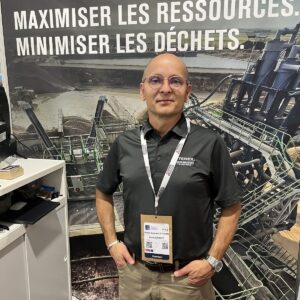
In 1995, Ralf Hennecke, a mining engineer by profession, joined BME as a technical representative from the mainstream mining sector. At the time, the plan, he says, was just to experience the other side of the industry – the supply chain – for a year or two and then head back to mainstream mining, which never materialised.
Some 30 years later, Hennecke is still with BME. Over the years, he has moved through the ranks – business operations, business development, commercial management, and marketing and technology, before assuming the top job as MD in August 2021.
Industry changes
During this three-decade period, a lot has changed – both from a product and mining industry perspective. From a product standpoint, initiation systems have significantly evolved, says Hennecke, from capped fuse and igniter cord systems to non-electric detonators, electric detonators and ultimately electronic detonators.
Capped fuse and igniter cord systems, he says, are hardly used anymore, while non-electric detonators are mainly deployed in quarries, small to mid-tier mines and waste blasting in Tier 1 mines. However, he says, electronic detonators “have become the flavour of the blasting game” due to the accuracy, safety and ultimately good blast outcomes associated with these solutions.
From an emulsion perspective, the industry has migrated from Ammonium Nitrate Fuel Oil (ANFO) and water-gel explosives, to bulk emulsions, as they are known today.
As far as technology is concerned, Hennecke has witnessed the shift from after-the-event reporting to real-time reporting, allowing the industry to move from retrospective, delayed data analysis to a system that provides instantly actionable insights as data becomes available.
With the advent of data collection and data visualisation platforms, this technology evolution allows for trend analysis and ultimately predictability of blast outcomes. This evolution, says Hennecke, is basically today’s artificial intelligence (AI) concept – collecting data and learning from it to provide solutions.
One of the major industry changes in the past 30 years, he adds, has been the move from solely selling explosives to offering integrated solutions that include the product and ongoing services to deliver sustained value for the mining industry. This transformation is part of a fundamental change from a product-centric to a customer-centric mindset.
While the mining industry itself, he adds, is generally sluggish to change, it continues to go through cycles. Apart from the cyclical commodity price cycles, the mining industry has largely shifted from owner-mining to contract-mining due to benefits such as reduced capital expenditure, access to specialised expertise, and flexibility in managing fluctuating market cycles.

Adapting to changes
As these changes unfolded, BME has adapted accordingly, positioning itself as one of the leaders in expert commercial blasting solutions in the global market. “To adapt to these industry changes, we have either developed solutions in-house or partnered with other technology companies, bolting-on their solutions to our own capabilities to offer the industry comprehensive blasting solutions,” says Hennecke.
The 2021 launch of the AXXIS Titanium, one of the world’s most advanced electronic blast detonation systems, represented one of the flagship in-house product developments in the history of the company, securing BME’s position among the global leaders in electronic delay detonator (EDD) design.
To date, the AXXIS electronic blast initiation system includes the advanced AXXIS Titanium and the streamlined AXXIS Silver for smaller operations. The AXXIS system provides high accuracy and safety through features such as dual safety capacitors and a programmable ASIC chip. In 2024, BME expanded the range with the Centralised Electronic Blasting System (CEBS) for underground mining, integrating with other BME tools such as BLASTMAP and the XPLOLOG for better planning and analysis.
When it comes to emulsions, BME is one of the pioneers of dual-salt, cold emulsion products, which it first introduced some 40 years ago. Fast-forward to 2025, the environmental benefits these products offer (relative to single-salt variants), have become even more important, including improved energy efficiency, lower nitrate contamination, and reduced greenhouse gas emissions.
On the partnership front, BME recently strengthened its blasting software offering beyond its premium Blastmap blast planning platform through a partnership with technology leader, Strayos. The alliance has brought together BME’s blasting expertise and Strayos’ advanced image processing and AI capabilities, delivering enhanced functionality, precision and next-generation software solutions to the mining industry.
The announcement of a strategic partnership and acquisition of a minority equity stake in Swedish company Hypex Bio Explosives Technology represented another major technology partnership. Hypex has developed a ground-breaking emulsion using hydrogen peroxide (HP). Said to be the first non-nitrate explosive emulsions in the market, the Hypex technology reduces carbon content by 90% over traditional sources. This technology, says Hennecke, has the potential to completely change the explosives supply industry.

Growth trajectory
Under the leadership of Hennecke, BME has been on a rapid growth trajectory, achieving a 41% Compound Annual Growth Rate (CAGR) over the past five years. Central to this growth are a number of initiatives, including expansion into new regions and commodity areas, commercialisation of new products and technologies, and the establishment of new partnerships.
However, for Hennecke, a principal factor in this growth has been the people. A people-centric approach adopted under Hennecke’s leadership has created a positive culture which has aligned employees with company goals and created an engaged, resilient and adaptable workforce, ultimately leading to better performance. This has not only resulted in bottom line growth, but also the growth of people.
“A strong focus on culture has transformed the company from what it was five years ago. Bearing in mind that all aspects of culture cannot be simultaneously addressed in any organisation, we deliberately chose three aspects of our culture journey that we felt were important to us. Firstly, every person must understand the purpose of the organisation through the strategy and what they individually contribute to that strategy. Secondly, we created a culture of ownership – employees need to operate as if they own the business. The third leg of our culture strategy is courage – allowing people to speak up freely and voice their opinions without retribution,” explains Hennecke.
New markets
One of the key growth pillars has been the expansion into new market areas. In fact, Hennecke says one of the major milestones in the history of the company was when the company first expanded its footprint into the SADC region in the early 1990s, with Namibia and Zimbabwe being among the first countries of focus.
The late 1990s saw BME expanding into West Africa, a strategic region where the company has been present for 25 years now. In 2015, the company planned to expand beyond Africa, over time establishing a footprint in North America, Australia and Indonesia. These new regions have over the years continued to grow, with 50-60% of BME’s business now coming from markets outside South Africa.
The expansion into new regions continues unabated with investments and complementary partnerships across specific markets. “We are still in the infancy of building our business in Australia and Canada. We have laid foundations with infrastructure builds such as plants and teams on the ground, signalling our commitment to these markets,” says Hennecke.
Complementary partnerships in some markets have created a strong footprint, while unlocking new commodity areas. For example, in 2023, BME marked a major step in its globalisation strategy with the formation of a strategic joint venture (JV) with PT Multi Nitrotama Kimia (MNK), a leading Indonesian producer of ammonium nitrate. While the JV has created an integrated offering with an expanded suite of products and services for both surface and underground mines, it has also allowed for the JV’s expansion from primarily coal, into the metals market.
In Canada, combining BME’s global experience with local expertise and infrastructure through a complementary 2019 JV with Canadian civil drilling and blasting contractor Consbec, has positioned the company well to meet and exceed the expectations of local customers. Having completed its local electronic detonator manufacturing plant – only the second such plant in Canada – BME Mining Canada is forging ahead with advanced plans to build its first hydrogen peroxide emulsion plant in the next six months, highlighting its commitment to this market.
Extended value offering
During his MD tenure, Hennecke has overseen the 2024 consolidation of Protea Mining Chemicals (PMC) business under the unified mining division, BME. As part of the rebrand, the mining division focuses on two revitalised offerings, BME Blasting Solutions, specialising in explosives and initiation systems, and BME Metallurgy, dedicated to mining chemicals and metallurgical solutions for enhanced mineral recovery.
While the alignment is still in its infancy, Hennecke says it will transform the business through the provision of integrated solutions to the mining industry. It allows BME to offer solutions beyond the mining bench, extending the value offering to the milling and comminution circuit.

Growth opportunity
Looking ahead, Hennecke says the globalisation strategy will continue to be a source of growth for the foreseeable future. In SADC, the Central African Copperbelt, driven by critical minerals, is a major growth area, while Namibia, with its uranium deposits, also provides compelling growth opportunity.
“Looking inward, doing the basics right – maintaining excellent safety and service records, hiring and retaining the right people, maintaining the right quality product and providing fit-for-purpose solutions to an evolving mining industry – will provide us with a strong platform to take our business to new heights,” concludes Hennecke.