

Consistent aggregates quality is a key competitive edge for every quarry operation. That is the view of Nithia Pillay, Regional Product Technical Manager at AfriSam, who stresses that a strong quality control regime ensures that quarries supply products that meet the required standards and specifications. High-quality products result in satisfied customers, often translating into customer loyalty, repeat orders and positive references.
Traditionally, there has always been a trade-off between production and quality control in the industry, with the former gaining more preference. However, driving production alone and neglecting the necessary quality checks can be even more detrimental, possibly resulting in materials that are out of spec and ultimately rejection or reclassification to a lower quality material and a lower sales price per tonne. The result is potential loss of income and reputational damage.
“It is important to understand that quality control informs many other processes in the production process of aggregates. For example, insights from quality control inform other pertinent areas of the value chain such as face-mapping and overall equipment efficiency (OEE), amongst others,” says Pillay.
“In fact, no other process is inextricable from quality control. Driving a high production process of 500 tonnes per hour (tph), for example, means nothing if the product is out of spec and you cannot make revenue out of it. It is therefore imperative to employ a rigorous quality control regime that ensures compliance with requirements and specifications on a consistent basis,” Pillay adds.
Testing regime
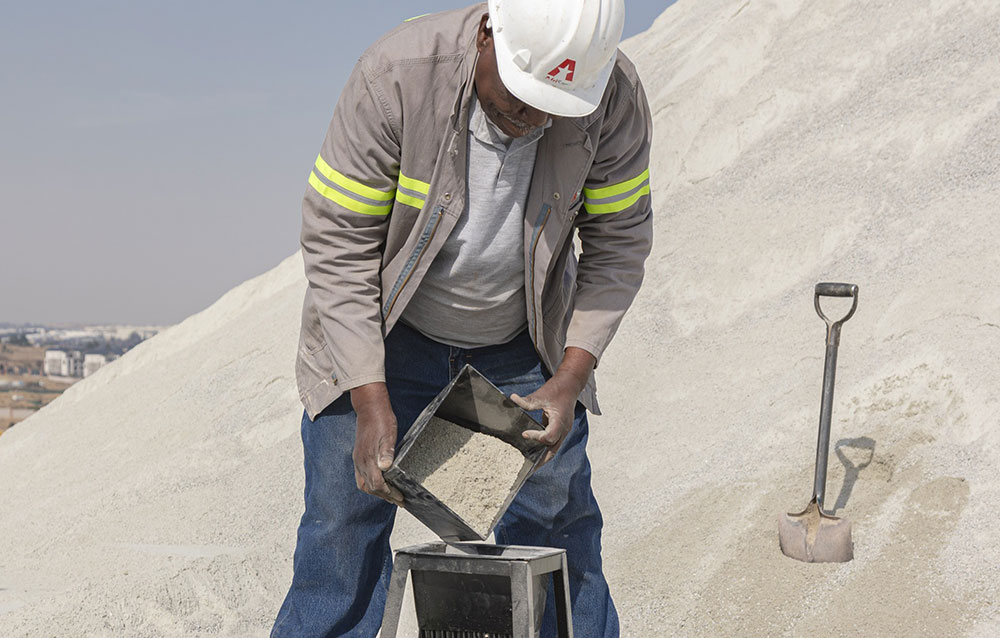
To comply with standards and specifications, AfriSam performs various aggregate tests – both internally and externally. Internal tests, which are conducted in an AfriSam laboratory, include Grading, Flakiness Index, Apparent Relative Density (ARD) and Average Least Dimension (ALD), amongst others, and these are considered to be part of process control.
External tests, undertaken by independent South African National Accreditation System (SANAS) accredited labs, include Petrographic Examination, X-ray Diffraction Analysis (XRD), Aggregate Crushing Value (ACV) and 10% FACT (Fines Aggregate Crushing Test), and these form part of the quality control process. AfriSam acknowledges the need for accurate and relevant testing to meet and surpass industry requirements and as a result the company has embarked on process enhancement by seeking SANAS accreditation for the process control testing currently in place.
“There is a difference between process control and quality control. Process control entails proactively managing the production process to ensure consistent quality, while quality control involves inspecting and testing the final product to verify it meets specifications. With process control, samples are taken on an ongoing basis and are subjected to necessary tests such as grading and flakiness index to ensure that non-conforming aggregate does not leave the quarry. In the event of non-conformance, we conduct extensive analyses and forensic investigations to determine the root causes of shortcomings and develop solutions accordingly – this forms part of AfriSam’s continuous improvement initiative,” explains Pillay.

Process control
AfriSam conducts several process control tests, and these tests are an integral part of the daily production processes. A grading test, also known as sieve analysis, determines the particle size distribution (PSD) of an aggregate sample. This test is crucial for quality control and compliance in civil engineering projects, ensuring that aggregates meet the specified requirements for a particular application.
Flakiness Index measures the flatness of an aggregate. A high flakiness index suggests a higher percentage of flat or thin particles, which can affect the workability of concrete and the performance of road surfacing aggregates.
The ARD test is used to determine the density of the aggregate particles. This test is crucial for determining compliance of the density with applicable specifications, thus understanding how an aggregate will perform in various applications, such as road construction and concrete. The apparent relative density of aggregate generally varies between 2.7 and slightly above 3.0.
The ALD of an aggregate is the average thickness of a group of aggregate particles, determined by measuring the smallest dimension of each particle and calculating the average. It is a key parameter particularly in road surfacing, as it influences the quantity of bituminous product needed and the spread rate of surfacing aggregates.
Quality control
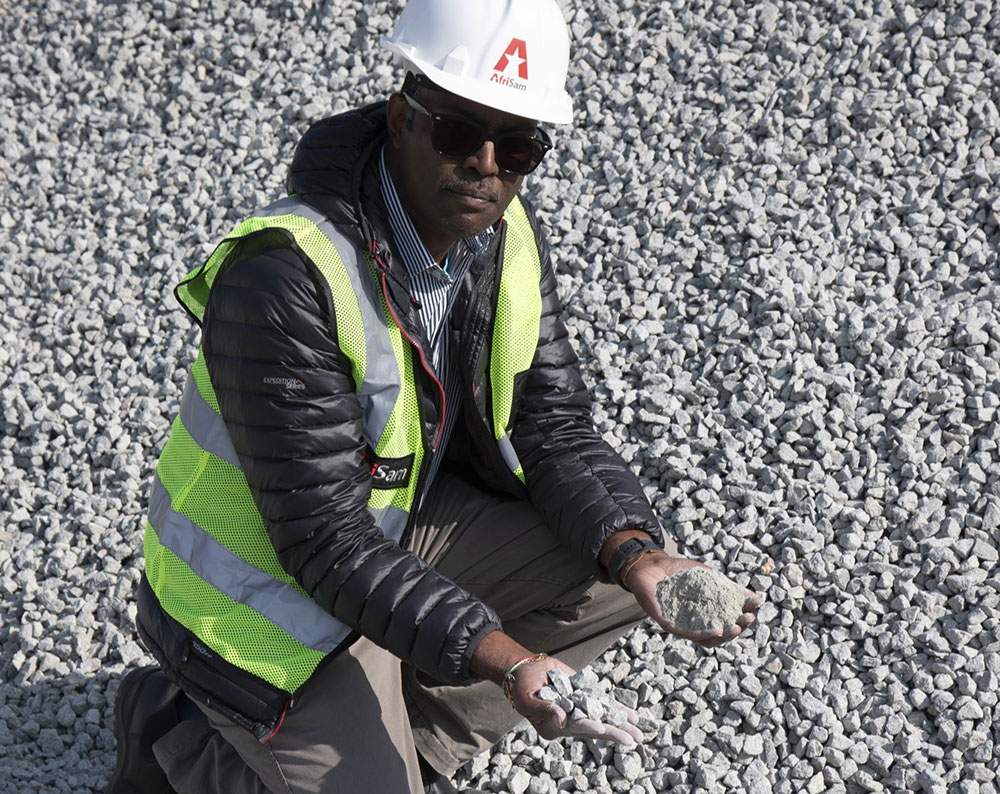
The XRD test is one of the major quality control tests undertaken at AfriSam quarries. It is used to determine the mineralogical composition, identify potentially deleterious phases and assess the quality of the material.
“An XRD test will tell us how the rock type is changing. If it is changing, is it getting better or worse? It gives us the opportunity to better manage the resource. If, for example, there are intrusions of ‘brown’ material in our granite deposit it gives us the opportunity to make informed decisions on which products can be produced with the current resources,” explains Pillay.
A petrographic test involves microscopically analysing samples to assess their quality, composition and potential for durability in concrete. It helps identify rock types, mineral constituents and their condition, including weathering, alteration and presence of reactive materials such as chert.
ACV and 10% FACT tests measure the crushing strength of aggregate for concrete, surfacing (chips) and asphalt, as well as for crushed stone base. These results do not necessarily relate to the flexural or compressive strength of concrete made with that aggregate, but are a useful index of overall quality. There is generally good correlation between ACV and 10% FACT values.
While there is no stipulation in terms of frequency, AfriSam commits to at least once a quarter for each of the quality control tests, highlighting the company’s dedication to quality control. “While we adopt a three-month frequency – which by all means is costly on our behalf – some competitor quarries do it once every two to three years. For us, it is about keeping the finger on the quality pulse and passing the confidence to our customers,” says Pillay.
Standards
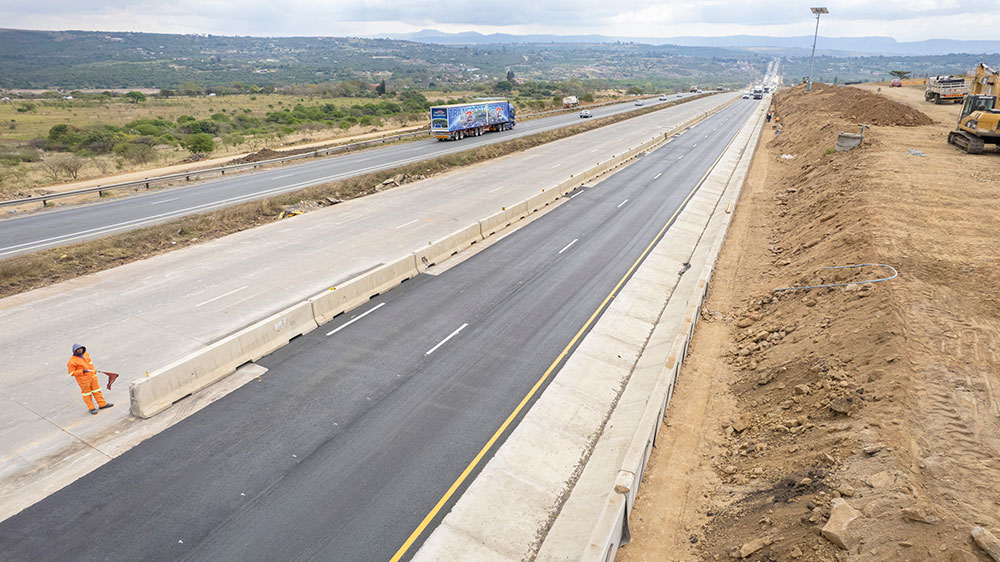
There are various standards that govern aggregate production in South Africa. AfriSam complies with the new Committee of Transport Officials (COTO) standards for road and bridge works. These came into effect on August 18, 2020, replacing the Committee of Land Transport (COLTO) standard specifications for road and bridge works of 1998, and became mandatory for use in procurement documents for South African road authorities by March 1, 2021.
“The COTO standards for aggregates used in asphalt – referred to as Class 1 and Class 2 – are particularly stringent. These classes are very strict by their nature and require high quality compliance requirements for shape and grading. The shape of the individual particles must be properly measured and should be cubicle, which creates a ‘bottleneck’ in the production process,” he says. “Typically, we cannot produce asphalt stone as much as we would produce, for example, concrete stone, which has a wider envelope and does not have a stringent shape requirement.”
Course and fine aggregates used in concrete should comply with SANS 1083, while sands used for mortar and plaster should comply with SANS 1090. SANS 1083 includes requirements for various physical properties of aggregates, such as flakiness index, relative density and abrasion resistance. Equally, SANS 1090 focuses on fine aggregates for plaster and mortar, addressing properties such as grading, cleanliness and clay content.
From the pit to the stockpile
When Quarrying Africa visited AfriSam Jukskei Quarry, Pillay highlighted the extensive nature of the process and quality control practices at this operation, which are duplicated across the company’s operations. Quality control here starts well before the planned blast.
“From the previous blast, we collect drill chips, which we send for an XRD test. This gives us an idea of what to expect from the upcoming blast, which then informs our selective mining processes and allows us to map the various benches for future blasts. This is done before every single blast so that we have a grasp of what type of material to expect and what we can make with it. Current sales and demand trends determine the material we need to produce; the latter is overlaid onto the bench mapping to confirm blasting activity.” says Pillay.
After material has been processed and stockpiled, AfriSam lab personnel collect samples from each stockpile, and regular testing is carried out in accordance with standard test methods for compliance of all aggregate products from each plant with relevant internal and national specifications. Grading results are captured daily to a central computerised system for continuous analysis to ensure consistence in product quality.
“Our protocol is very strict and entails the collection of several samples at frequent intervals. In fact, we take two to three samples per day per product to ensure production consistency. If any deviations occur, we can pick it up quickly and initiate corrective action,” says Pillay.
All results are logged onto a database called LIMS. Data generated is constantly analysed and interpreted to inform decisions. The data, he says, is analysed not just for hypothesis purposes, but to come up with solutions to problems. “There is a lot of information generated from the process control and quality control protocols, and what we do with it is very important to make processes better.”

Industry bodies
To influence industry standards, the AfriSam technical team provides critical input to industry bodies. For example, the company is part of the COTO Review Committee and provides feedback through surface mining association, ASPASA. “We recently provided feedback on the review process of the SANS 1083 standard. The industry is considering combining into one the various standards that govern various materials, such as concrete stone, plaster mortars, asphalt and granular materials,” says Pillay.
Another current industry discussion is the implementation of testing frequencies. In recent times, he says, project engineers have started to demand quality control test results that are not more than three months old, which is in line with AfriSam’s current practice, yet some competitor quarries only test once in every two to three years.
“Being part of the industry bodies ensures that we stay up-to-date with new requirements and trends. This allows us to offer materials that meet the evolving needs of the construction industry and contribute positively to the infrastructure development agenda of the country,” concludes Pillay.


