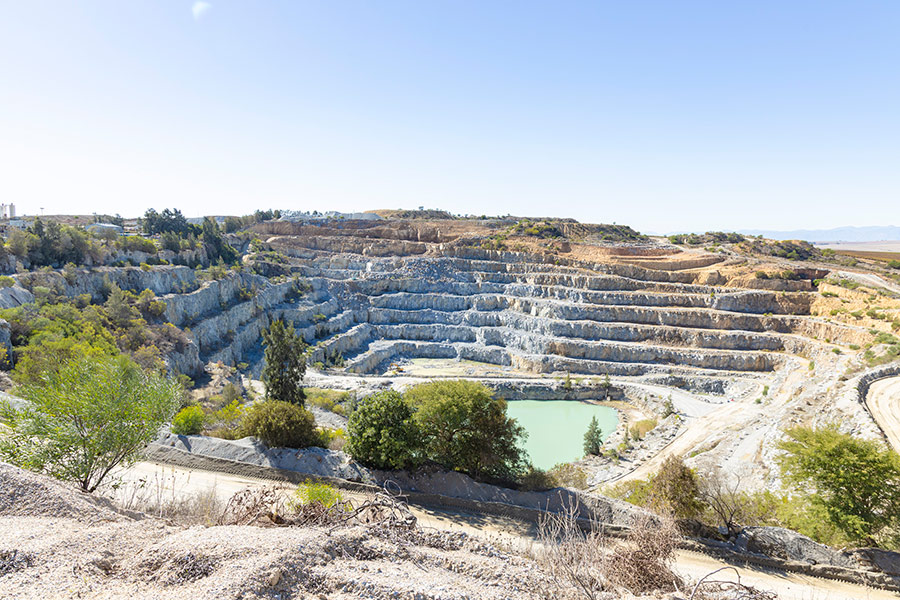
Following a busy 2025, AfriSam’s Rheebok Quarry achieved record sales volumes, with more than 700 000 tonnes of material passing through the gate during the year – almost triple its typical annual volumes of around 250 000 tonnes.
Conveniently located along the N7 National Route, currently undergoing multi-billion-rand upgrades by the South African National Roads Agency (SANRAL) and the Western Cape Government, Rheebok Quarry has benefited significantly from the rollout of these major infrastructure improvements.
The record-breaking 2025 performance was driven largely by a major contract to supply roadstone for the construction of the Malmesbury Bypass. Designed to divert freight and through-traffic around Malmesbury, the project improves road safety, eases congestion in the town centre and strengthens agricultural logistics across the Swartland region. Built by H&I Construction, the greenfield R693-million, 6,7-km bypass broke ground in May 2023 and officially opened to traffic on 31 March 2026.
“Thanks to our close proximity to the project, we became the primary supplier of aggregates and ready-mix concrete for the Malmesbury Bypass. With the substantial volumes required, the project enabled us to achieve record production and sales volumes during 2025,” says Luca Clayton, Acting Works Manager at Rheebok Quarry.
Not without challenges
For a quarry with a plant originally designed to produce between 250 000 and 300 000 tonnes per year (tpy), delivering well over 700 000 tpy was a remarkable achievement. According to Clayton, one of the biggest challenges was the plant’s single-line configuration. While effective for standard production, this type of setup is generally designed to produce specific aggregate sizes, limiting the flexibility needed to respond quickly to changing market demand or customer requests for specialised products.
“If there is a need to produce special material sizes, switching from standard products to specific grades often requires lengthy shutdowns or even extensive modifications. Every product change calls for a complete screen mode change, which can take anywhere from half a day to a full day, depending on the configuration. That becomes a significant constraint in a high-volume production environment,” explains Clayton.
To overcome this limitation, the operation shifted from its traditional 18-hour production schedule to a full 24-hour operating cycle. This enabled the team to significantly increase output and meet strong market demand without the need to invest in additional plant capacity.
While boosting production is one challenge, operating a quarry around the clock introduces another: maintaining high safety standards. For Clayton and his team, however, safety was never compromised in pursuit of production targets.
Despite the demanding operating schedule, the quarry recorded zero Lost Time Injuries (LTIs) throughout 2025. This strong safety performance was reinforced by an impressive 93,41% score in the annual ASPASA ISHE Audit and a perfect 100% score in the ASPASA Environmental Audit, demonstrating that compliance remained a priority even during periods of peak production.
Continuous operations also create maintenance challenges, says Clayton. With equipment running almost non-stop, finding opportunities for routine maintenance becomes increasingly difficult. To address this, the Rheebok Quarry team introduced a dedicated weekly maintenance window, during which production stopped completely for the whole day. This planned downtime allowed essential maintenance to be carried out, ensuring the plant continued to operate at peak performance.

Team dynamics
In a 24/7 operation, Clayton believes a committed and engaged workforce is the first line of defence against safety incidents and major equipment failures. At Rheebok Quarry, the team has embraced a proactive safety culture where every individual takes ownership of safe work practices. By consistently placing people’s wellbeing ahead of production, the team maintains safe working conditions while sustaining exceptionally high output.
The team also takes a proactive approach to equipment reliability rather than waiting for failures to occur. Despite the demanding production schedule, routine inspections are completed as planned, lockout procedures are followed without exception and preventative maintenance remains a top priority. This disciplined approach helped protect both employees and plant assets while minimising the risk of unexpected downtime during the busy schedule.

Strategic investment
Making targeted plant improvements ahead of increasing production demands also played an important role in maximising output. One of the most significant upgrades was the investment in a Sandvik CH430 cone crusher from Sandvik Rock Processing during 2024.
“The investment in the Sandvik CH430 cone crusher significantly improved throughput by reducing oversize material and optimising the crushing circuit. This enabled us to process material more efficiently while eliminating unnecessary reprocessing,” says Clayton.
He also highlights the crusher’s contribution to both safety and operational efficiency through its hydraulic Hydroset system, which enables precise, automated closed-side setting adjustments. Energy efficiency was another important consideration. While the previous crusher was powered by a 160 kW motor, the Sandvik CH430 operates with a 132 kW motor, reducing energy consumption and lowering operating costs while supporting AfriSam’s broader sustainability objectives.
According to Clayton, the Sandvik CH430 is also equipped with the Automatic Setting Regulation (ASRi) system, which continuously monitors and optimises crusher performance. By making real-time adjustments, the system reduces operator intervention while maintaining consistent product size and quality. It also tracks critical operating parameters such as temperature and pressure, enabling proactive maintenance that helps prevent unplanned breakdowns – an invaluable advantage in a high-production environment.

Focus on tech
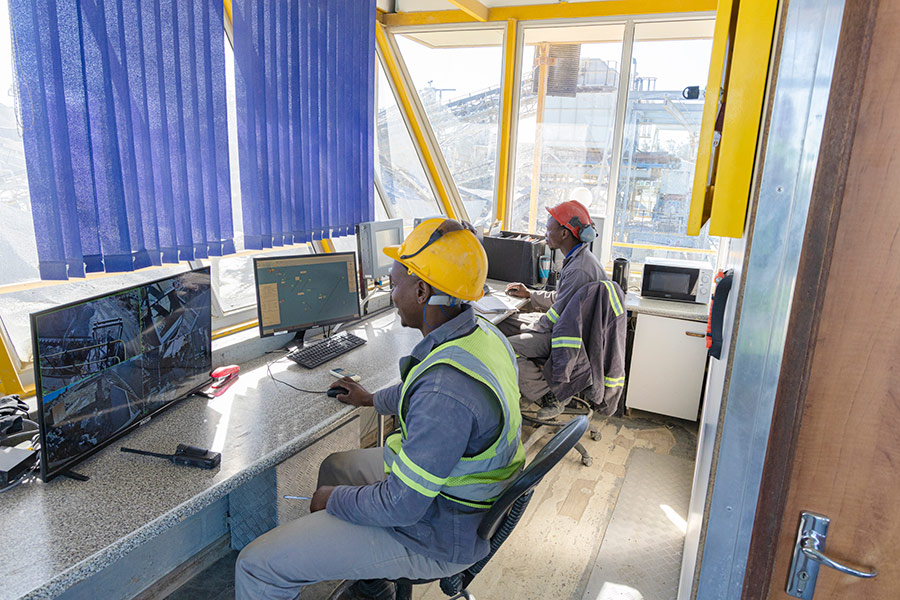
In line with AfriSam’s strategy, Rheebok Quarry continues to embrace technology to optimise processes and boost production efficiency. A good example is the recent installation of camera systems across the plant. These cameras monitor key processing areas – including chutes, crushers, screens and conveyors – helping to prevent equipment failures, improve material flow and enhance overall site safety.
“We are currently expanding the camera network to give operators more ‘eyes’ on the plant, enabling them to monitor operations more effectively,” explains Clayton. “We are also installing reverse cameras on our earthmoving equipment to eliminate blind spots and improve safety on site. Our load-and-haul contractor, Jodan Construction, has already implemented this technology, and we are following their lead.”
Technology has also transformed the way Clayton manages stockpiles. Instead of spending hours taking manual measurements with measuring wheels and calculating volumes, he can now use a cellphone app to generate daily volume and tonnage estimates in just a few minutes.
To verify accuracy, the quarry also uses an external surveying company that employs drone technology to measure stockpiles and produce quarterly reports. Clayton says the app’s results closely match the drone surveys. For example, on an 8 000-tonne (t) stockpile, the difference between the two measurements was just 1,25%.
Blast optimisation
Technology plays an equally important role in the pit, where it helps Rheebok Quarry tackle one of its biggest operational challenges. Known for its complex geology, the quarry mines an abrasive, highly competent yet heavily fractured granite that is notoriously difficult to blast, making blast optimisation a critical part of the operation.
The fractured nature of the rock often results in uncontrolled breakage during blasting. When natural cracks intersect the blast holes, the rock tends to break along these lines of weakness rather than as planned. This can leave large boulders displaced but not sufficiently fragmented, reducing overall blast efficiency.
To get the better of this challenge, Rheebok Quarry relies on a dedicated hydraulic rock breaker (pecker) to reduce oversized boulders to a maximum of 400 mm before they enter the primary crusher. According to Clayton, this mechanical secondary breaking method is preferable to increasing explosive charges, particularly because of the potential risk of flyrock. This is especially important given that the pit is situated less than 300 metres (m) from the busy N7 national highway.
As part of its drive to improve blast performance, the quarry recently enlisted the expertise of a blasting consultant, who recommended a revised blast pattern. As a result, the operation changed its burden and spacing from 4 m x 4,5 m to 3 m x 3,2 m. The adjustment has delivered noticeably better fragmentation and significantly reduced the number of oversized boulders.
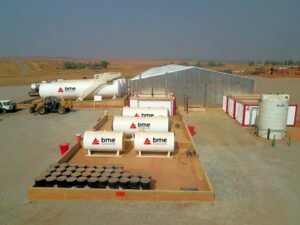
“We also use BME’s AXXIS electronic initiation system, which gives us greater control over each blast,” says Clayton. “This improves fragmentation and ultimately creates more value throughout the downstream production process.”
Positive outlook
Although the quarry experienced a relatively subdued first half of 2026, Clayton is optimistic that demand will strengthen during the second half of the year as more construction projects move into execution.
One such opportunity is the R8-billion Cape Winelands Airport expansion at the former Fisantekraal Airfield, about 20 km northwest of Stellenbosch, which is set to become a major new gateway to the region. With Rheebok Quarry located just 30 km from the site, Clayton believes the operation is well positioned to supply significant volumes of aggregates. There is also potential to establish a concrete batching plant in the area to support the airport development and other nearby projects.