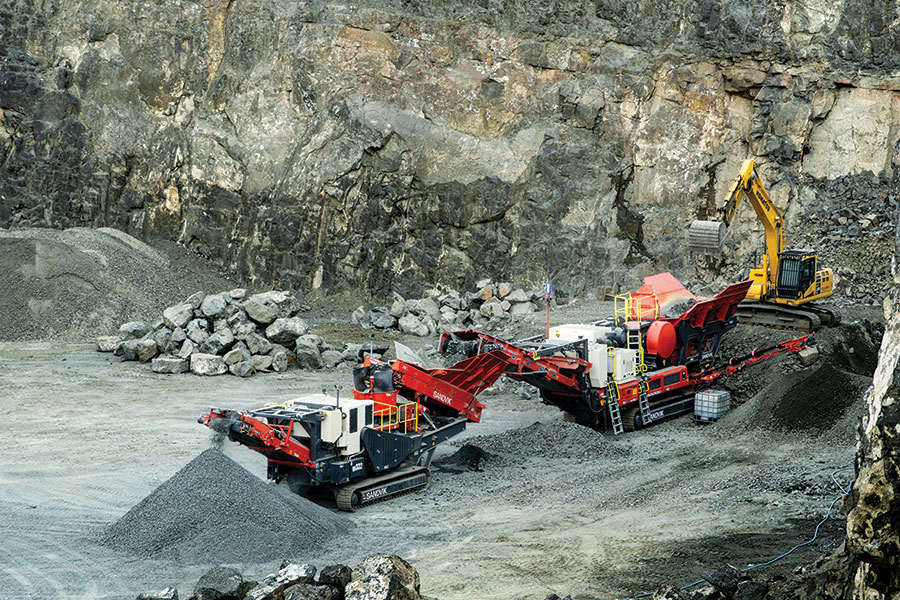
During the last quarter of 2025, Sandvik Rock Processing announced the launch of its first fully-electric mobile crusher in Africa, the UJ443E, marking a major step in the transition from legacy diesel-powered machines to fully-electric mobile crushing plants. This comes on the back of the industry’s quest to simultaneously reduce equipment lifecycle costs and meet sustainability goals.
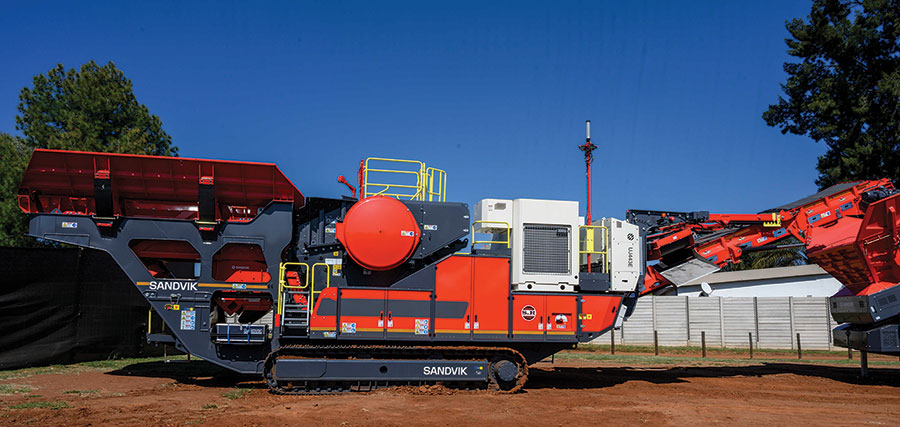
Commissioned on site at the start of January this year, the first UJ443E has been deployed in a Platinum Group Metals (PGM) application in Rustenburg, North West Province, South Africa. At the time of writing, the second unit was undergoing a cold commissioning process at the S&R Enterprises facility in Gauteng, ahead of its delivery to a customer also operating in a PGM environment.
“The delivery of the two UJ443E machines marks the first time Sandvik mobile crushing units built on a fully electric track platform are being deployed to work in Africa,” says Tarynn Yatras, Vice President Sales Area Africa for Sandvik Rock Processing. “The first two fully electric machines on the continent – the third and fourth UJ443E units to roll off the global Sandvik production line – highlight Africa’s pioneering attitude in technology adoption.”
PC Kruger, Business Line Manager Crushing at Sandvik Rock Processing, agrees, saying that African contractors are in fact outpacing some of their global peers in the uptake of Sandvik fully electric mobile crushing solutions, proving that technology adoption in the region is increasingly strategic rather than merely imitative.
Early interest and drivers
Both Kruger and Yatras report early interest in electromobility in the African crushing industry. The sale of the two UJ443E units follows hard on the heels of the delivery of the first Sandvik dual-powered machine, a QA452e tracked mobile, triple-deck sizing screen with Doublescreen technology, late last year. Sold by southern African distributor, S&R Enterprises, the unit was, upon its arrival, immediately delivered to a contractor working on a flagship dam project in Lesotho.
Commenting on the major drivers behind the early adoption of the fully electric crushing technology, Yatras notes that the uptake of electric crushers aligns with the industry’s push for lower-carbon, more cost-effective and operationally flexible solutions.
“African customers across industries – particularly in the mining, quarrying and even construction, sectors – are increasingly open to adopting electric crushers. This shift is driven by the need to reduce high diesel costs, lower maintenance requirements, improve operational efficiency, while meeting sustainability goals,” explains Yatras.
Apart from the significant reduction in diesel costs, says Kruger, electric crushers are favoured for having fewer moving parts, which results in reduced oil changes and component replacements, thus reducing maintenance costs significantly.
“In addition to the competitive initial investment, Sandvik fully-electric models provide lower total cost of ownership (TCO) compared to the traditional diesel-hydraulic counterparts,” says Kruger. “These machines can operate via the electrical grid or, in the absence of one, with an onboard genset using diesel or biofuels such as hydrotreated vegetable oil (HVO),” says Kruger.
Based on early local data, adds Kruger, Sandvik Rock Processing has already seen a 20% saving on diesel consumption when powering the UJ443E with a genset compared to running a comparable diesel-powered UJ440.
The savings are much higher when powering the machine with grid electricity. Diesel is the largest contributor to operating costs for crushers. Replacing diesel consumption with electricity, which is generally much cheaper per kilowatt, significantly reduces daily running costs. Electric motors are also highly efficient at converting power into mechanical energy compared to diesel engines, which lose significant energy as heat.
UJ443E in detail
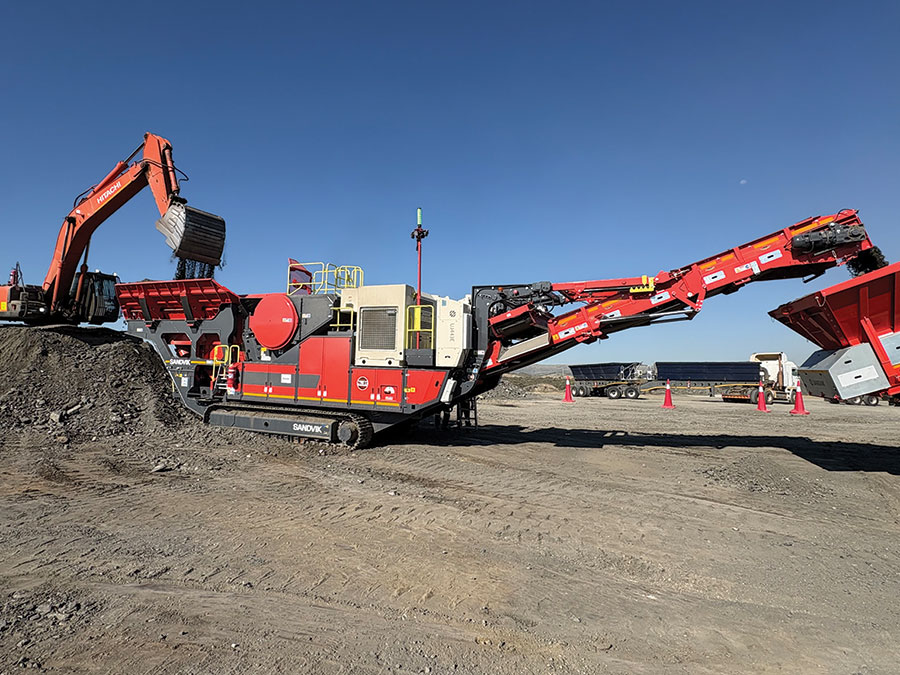
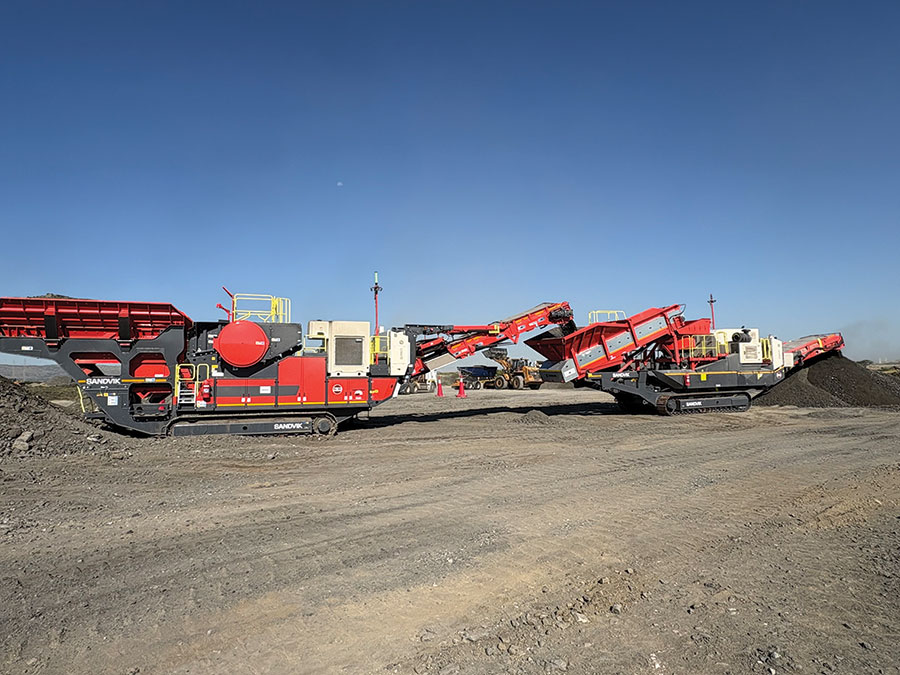
Built on a fully electric track platform, the Sandvik UJ443E is fitted with the proven CJ412 jaw crusher. The latest generation unit features smart technology for real-time performance monitoring and adjustment.
“The Sandvik CJ412 jaw crusher has enhanced connectivity features, providing the operator with live operating parameters, heavy duty electric drive, and onboard hydraulics for closed side setting (CSS) adjustments,” says Kruger. The crusher comes with an unblock facility, which reduces the need for an onboard rock hammer, thus improving safety and reducing downtime.
The fully electric track drives provide better control and agility when tracking and loading. This significantly reduces the need for hydraulics on the plant and ultimately long-term service costs. In fact, the UJ443E consumes about 90% less hydraulic fluid than its predecessors, which translates into lower maintenance costs and a lighter environmental footprint.
The machine features a redesigned feed station with patent-pending hydraulic lift function for improved maintenance access and fixed jaw removal. A larger feed hopper is provided with a patent-pending folding and locking mechanism. The standard volume is 8 m³, which can be increased with optional hopper extensions.
Other innovations include three-speed electric tracks for precise movement, a redesigned feed station with hydraulic tilt access for easier maintenance, and a downstream 125-amp connection for integrating other downstream electric equipment such as cone crushers and screening plants.
Support matters
To ensure that the local support teams are acquainted with the new fully-electric crushing plant, Sandvik Rock Processing brought in three master technicians from the Ballygawly, Northern Ireland factory. During their two-week stay in South Africa, the technicians took the local Sandvik and S&R Enterprises teams through the hot and cold commissioning processes. According to Yatras, their stay provided a platform for knowledge transfer to the local support teams.
The first two UJ443E are under Sandvik’s Hyper Care programme, confirms Kruger, where the local teams are in constant communication with the factory to ensure seamless operation. The Sandvik My Fleet telematics enhances support by enabling remote diagnostics and performance monitoring. Real-time monitoring allows for constant tracking of machine performance, early detection of alarms, and for ensuring optimal, efficient operation.
As with any new product, both Sandvik Rock Processing and S&R Enterprises have invested heavily in the necessary parts and spares. “We have identified critical component and recommended spares lists. Based on that exercise, both Sandvik and S&R Enterprises have invested in a sizeable stockholding of these components, allowing us to be able to support these machines in the field,” says Yatras.

Positive outlook
Given the early interest in the technology, Yatras is positive that the uptake of electric crushers will only accelerate in the coming years as Sandvik and its local partners build positive reference cases and the local African industry witnesses the benefits of the technology.
“While historically perceived as a laggard in technology adoption, Africa is emerging as a global leader in specific technology sectors, and we are seeing that with electric crushing technology. Rather than following the traditional, slow adoption path, local contractors are moving quickly to make the most of modern solutions,” says Yatras.
Yatras commends S&R Enterprises for playing a central role, in partnership with Sandvik, in shifting customer mindsets about new technology, highlighting that both the OEM and its distributor have been the primary architects of these new products, and that they possess the most accurate information to address consumer anxieties.
Within just over a year of its existence, the distributor partnership between Sandvik Rock Processing and S&R Enterprises has recorded massive successes. In fact, says Yatras, on the back of the partnership – the first sales area-managed distributorship agreement for Sandvik Mobiles in the world – Sandvik Rock Processing recorded one of its most successful years in mobile sales in Africa in 2025.
“Traditionally, Sandvik has always employed a dealer direct model, where partnerships for mobile suppliers are managed by the factory. With S&R Enterprises, we took a different approach, making it the first ever sales area-managed partnership, and that has paid dividends. In Africa, the importance of local partnerships cannot be stated enough – they provide essential, on-the-ground expertise to navigate complex regulatory, cultural and logistical landscapes,” explains Yatras.
In conclusion, Kruger notes a modularised approach to mining in Africa, especially given the need for mobility and cost-effective operation. Modular plants have always been favoured for their ability to be moved quite quickly, while they could also be run on grid electricity. Electric mobile crushers, he says, are set to revolutionise the mining industry by combining the flexibility of on-site processing with the lower operating costs and sustainability of electric drives.
“In addition, their track-mounted agility enables them to be easily moved around on and between job sites. We are super excited to see what the UJ443E will bring in the 400-600 tonnes per hour production environments,” concludes Kruger.