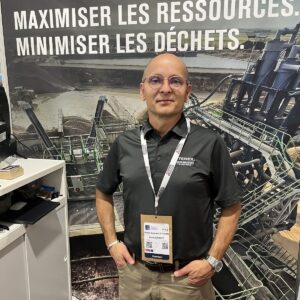
Commenting on some of the notable trends in the screening market in southern Africa, Stuart tells Quarrying Africa that one of the most significant challenges in the regional screening market is the high and unpredictable cost of importing equipment. Shipping fluctuations, he says, can delay delivery timelines and increase project costs. To help customers overcome this, Haver & Boecker Niagara is focusing on local solutions that reduce reliance on imports.
“A key initiative is our screen refurbishment programme. Instead of replacing ageing equipment, we assess whether a rebuild is possible. What many operations do not realise is, often restoring machines to near-new condition is just over half the cost of a new screen. This approach not only saves money but also extends the life of existing assets, offering a practical and sustainable alternative for operations across Africa,” explains Stuart.
Despite the critical role of screening in the overall success of operations, Stuart notes that poor procurement decisions in the region, often driven by price, are made, with less emphasis on long-term performance. This, he says, can lead to short-term savings but higher costs over time due to frequent replacements or failures.
“At Haver & Boecker Niagara, we help customers make informed decisions by comparing solutions side-by-side – stripping away pricing to focus on quality, durability and performance. For example, one of our screens operated for 15 years at a limestone mine, compared to just five years for a competitor’s vibrating screen at the same site. That kind of longevity translates directly into operational savings and reliability,” says Stuart.

Key solutions
To respond to evolving market needs, Haver & Boecker Niagara has introduced several solutions tailored to the African market. For example, with screen refurbishment, the company assesses and rebuilds out-of-service Haver & Boecker Niagara screens, restoring them to 90% new condition. This is a cost-effective alternative to full replacement and helps customers extend the life of their assets.
“In addition, we maintain a warehouse of critical original equipment manufacturer (OEM) parts in South Africa and work closely with clients to ensure they stock site-specific spares. This minimises downtime, thus increasing productivity and profits, while ensuring the equipment is repaired with components that meet original specifications,” continues Stuart.
A strong aftermarket support regime is another key initiative. Because of its global footprint, Haver & Boecker Niagara’s team of experts in Canada, Brazil and Germany can remotely analyse the data and provide actionable insights around the clock. This, paired with 24/7 monitoring tools such as Pulse Condition Monitoring, allows operations to be more proactive with maintenance, even in regions where experienced labour is becoming harder to retain.
In addition, the company has conducted side-by-side tests of its screen media against competitors’ products in real-world applications. In every case, says Stuart, Haver & Boecker Niagara’s media has outlasted the alternatives – sometimes by more than double the lifespan.
“What truly sets Haver & Boecker Niagara apart is our ability to serve as a full solutions provider – a one-stop shop for screening technology, service and support. We do not just sell equipment; we partner with our customers throughout the lifecycle of their machines. From OEM parts and rebuilds to diagnostics and aftermarket service, we provide everything needed to keep operations running efficiently,” he says.
A key part of that value, he adds, is the quality of the company’s vibrating screens and screen media. In regions where lower-cost imports are common, Haver & Boecker Niagara’s equipment is said to stand out for its durability and performance.

The future
Commenting on some of the major developments that we are likely to see in the near future when it comes to screening, Stuart says minimising downtime remains a top priority for aggregate operations and expects manufacturers to continue focusing on technologies that support faster maintenance and more reliable performance.
“One of the most impactful developments is the integration of vibration analysis software into screening equipment. In Africa, many skilled labourers are leaving for opportunities abroad, which makes it more difficult for operations to retain experienced personnel. To help bridge that gap, we developed Pulse Condition Monitoring – a smart, 24/7 monitoring system that uses artificial intelligence to track the health and performance of vibrating screens,” he explains.
“If a screen begins to underperform or shows signs of failure, Pulse Condition Monitoring alerts operators directly on their mobile devices. We like to say it gives operators a ‘Superman’s eye’, allowing them to see issues that are not visible to the naked eye. It is a powerful tool for staying ahead of maintenance needs and avoiding costly downtime,” adds Stuart.
Haver & Boecker Niagara has also made significant improvements to its screen media. For its vibrating screens used in aggregates, the company has transitioned from traditional woven wire mesh to polyurethane panels. These panels offer greater durability, longer wear life and better performance in wet or corrosive environments.

Another innovation Stuart is excited about is the new Ty-Deck Twist system for screen media panels. Traditionally, removing and installing screen media panels required hammers or mallets, which could be time-consuming and physically demanding. In some cases, screens would be offline for up to three days during resurfacing. Haver & Boecker Niagara’s Twist technology replaces the hammer-driven pins with a screw-like mechanism, allowing operators to quickly and easily secure or remove panels. This simple change can reduce maintenance time from three days to just one, significantly improving uptime and efficiency.
“At Haver & Boecker Niagara, we are more than an equipment supplier – we are a long-term partner. Our goal is to be a one-stop resource for customers. We believe in building trust through transparency, quality and responsiveness. As skilled labour becomes harder to find in some regions, our tools and services help bridge the gap, ensuring that even with fewer hands on site, operations can run smoothly and efficiently,” concludes Stuart.