
Seeking high-quality products at cost-effective prices is a fundamental and enduring trend in the quarrying market, driven by a combination of factors, including the need for reliability in challenging environments, and the influence of market dynamics on profitability. While digital transformation and sustainability are some of the leading new trends, the core business principle of ‘value for money’ remains a constant driver for procurement decisions.
This is the view of Douglas van der Westhuizen, technical sales representative at Tru-Trac Rollers, a specialist provider of conveyor components for the global mining and bulk material handling industries, who says that one of the trends shaping the industry is the requirement for high-quality products at competitive prices. This, he says, is particularly the case in the quarrying and related industries such as cement, where a combination of generally tight budgets and market dynamics are central to the need to ‘tighten the belt’.
Given the arduous nature of quarrying operations, high-quality products are essential to ensure reliability, minimise downtime and maintain safety, all of which impact the bottom line. “Traditionally, quarrying has always been deemed a light duty industry compared to mainstream mining. However, in South Africa we have noticed that the opposite is true – quarrying operations are demanding. To operate efficiently and profitably, the industry is reliant on good products, but tight budgets are a reality that operations have to contend with, mainly due to the fact that the industry processes high-volume, low-value material,” says Van der Westhuizen.
Response to needs
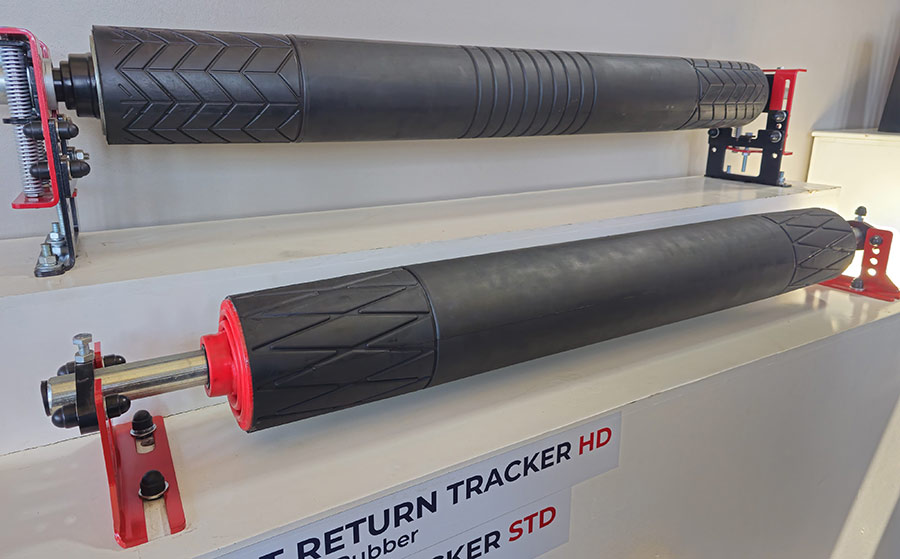
Having over the years fostered strong ties with key quarrying customers, Tru-Trac has committed itself to delivering quality products at competitive prices to the industry. This comes in the form of a newly designed range of belt scrapers and trackers that speak directly to the needs of quarries. As with any other new product from Tru-Trac, the Q-Series range is currently undergoing a rigorous testing regime before commercial rollout, confirms Guy Fitt, national sales manager at Tru-Trac.
According to Fitt, the Q-Series range is ideally suited for conveyor belt widths between 300 mm and 1 200 mm – typical sizes found in most quarries and cement operations. “Having done business in the quarrying industry for a while, we saw the need for us to develop a quality product that comes at a competitive price. We put our heads together and redesigned some of our existing premium products to cut costs without sacrificing on quality and functionality,” says Fitt.
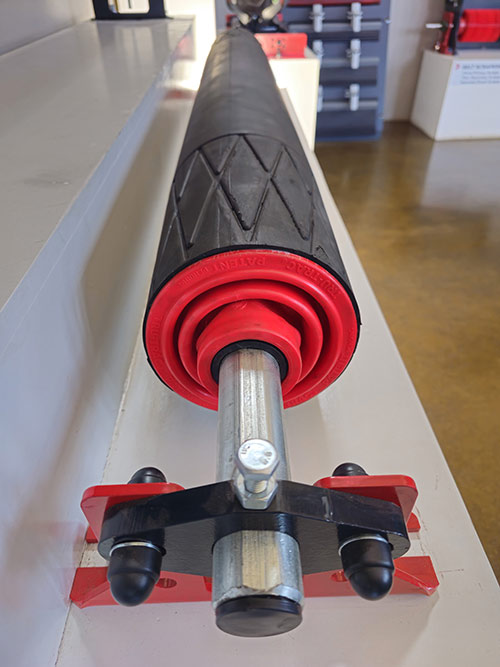
By changing some internal component designs, says Van der Westhuizen, Tru-Trac managed to cut both manufacturing and material costs. “For example, we looked at things such as the flat return tracker, the primary, and secondary scraper. While the primary scraper maintains the same quality and functionality as its premium counterpart, we changed the stainless-steel component to the normal mild steel zinc-plated option, which reduces the price significantly. While the premium product comes with a lifetime guarantee on tensioners, the Q-Series still gives you the same performance but is not guaranteed for life,” says Van der Westhuizen.
From a physical standpoint, adds Van der Westhuizen, the flat return tracker looks exactly the same as the premium offering, but adopts slightly different brackets. The secondary belt scraper maintains the same functionality as that of the premium solution, but it uses a smaller cushion for the blades. These cushions bolt directly onto the shaft, eliminating the need for the cassette. It also has a lower profile, allowing Tru-Trac to offer it at a significantly lower price.

Common conveyor problems
Quarries and mines lose thousands of productive hours each year due to conveyor system issues and, according to Fitt, some of the most common ones include belt misalignment, material carryback, and rip events – all of which directly impact throughput, operational costs, and safety.
“One of the most common causes of unscheduled downtime on conveyor systems is belt misalignment, which causes spillage, belt edge damage, damage to the structure, increased power consumption and increased labour costs. Misaligned belts will ultimately result in lost production, increased operating costs, and safety hazards,” says Fitt.
Misaligned belts, says Van der Westhuizen, can also result in environmental issues by increasing material spillage and dust generation, which can contaminate nearby ecosystems and water sources, lead to regulatory non-compliance and negatively affect the health of both workers and nearby communities.
Carryback, adds Fitt, is another ‘common enemy’ in conveyor systems. Carryback represents loss of product, which, over time, can add up to significant financial costs, especially in systems handling large volumes. “Carryback directly reduces conveyor productivity by creating unscheduled downtime for cleanup, degrading components such as rollers and pulleys, causing material loss and leading to belt tracking issues that necessitate further maintenance,” says Fitt.
Best practice
Drawing on decades of field experience, Fitt and Van der Westhuizen outline some of the best-practice maintenance approaches to keeping conveyors running at peak performance in demanding quarrying conditions.
According to Fitt, continuous inspection, the need to always ‘look and see’, is crucial to keeping conveyor systems operating at peak performance. With this approach, minor issues are identified early on before they escalate into major problems that lead to unexpected breakdowns. This approach minimises unplanned interruptions, ensuring that material transport is uninterrupted and production schedules are maintained.
“Our maintenance teams are regularly on customer sites, conducting these ‘look and see’ inspections. Through these inspections, we can advise customers on potential issues before they become big setbacks. Addressing small issues when they are first noticed is significantly less expensive than emergency repairs on major failures such as belt rips,” says Fitt.

According to Van der Westhuizen, constant condition monitoring of conveyor components is one of the best practices in ensuring correct belt tracking at all times. It is essential to be fully aware of the basic characteristics of the different belt tracking components and for these to be employed correctly.
“It is important to make sure that all the structural conveyor components such as pulleys, idlers, take-ups and the supporting structure are properly aligned at all times. In fact, these should be the principal areas of concern whenever trying to identify belt tracking problems. All pulleys, snub rollers, troughing and return idlers must be square with the frame parallel to each other, and also be level,” concludes Van der Westhuizen.


