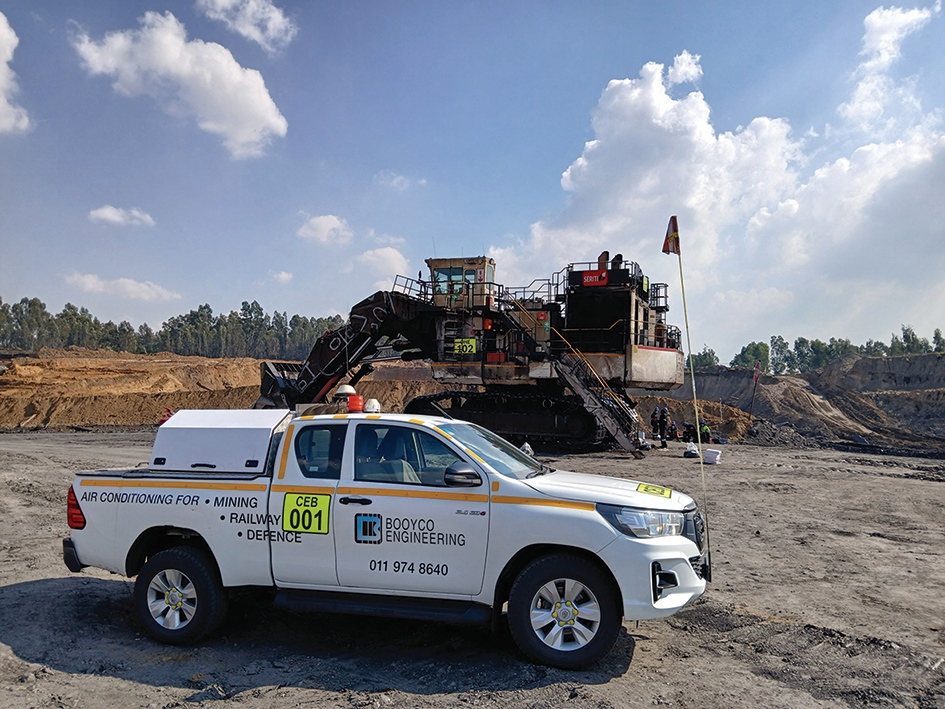
Evolving health and safety requirements on mines across Africa make it vital that ambient conditions are fully accounted for when specifying HVAC systems for mobile mining equipment.
Brenton Spies, MD of Johannesburg-based Booyco Engineering, explains that nominal cooling capacity can provide a misleading picture of actual HVAC performance, particularly in the high ambient temperatures experienced across many African mining regions.
“A cooling system that delivers its stated capacity under relatively mild conditions will perform very differently when exposed to the extreme ambient temperatures encountered in parts of Africa,” Spies says. “A 9 kW system operating in an environment that regularly experiences 46 degree heat, for instance, has a very different output in 29 degree surroundings; it is just not the same cooling capacity.”
He highlights that this is also an issue encountered in other demanding applications, such as military equipment, where cooling performance must be specified against the actual environmental conditions in which the equipment will operate.
For mining equipment, which is increasingly governed by stricter health and safety standards, another important consideration is the draw-down period. This is the time required to bring a hot cab down to a comfortable operating temperature for the operator and can significantly affect machine utilisation when large equipment is left idling while the cab cools.
“A correctly specified unit should take the temperature from 46 degrees to a comfortable temperature within about 20 minutes,” Spies says. “If the specification of the unit has not taken ambient conditions into account properly, the mine could end up idling a large diesel engine for significantly longer to cool down the cab – counting the cost in diesel and standing time.”
The mining environment presents further challenges, he adds, as HVAC equipment must withstand dust, vibration, long operating cycles and, in many applications, limited installation space. Underground machines are particularly challenging, as larger and more efficient components cannot simply be accommodated by increasing the physical size of the system.
This is becoming increasingly relevant as HVAC technology evolves. New efficiency requirements are driving the development of more efficient fans and compressors but achieving greater efficiency can sometimes require larger components.
“In an underground environment, we have limited space on mining vehicles,” he says.
Booyco Engineering addresses these challenges through purpose-engineered systems, drawing on more than four decades of experience in specialised mobile HVAC applications including military and rail. This expertise is also informing the development of the company’s next generation of mining HVAC systems, where the balance between cooling performance, efficiency and available installation space remains critical.
“For mining companies and equipment OEMs, the message is simple,” he concludes. “Cooling capacity needs to be specified against the conditions in which the machine will actually operate.”