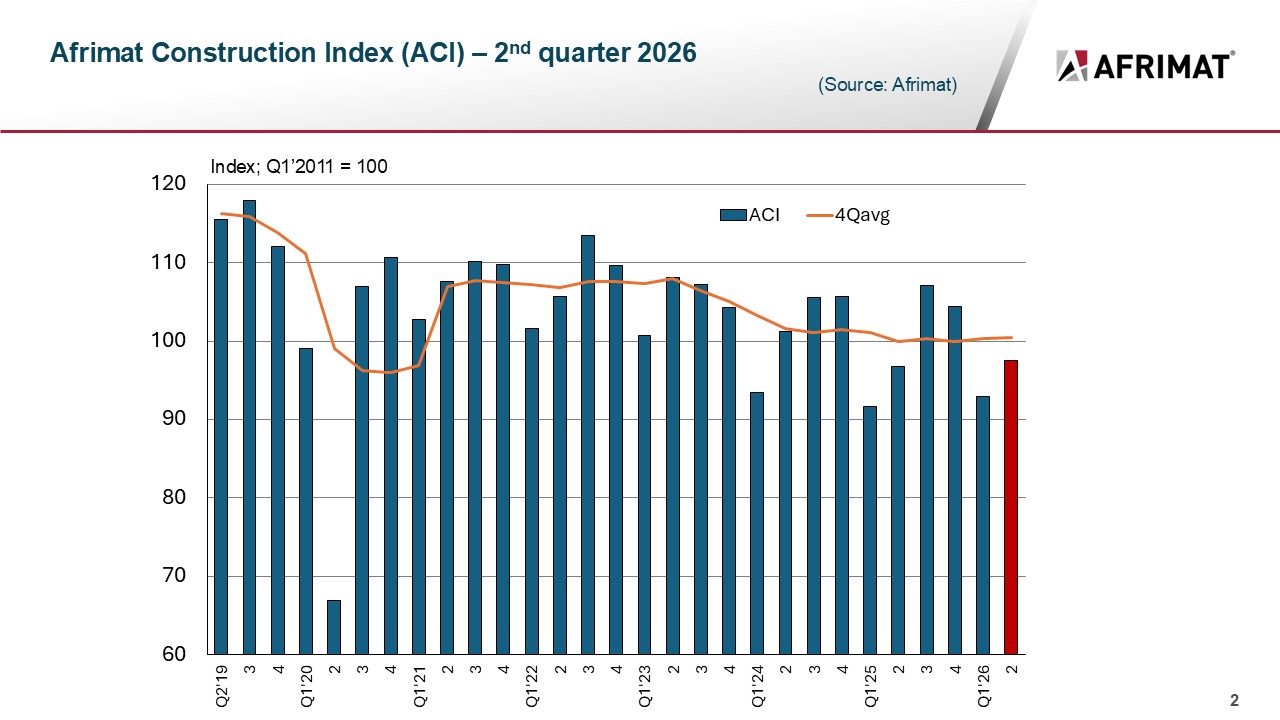
The Afrimat Construction Index (ACI) for the second quarter of 2026 has been released, showing an impressive 5% quarter-on-quarter increase, outperforming the country’s GDP by a considerable margin.
According to economist Dr Roelof Botha, who compiles the quarterly index on behalf of Afrimat, even though the year-on-year increase of 0,7% was marginally lower than the 0,9% increase in GDP, it is encouraging that employment in the construction sector has increased by 95,000 since the second quarter of 2025.
“Against the background of the year-on-year decline in South Africa’s total employment during the second quarter, the ability of the sector to have created 95 000 new jobs is exceptionally good news,” says Dr Botha.
The index value is expressed in real terms, i.e., after adjusting for the effects of inflation.
One of the highlights of these results is the consistency of the growth trends for the following indicators, all of which have recorded growth rates that are well above the latest consumer price index of 4,3% (as at July 2026) on both a quarter-on-quarter and a year-on-year basis:
- Wholesale trade sales of construction materials
- Employment in construction
- The value of building plans passed by the larger municipalities
- The volume of building materials produced
“The quarter-on-quarter increase of 8,5% in the volume of building materials produced is especially encouraging, as this indicator represents one of Afrimat’s core activities,” says Botha. “Compared to the first quarter of the year, the real sales values of building materials also performed well, improving by 7%”.
He adds that although activity levels in the sector remain subdued, the ACI’s seasonally adjusted reading has been above the base period level of 100 (2011) for four successive quarters, signalling a recovery from the negative effects emanating from the state capture era and the pandemic.
“As was the case in the previous quarter, five of the 10 indicators recorded positive year-on-year growth rates, while two of the other five recorded declines of less than 2%. The quarter-on-quarter performance was even more impressive, with six of the indicators recording increases in real terms.”
According to Botha, construction activity during the rest of the year and into 2027 is poised to benefit from several potential growth drivers, including:
- The Metro Trading Services Reform Programme (MTSR), which has been boosted by a loan of US$1-billion obtained from the New Development Bank. The MTSR is a government-led initiative aimed at improving the governance, financial sustainability and operational performance of metropolitan municipalities, especially in water and sanitation, electricity and energy and solid waste management.
- Prospects for a dramatic decline in oil and fuel prices when geopolitical stability improves, especially as a result of Venezuela’s intention to increase its oil production by one million barrels per day. Lower fuel prices will place downward pressure on inflation, which could lead to a resumption of the rate-cutting cycle, hopefully by early next year.
- Industry Insights has reported that South Africa’s newly released 2026 Construction Book lists 110 projects worth approximately R396 billion, an increase of 71% from the R232 billion recorded in the 2025 edition.
Commenting on the results, Andries van Heerden, the CEO of Afrimat, says that as a mid-tier miner, the group remains committed to building a sustainable, enduring South African business that supports the foundations of the local economy.
“In over two decades of operations, this has been one of the most challenging years we have experienced, driven largely by structural shifts in the local economy and compounded by ongoing geopolitical uncertainty, including the conflict involving Iran.”
Despite these headwinds, Afrimat’s diversified portfolio has enabled the group to remain resilient and continue creating value across its operations.
“Only a few years ago, when iron ore prices were strong, and the rand-dollar exchange rate was favourable, our Bulk Commodities segment underpinned the business and helped us support our people through COVID. Today, it is our Aggregates business that is providing that stability and demonstrating the strength of our diversified model.”
Afrimat has successfully completed the divestment of the required quarries in line with Competition Commission directives and has made significant progress in improving the performance of acquired operations. The group’s integration programme has largely been completed, with the benefits of a stronger, more efficient operating platform already beginning to emerge.
Market conditions are also showing encouraging signs. Afrimat is experiencing volume growth driven by increased spending across a range of sectors and infrastructure projects nationally, including rail maintenance, provincial road upgrades, water infrastructure developments, residential and commercial construction, and the continued rollout of renewable energy projects.
“As a national aggregates supplier, we are uniquely positioned to participate in a broad range of projects across the country. Our exposure to numerous small and medium-sized contracts, rather than relying on a handful of large projects, continues to support activity across our quarry footprint.”
Van Heerden concludes by saying: “These trends provide a glimpse of the positive developments taking place across South Africa. As business leaders, we have a responsibility to recognise and build on this momentum. Sustainable progress requires constructive collaboration between the public and private sectors, founded on mutual respect and shared purpose. We are increasingly seeing this approach gain traction and, where we can, Afrimat will continue to contribute its expertise, knowledge and products to support the country’s growth and development.”