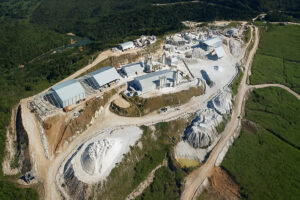
Located in Port Shepstone, KwaZulu-Natal, Rossmin Mine sits at the heart of the famous Marble Delta, a unique limestone formation near the confluence of the Umzimkulu and Umzimkulwana rivers, with a limestone deposit considered to be of the highest quality in South Africa.
Since its formation in 2010, the innovative and community-driven operation, has established itself as a major source of high-quality carbonate products for industrial, agricultural and food applications, supplying countrywide through distribution centres in Durban, Johannesburg and Cape Town.
Quality matters
A principal factor to the success of the operation is the high-quality nature of its limestone. The operation, explains mine manager Fana Shozi, produces high-brightness, low-contamination marble limestone. Part of the distinctive Marble Delta geological formation, the deposit allows the company to produce a versatile range of products, from agricultural lime and industrial fillers to food-grade ground carbonates.
Rossmin’s resource base includes both calcitic and dolomitic limestone, offering flexibility in product chemistry to meet the requirements of a diverse customer base across construction, manufacturing and agriculture.
“Our market is currently driven by a steady demand for local, high-quality limestone products in sectors such as agriculture, animal feed, plastics, coatings and food processing. Our focus on consistent product quality and reliable delivery has ensured a growing national footprint,” says Shozi.
To drive quality, Rossmin subscribes to the ISO 9001 and ISO 22000 Quality Management Systems, ensuring that all products, including food-grade ground calcium magnesium carbonate, are produced in accordance with Hazard Analysis and Critical Control Points (HACCP) and Good Manufacturing Practices (GMP) requirements. This integrated approach to quality control guarantees consistency, safety and reliability across its full product range.

Not without challenges
While the business sees encouraging signs of recovery in certain manufacturing sectors, it remains under severe pressure from cheap imports originating from countries with less stringent labour, mining and environmental regulation.
“Despite these challenges and the inherent tight margins, we remain optimistic, largely due to the green shoots that we see in the economy and the growing recognition of the value of local manufacturing. However, import protection and reduced red tape for small and mid-tier mining companies are urgently needed to safeguard South African jobs and industry,” says Shozi.
Rising above challenges
To rise above challenges, especially the escalating input costs, Rossmin has prioritised efficiency, local innovation and operational optimisation. Key initiatives include local sourcing of maintenance components, particularly in metallurgy and mechanical fabrication, leveraging South Africa’s mining engineering expertise to reduce lead times and control costs.
In addition, the operation, says Shozi, continues to improve processing plant performance and logistics reliability, while enhancing workforce capability through digitalisation, thus ensuring data-driven decisions.
“Another major innovation is the adoption of artificial intelligence (AI) to enhance the training of employees and contractors on the complexities of mining regulations and codes of practice. This interactive system improves understanding and retention of safety-critical information and supports regulatory compliance across all levels of the operation,” says Shozi.

Prioritising compliance
Compliance in the mining industry is a significant expense, but it is indeed necessary for legal, safety, environmental and business reasons. The costs of non-compliance, which can include hefty fines, operational shutdowns, and severe reputational damage, consistently outweigh the costs of maintaining a robust compliance programme.
With that in mind, health and safety compliance remains a cornerstone of Rossmin’s operations. Through a proactive safety culture supported by digital learning and strong leadership, Rossmin has established a track record for excellence in occupational health and safety management. To provide context, the mine is approaching a milestone of 1-million lost-time injury (LTI) free hours, with zero fatalities since inception.
Rossmin also operates under the ISO 14001 Environmental Management System principles, underpinned by a proactive commitment to sustainability and biodiversity protection. A highlight of this commitment is the management of an 80-hectare biodiversity offset area, developed in partnership with Ezemvelo KZN Wildlife and local specialists.
“The area conserves pristine grassland and is home to an endemic limestone-loving snail found only in the Marble Delta. Controlled harvesting of medicinal plants is managed collaboratively with local registered Inyanga (herbalists), combining environmental stewardship with cultural respect,” explains Shozi.

Beyond the mine gate
Beyond the mine gate, Rossmin is deeply invested in community development. The company supports nine local no-fee schools through the provision of boreholes, new classrooms and a sports field, improving access to education and well-being in an area of extremely high unemployment.
These initiatives form part of Rossmin’s Social and Labour Plan (SLP) and reflect its belief in education as a key driver of sustainable community growth.
The future
Looking ahead, Rossmin continues to invest in research and development to reduce environmental impacts, improve operational efficiency and meet evolving customer demands. Projects include optimisation of dust suppression and water management systems, as well as investments in lower-impact processing technology.
“Rossmin remains positive about the future. The company’s long-term strategy centres on sustainable growth, technological advancement and local value creation. In our view, Rossmin represents what is best about South African mining – innovation, resilience and a genuine commitment to community and environment. We are proud to be a local manufacturer creating real jobs while producing world-class limestone products,” concludes Shozi.