The launch of the OneASTEC business model in 2021 ushered in a new era for Astec and its customers throughout the world, and the same impact has been experienced in the Africa Middle East (AME) region. Having previously focused on the Osborn brand alone, says Goosen, the Rock to Road strategy, a key lever of the OneASTEC business model, has allowed Astec AME to expand its product range significantly, thus opening up new markets and allowing customers to acquire most of their capital equipment requirements from one source.
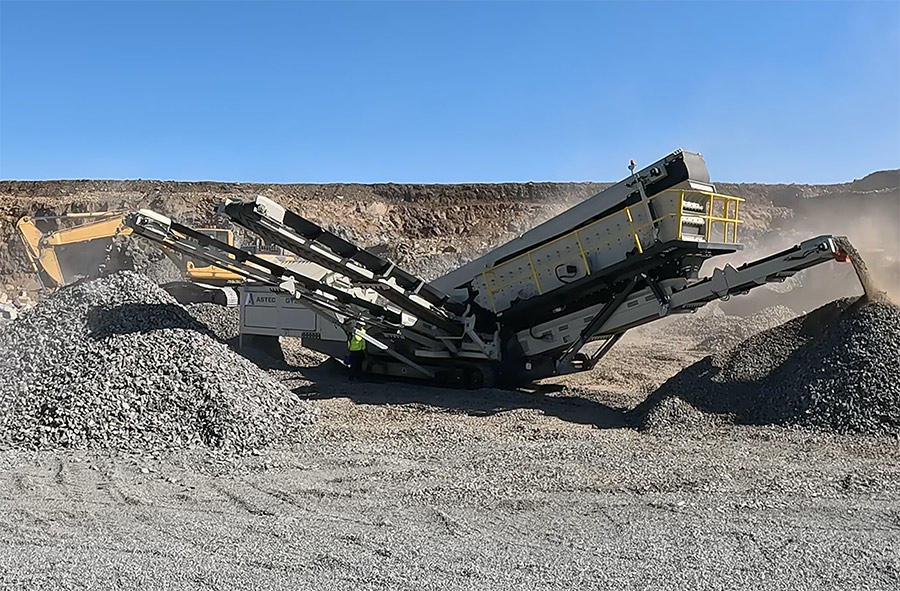
The company’s operations are divided into two primary business segments. Material Solutions incorporates aggregate, material handling and processing solutions, including crushers, screens, apron feeders, rock breakers and bulk material handling equipment. Infrastructure Solutions encompasses road building, asphalt and concrete plants, as well as thermal and storage solutions.
Living up to the Rock to Road billing, Astec now offers equipment for every phase of the road construction process – from quarrying, crushing and processing the aggregate, to concrete production and road surfacing – providing more than a hundred products to customers in the aggregates, construction, infrastructure and mining value chain.

Product growth
“The impact of the Rock to Road strategy has been twofold – product growth and footprint growth, both of which are central to the growth of our business,” says Goosen. “To date, I believe we provide the broadest product portfolio of any other original equipment manufacturer (OEM) in the world in the Rock to Road value chain, which gives us a competitive edge.”
The product growth has also had a massive impact on Astec AME’s local manufacturing activities. Traditionally home to the Osborn range only, which in itself represented one of the widest ranges in the comminution and material handling space, the Astec AME manufacturing facility has added several other products to its local manufacturing portfolio.
For example, the production of Astec Industries’ Titan series cone crushers for the market outside of the US is relocating to South Africa. The group’s Johannesburg-based Astec South Africa division will start with manufacturing of the T200 at its Elandsfontein facility during the first quarter of 2025. The production of the rest of the range of Titan cone crushers, including the T300, T400 and T500, will follow soon after the T200.
The strategy is geared at optimising Astec’s international manufacturing footprint and maximising efficiencies within Astec’s Materials Solutions group. It also forms part of Astec’s drive to consolidate operations and to become more flexible in production capabilities in order to meet customers’ demands within the regions.
However, adds Goosen, from a business growth perspective, the Rock to Road strategy has not yet realised its full potential. This is largely due to the macro-economic environment in South Africa, where project owners such as the South African National Road Agency Limited (SANRAL) and municipalities have been under pressure in recent years, leading to a depressed infrastructure development market.
“We have, however, started to see an uptick in construction activity in the past 12 months, with SANRAL bringing several meaningful projects to the market. Consequently, we have also started to see some good movement of our products into these projects. For instance, we recently demonstrated our new Astec RX-600ex-4 cold planer on the R21 highway rehabilitation in Gauteng. We have also just supplied our Astec SB-3000 Shuttle Buggy and other road building equipment to projects in the Western Cape,” explains Goosen.
While the local market has not fully capitalised on Astec’s Rock to Road capability, Goosen is positive that the product awareness created over the past three years has laid a solid foundation for future growth, especially at a time when construction projects are starting to come to market.
“Customers are now aware of what we have from a product perspective and the performance of our equipment. Going into 2025, we are confident that we will start seeing this awareness turning into sales. We have both the inventory and support in place to fulfil the needs of the market,” he says.

Footprint growth
Apart from product expansion, another significant impact the strategy has had is the growth of Astec’s footprint in Africa and Middle East. To support its expanded product portfolio in such a big market area, the company had to develop a formidable channel-to-market, while maintaining a direct-to-market approach in South Africa.
Over the past three years, Astec AME has appointed highly qualified dealers across the region to provide sales and service support to customers. To date, the company has a total of 12 dealer partners in the region, with some of them responsible for several countries in their territories.
One example is Unatrac, which is part of the Cairo-headquartered Mantrac Group, offering sales and support services for all of the equipment in Astec Industries’ Material Solutions division in Nigeria, Ghana, Sierra Leone, Liberia, Kenya, Tanzania, Uganda, Egypt, Iraq and the Ural and Volga regions in Russia. Meanwhile, French company Aramine is the official dealer of Astec Material Solutions products in several strategic countries in West Africa (Mauritania, Mali, Senegal, Guinea, Côte d’Ivoire, Burkina Faso, Benin, Togo and Niger) and the Maghreb (Algeria, Tunisia and Morocco).
In southern Africa, Astec AME has dealers in strategic countries such as Namibia, Zimbabwe and Zambia, among others. The company has recently appointed Elite Crushers & Hydraulics as its dedicated agent in Botswana. This follows hard on the heels of the recent appointment of Zinpro RDC SARL in the Democratic Republic of Congo (DRC), a key market to date.
While it has taken time to establish the brand and the product simultaneously in most of these regional markets, Goosen is confident that the dealer partners are now well equipped to sell and support the product in their respective markets, and opportunities are starting to come through. With such a strong dealer network, the company has once again built a solid foundation for growth. The past three years, declares Goosen, have been about creating the base, and now it is time to reap the rewards.
“We have a strategic growth plan to double our global business at group level by 2030. As Astec AME, we have an even more ambitious target to do a lot more than that. With the networks that we have created, we expect to see exponential growth in the next two to three years,” says Goosen.
Key trends
Commenting on some trends observed, Goosen starts by highlighting the global move towards newer solutions such as electric and hybrid equipment. These are driven by the Environmental, Social and Governance (ESG) agenda. While developed markets have gone further down this road, Goosen believes that the local market is still lagging behind.
Another trend of note, he adds, is the growing need for information and access to information that the equipment generates as customers seek to make data-informed decisions to optimise their operations. This has been a major product development strategy for Astec Industries in the past few years.
In fact, the company has made some major acquisitions of technology-focused companies in the United States and Europe to reinforce its digital solutions offering. The acquisition of MINDS allowed Astec to enhance its equipment solutions for asphalt road building, aggregate processing and concrete production with a suite of plant automation and control systems. The March 2022 transaction followed Astec’s November 2020 purchase of Grathwol Telematics. These acquisitions were instrumental to the launch of ASTEC Digital, a game-changer for the Rock to Road industry, offering customers greater control, efficiency and sustainability.
Closer to home, says Goosen, one of the notable trends is that more and more customers, particularly in mining, are becoming reliant on the OEM to provide them with the technical ability. While this trend has taken root in the yellow equipment side of the market, Goosen believes it is only starting to gain traction in crushing and screening.
“The need for OEM technical support from a crushing and screening point of view is growing. Whereas in the past we would only be required to come out to assist with major breakdowns or a major liner change on a big machine, we are starting to see the need for man-on-site type of arrangements. This is largely due to the fact that mines are struggling with competence to support their own equipment,” reasons Goosen.
The future
Looking ahead, Goosen tells Quarrying Africa that Astec Industries AME has a two-pronged approach to growing its business – sales and manufacturing. On the back of the product expansion and footprint extension in recent years, the next step is to drive sales to grow the business.
The other part of the growth strategy is to further grow the company’s manufacturing capability in South Africa. In an environment with a relatively lower labour cost base than developed markets such as the United States and Europe, there is huge potential to grow local manufacturing for export markets.
However, says Goosen, the downside is a challenging economic environment that makes it difficult to sustain manufacturing businesses and allow them to flourish. “As a country, we need to have discussions on how we can sustain manufacturing-led growth and become competitive on a global scale. A strong local supply chain is critical for the full realisation of our local manufacturing capabilities,” says Goosen.
To close the skills gap, Astec AME is investing heavily in its skills development programmes. To provide context, the company has vibrant learnership, apprenticeship and internship programmes aimed at supporting its manufacturing capabilities by creating the much needed competency to become globally competitive. The company will also continue to invest in its Elandsfontein manufacturing plant to allow for the addition of more product lines.
“For example, in 2025 we will be launching a range of standard skip-mounted modular plants. These will be made in our Elandsfontein manufacturing facility for the rest of the Astec group. These will be targeted at junior miners and aggregate operations,” concludes Goosen.