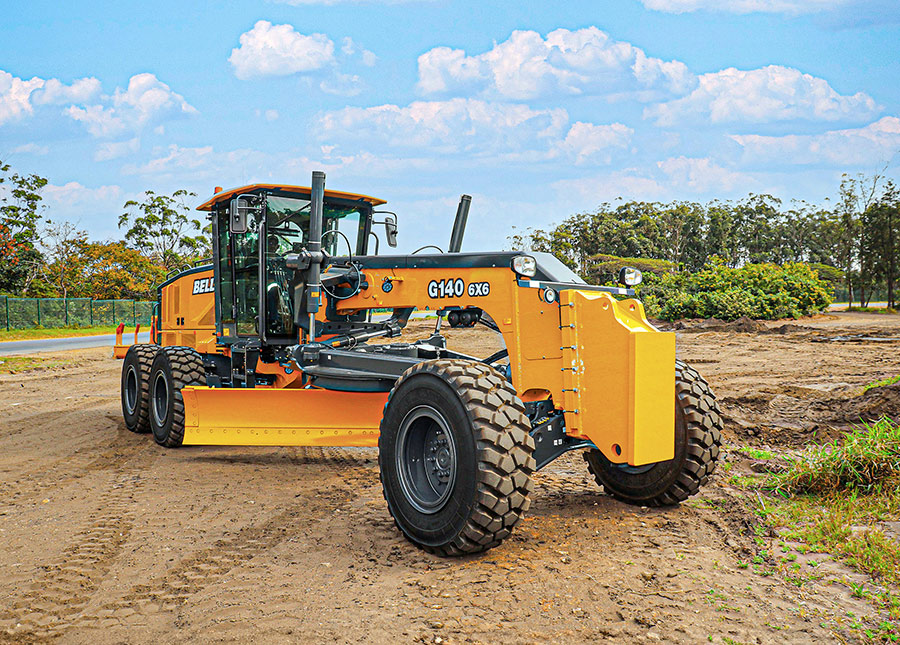
In 2025, Bell Equipment entered the motor grader market with the launch of three base models – the G140, G160 and G200 – giving its mining and construction customers a complementary product alongside its established articulated dump truck (ADT) range.
The move was driven by the size and potential of the global motor grader market, says Bell Equipment Head of Group Marketing Stephen McNeill.
“Most major ADT markets are also significant motor grader markets. Developing our own grader range was therefore a natural step in providing a more comprehensive OEM offering to dealers and customers operating in these regions,” he says.
Early interest
Bell officially launched the grader range during events in Johannesburg, Durban and Cape Town in the second half of 2025. Less than a year later, the company is reporting encouraging market acceptance.
“The range has performed well to date, with numerous units operating across South Africa in both construction and mining applications. We have also placed a sizeable number of machines in neighbouring markets such as Namibia, Botswana and Zambia,” says McNeill.
“By the end of this year, machines will also be operating internationally, initially in Australia and North America.”
The range comprises the G140, G160 and G200, each available in four- or six-wheel-drive configurations. To date, the G140 has attracted particularly strong demand. Designed for maintenance and light- to medium-duty construction applications, the 21-tonne machine is powered by a 6,7-litre Cummins QSB6.7 engine delivering 179 kW in both 6×4 and 6×6 configurations.
All models are equipped with ZF transmissions. The G140 uses the proven Ergopower transmission, while the larger G160 and G200 feature ZF’s cPower hydromechanical transmission, which combines continuously variable speed control with hydrostatic-mechanical power splitting. The result is improved fuel efficiency, enhanced operator comfort and higher productivity, while allowing the machine to operate efficiently at lower engine speeds.
Competitive edge
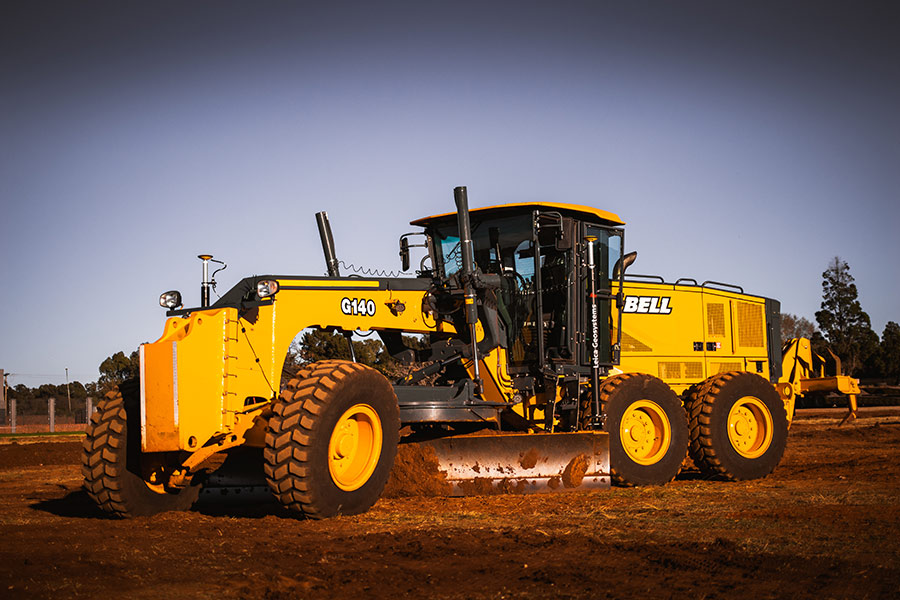
McNeill attributes much of the range’s early success to its extensive list of standard features. “Bell graders come equipped with advanced productivity-enhancing features, including smart automation for precision grading, a maintenance-free sealed slew ring, and a built-in interface for Proximity Detection Systems (PDS) and Collision Avoidance Systems (CAS),” he says.
A key differentiator is the sealed slew ring, which Bell believes sets a new benchmark in the grader market. Unlike traditional open-gear systems, the sealed design maintains mouldboard accuracy through reduced wear while requiring significantly less maintenance.
Integrated seals protect the internal raceways from dirt, dust and moisture, making the system particularly well suited to harsh mining and construction environments. Reduced contamination and wear contribute to longer service life, lower maintenance costs and improved reliability.
To support evolving mine safety requirements, Bell provides a PDS gateway controller compliant with ISO 21815-2, enabling customers to integrate their preferred third-party PDS or CAS solution.
The company has adopted a similarly flexible approach to machine control technology. Bell graders are designed to integrate seamlessly with Leica Geosystems, Topcon and Trimble grade control systems, allowing customers to choose their preferred platform.
The machines also incorporate several design features aimed at improving grading precision and versatility. A two-position drawbar enables operators to adjust drawbar height according to tyre size, ensuring it remains level and preventing mouldboard corners from digging in or lifting during circle rotation.
Built for Africa
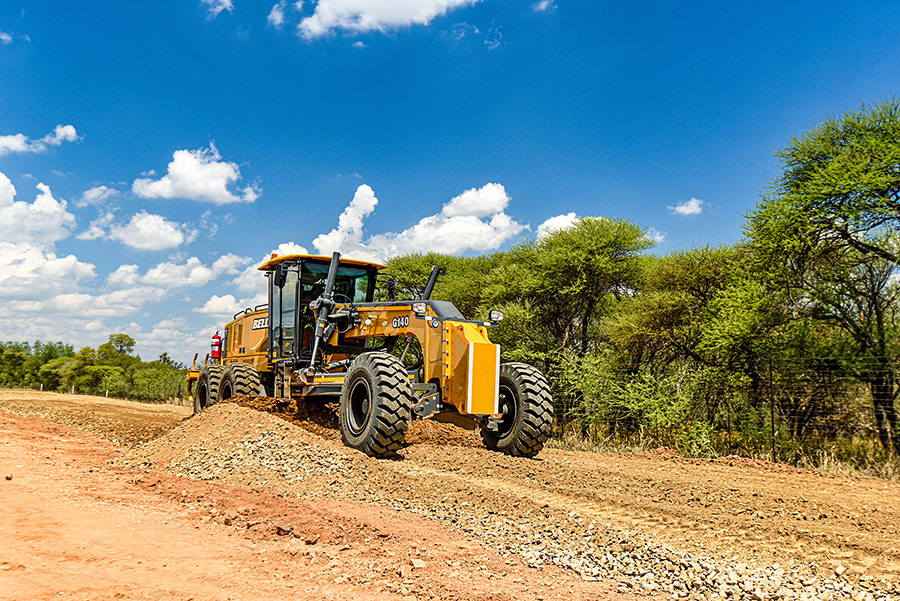
Durability was a primary consideration during development, with Bell focusing on creating a machine capable of withstanding demanding African operating conditions.
One example is the main frame’s single-piece construction, which eliminates fabricated joints that can become fatigue points over time.
“The single-plate gooseneck extends from front to rear, eliminating welded joints. By removing these potential weak points, we reduce the risk of structural failure,” says McNeill.
The grader’s two-cylinder cantilevered ripper uses a parallelogram design that maintains an effective ripping angle throughout its working range. A tilting ripper beam improves departure angle when retracted, while the high-lift design enhances transport clearance.
“Structurally, the Bell motor grader is a robust machine designed for the demanding conditions encountered in local mining and construction environments,” concludes McNeill. “Feedback has been positive, with operators and fleet owners recognising immediate value in the machine’s precision, reliability and ease of operation.”