What started out as a small-scale operation back in 2008 to service road construction and building projects in the small town of Vryburg and surrounding areas, has, over the years, transformed into one of the flagship quarrying operations in South Africa. A recent tour of the operations by Quarrying Africa revealed the extensive nature of process optimisation initiatives, complemented by large capital investments to modernise the operation in the quest for efficiency and productivity.
Initially, Northwest Crushers – relying on mobile crushing and screening equipment – processed basic aggregates for a few contracts in the area. Sensing growing market opportunity, the owners have, in recent years, committed large capital investments in capacity building. This was set in motion by the 2015 investment in a state-of-the-art CDE EvoWash 102 sand-washing plant, followed by the 2016 investment in a readymix concrete plant to maximise beneficiation and open up new market opportunities.
In 2020, the operation further expanded its business with the establishment of a brick manufacturing plant. In 2025, Northwest Crushers has not only commissioned a new static plant (allowing for the migration from costly mobile crushers) but also commissioned a completely off-the-grid solar plant with battery storage, allowing the operation to break free from unreliable grid power and costly generators.
Challenges to opportunities
From the onset, Northwest Crushers battled with its challenging geology – a quartzite rock with large intrusions of sand. Consequently, after blasts, the head feed would generally contain 60% sand. As a result, explains commercial manager Michael John Wessels, the operation would end up with large stockpiles of sand – albeit good quality sand.
However, finding the market for the abundant sand, given the unfair competition from illegal sand mining activities, was a challenge. The market could only consume a certain portion of the vast sand stockpiles. The investment in a CDE EvoWash 102 sand-washing plant was strategic in the sense that it allowed Northwest Crushers to separate itself from competition, taking the lead in the supply of high-quality manufactured sand.
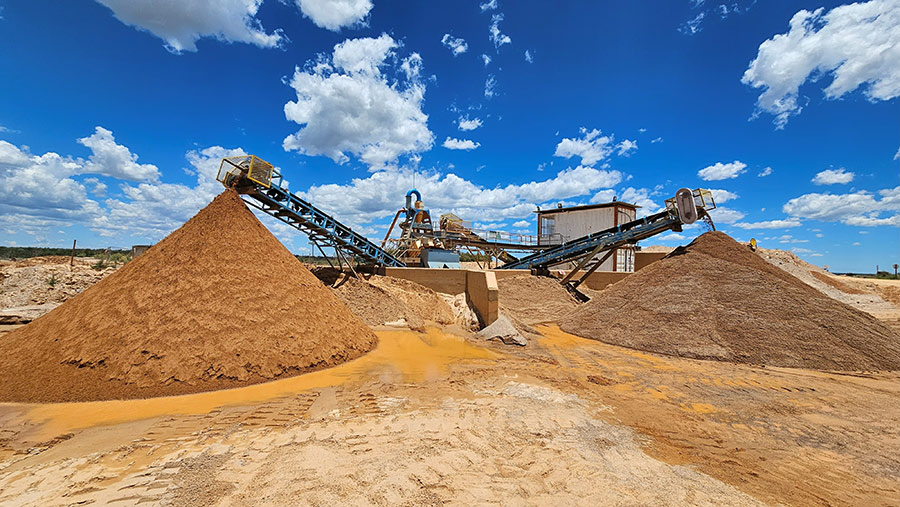
With a maximum processing capacity of approximately 120 tonnes per hour (tph), the EvoWash 102 utilises advanced hydrocyclone technology and a high-frequency dewatering screen to efficiently separate fine materials and eliminate the loss of valuable fines to settling ponds, which is a common issue with traditional sand washing systems.
The CDE plant at Northwest Crushers delivers two different, high-quality sand products – washed crusher dust and super sand – of consistent grade, simultaneously. This cyclonic materials technology guarantees the removal of the undesired 75 microns, while retaining quality fines and maximising dewatering of the product to between 10% and 15% moisture. The quarry is currently investigating market opportunities for clay material from this plant (currently disposed as waste), possibly in clay brick and roof tile manufacturing.
While the sand washing plant enhanced quality, extra capacity remained a headache, especially given that 60% of the quarry’s output is sand. To take advantage of the excess sand capacity, the operation decided on a beneficiation route, which saw the investment in a readymix concrete plant and eventually a brick manufacturing plant. These investments have to date paid dividends, with the brick plant, which produces about 80 000 bricks per day, consuming 43% of the quarry’s total production, while the readymix plant takes 14% of the output, with the rest destined for external markets.
Blast optimisation
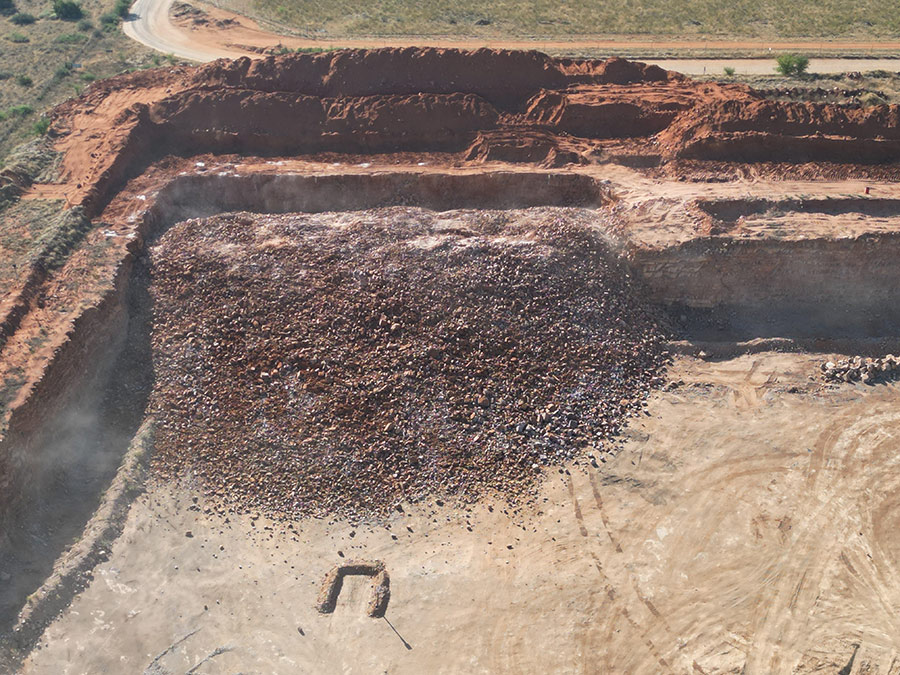
To win the cost control battle, Northwest Crushers places a major focus on optimisation of every aspect of its operations. This starts with good blasts, explains Wessels. As part of this process, Northwest Crushers has appointed an expert blasting company, B&E International, to take care of its blasting activities.
“Together with B&E International, we have gone through the process of optimising our blasts. We have placed a major focus on a blasting ‘recipe’ that suits our challenging geology, with a specific focus on burden and spacing. These factors are crucial for efficiently breaking rock by ensuring that explosive energy is used to its full potential, leading to better fragmentation,” explains Wessels.
For Director Joe Deetlefs, the easiest way to break rock is through blasting, which is why Northwest Crushers does not leave anything to chance when it comes to this process. “Good blasts are the starting point for cost savings in quarries because they significantly increase efficiency and reduce expenses in all subsequent operations, such as loading, hauling and crushing. Poor blasting leaves behind large, oversized rocks that require additional, costly secondary blasting or mechanical breaking before they can be processed,” explains Deetlefs.
Blasts are kept fairly large at 30 000 to 50 000 tonnes of material on the ground, allowing the operation to at least blast once every three months. Larger blasts lead to savings on drilling costs and other operational expenses due to the economy of scale.
Optimal operations
In a highly competitive and volatile aggregates market, the management team at Northwest Crushers closely monitors its cost per tonne to ensure profitability and operational efficiency. This metric is central to all strategic and operational decisions, including the selection of wear parts. “Over the years, we have trusted Caldas Engineering for our jaw and cone liners. Their alternative wear parts last longer, reducing the frequency of change-outs, offering better cost per tonne,” explains Wessels.
Technology adoption also forms part of the quarry’s focus on optimisation. A case in point is the use of belt scales from Loadtech Load Cells. With these scales, the production team can continuously measure the flow rate and totalised amount of material on a belt with high accuracy, typically within +/- 1%.
The belt scales also allow for tracking of plant downtime to identify bottlenecks and areas for improvement. In fact, says Wessels, the belt scales have allowed the quarry to reduce its ‘black belt’ time – the period when the conveyor system is running without actually transporting any material – by 10% at the primary section. Benefitting from a surge pile and a surge bin, the secondary circuit’s ‘black belt’ time is well below 5%.
In addition, Northwest Crushers has deployed a fuel monitoring solution from SmartMix Technologies. The integrated system is designed to give the quarry total control, visibility and accountability over every drop of diesel purchased, stored and consumed. The SmartMix Fuel Solution uses high-precision fuel probes and AI-powered analytics to monitor fuel levels with an accuracy of 99,5% and can detect changes in real-time to the litre. Apart from fuel management, the system also assists in tracking movement of assets.
The fully automated brick plant, supplied by Pan Mixers South Africa (PMSA), was designed to move away from bulk batching to weight batching, providing greater accuracy, consistency and ultimately, a higher quality final product. A moisture control system ensures correct mix designs that allow for optimum curing on strength and time, while reducing waste batches due to wet mixes. This quality control process is central to maintaining the prestigious CMA CS stamp of approval. The certification mark boosts consumer confidence and guarantees the quality of bricks.
Hauling run of mine (ROM) material represents a significant component of the total operating costs of any quarry or surface mine. Consequently, the incentive to increase efficiency and reduce costs in this area is very high for Northwest Crushers. Haul distances from the quarry face to the primary section of the plant are kept fairly short, between 300 and 500 m, allowing the haul trucks to complete more cycles per shift, transporting more material from the pit to the processing plant. Keeping haul distances short also reduces diesel burn, thus lowering operating costs.
People, states Deetlefs, are the “beating heart” of the business, which is why Northwest Crushers invests heavily in the development of its people. As part of that process, the quarry has engaged the services of Organisation Development International (ODI), a productivity and management consulting company.
“At Northwest Crushers, we see people as the most important pillar of the three keys (Process, Technology, People), which is why we have invested in training and upskilling junior supervisors and upcoming talent, to not only be good in their respective functions, but also in leading and managing people. This is done with a holistic overview of the complete processes of the company. ODI helps with the upskilling of people and linking processes between all sections – quarrying, brick making, readymix and logistics,” says Deetlefs.
From mobiles to static
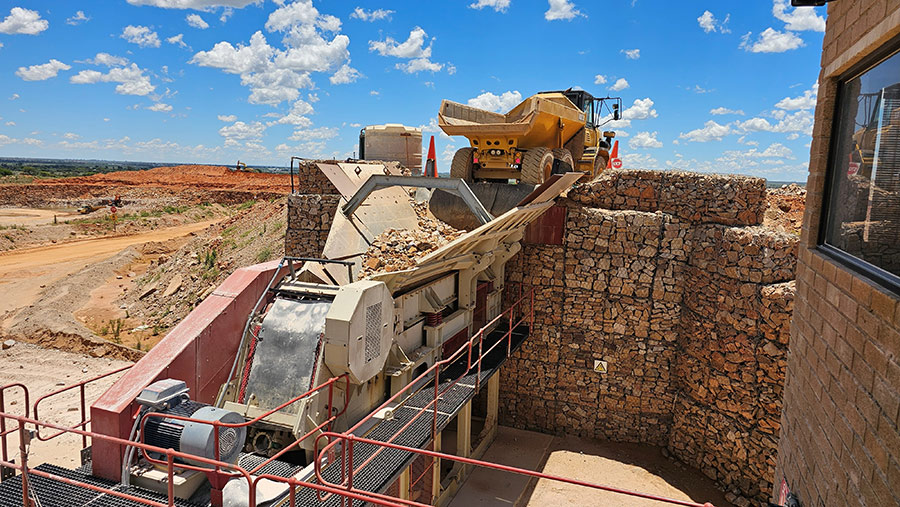
As part of the relentless focus on optimal processes, the quarry has also migrated from mobile crushing and screening equipment to a static plant. Commissioned in June this year, the plant has the capacity to produce up to 220 tph, confirms Wessels, producing a wide range of products. These include road stone (20 mm, 14 mm, 10 mm and 7 mm), concrete stone (14 mm and 20 mm) and various types of sand, amongst others.
“With a mobile train, diesel was a major cost, while downtime and costs related to maintenance were also a major driver in the decision to invest in a static plant, with the intention to lower operating costs and increase production efficiency over time,” explains Wessels.
When designing the plant, says Deetlefs, one of the key considerations was the adoption of the ‘doing more with less’ mentality, which involves a focus on maximising operational efficiency and output while minimising input costs and resource consumption. This, he says, is apparent in the pairing of a medium jaw crusher (a Finlay J1175) with a smaller Metso HP200 cone crusher, striking an effective balance between size and operational output for such a medium-scale operation.
“Our jaw is optimally sized to ensure constant choke-feeding of the cone crusher. Every ‘quarryman’ will tell you that a cone crusher is designed to operate with the crushing chamber full (choke-feeding). We have installed a 15 m³ surge bin to ensure a consistent, non-segregated feed of material, which allows for choke-feeding the crusher at all times. Choke feeding allows the cone crusher to operate at maximum capacity and throughput at all times, while promoting rock-on-rock crushing, which breaks down flat and elongated particles and results in a more cubical product shape,” says Deetlefs.
As part of the design of the process plant, all conveyors were kept flat (no single one has an angle over 16 degrees), wide and slow, primarily to maximise efficiency, enhance safety, and minimise equipment wear and material spillage. A flat angle, says Deetlefs, prevents material from rolling off the sides, especially for coarse or uneven aggregates. Wide conveyor belts accommodate a larger volume of material cross-sectionally, while lower speeds ensure a smoother, more controlled flow.
In addition, a large 8-m surge pile just after the jaw crusher acts as a material buffer, allowing the processing plant to continue running even if there are temporary disruptions in the mining or hauling operations. This ensures operational efficiency, increases productivity and reduces equipment downtime.
Going off grid
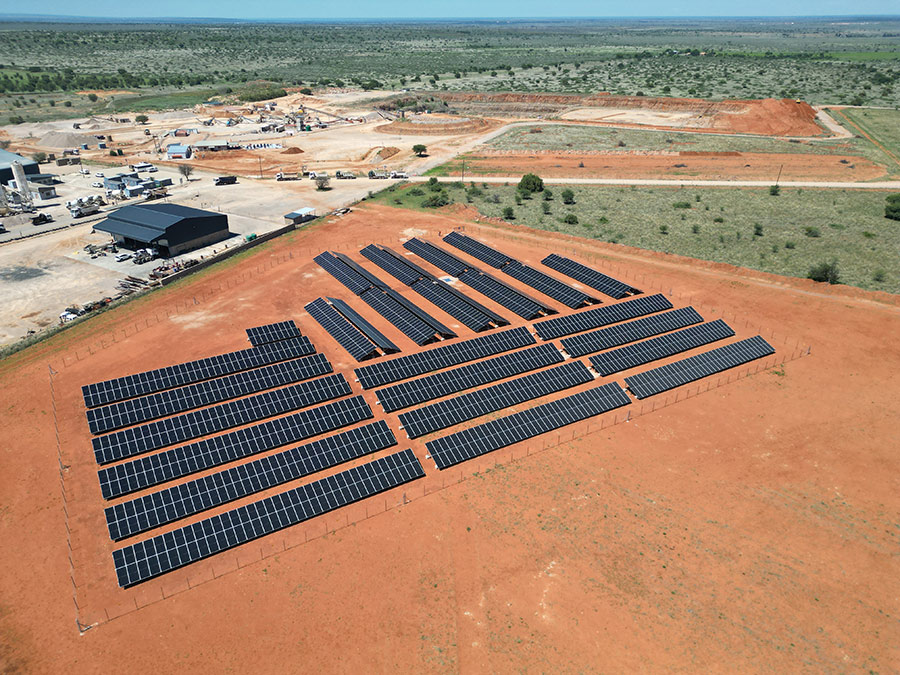
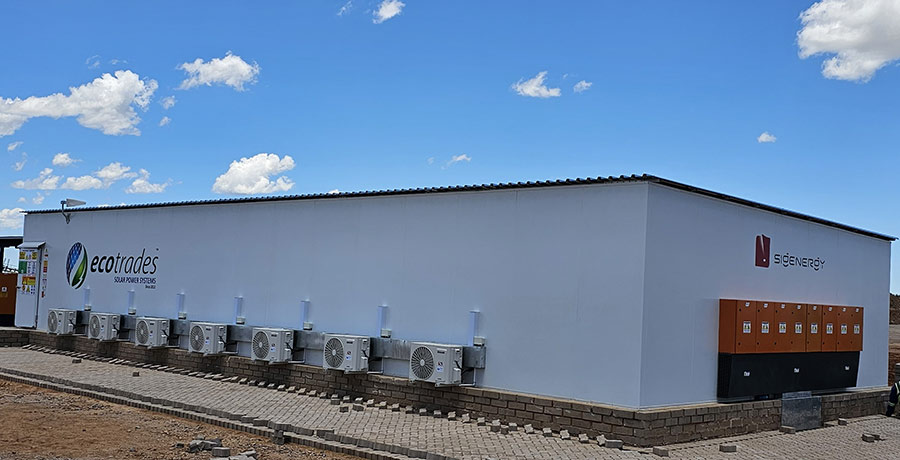
One of the major talking points at Northwest Crushers is the recent decision to go completely off the grid through a large capital investment in a massive 1,3-MW solar power plant with a 2,3-MWh battery storage capacity (which can be expanded to 3,6 MWh). During Quarrying Africa’s visit in November, the off-grid solar plant had been fully operational for two weeks, providing more than enough capacity to run the whole operation, including the processing plant, brick manufacturing plant, readymix plant and all other utilities on site.
Supplied and installed by Eco Trades, a leading Bloemfontein-based engineering, procurement and construction (EPC) company, which managed every stage from design to handover, Northwest Crushers’ solar plant is said to be one of the largest of its kind in South Africa.
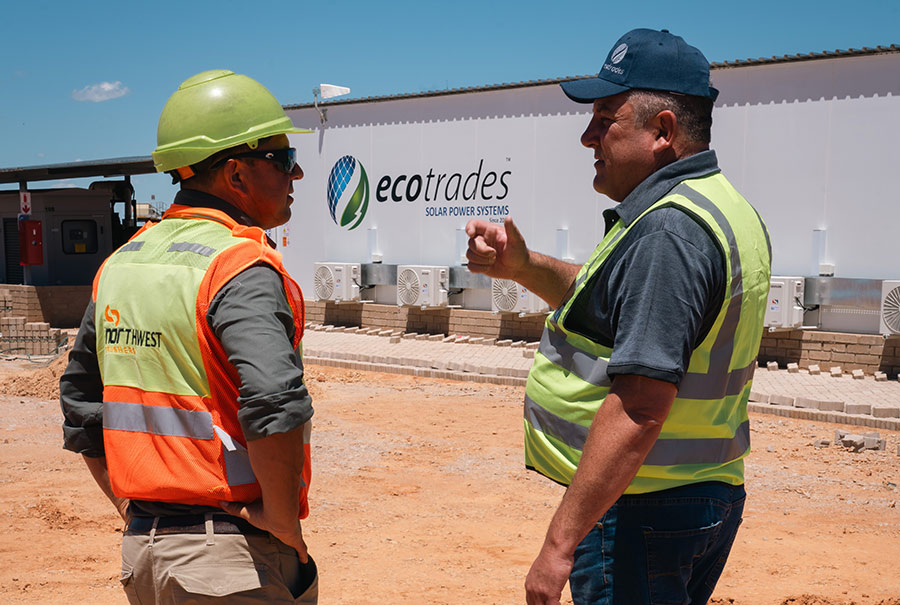
“The reason for this major capital investment was to break free from unstable grid power. Our allocated municipal power supply was not enough for our needs. To provide context, we were using grid power only on our primary section and had to power the rest of the plant with generators. This was a costly exercise. Frequent power trips also resulted in costly downtime through jaw crusher blockages,” explains Deetlefs.
The investment in a solar plant has also given the quarry a hedge against volatile and unpredictable grid electricity prices. With no access to Eskom power, Northwest Crushers was billed according to municipal peak period charges, which resulted in a high overall electricity bill. Due to significant cost savings, the solar plant investment is expected to pay for itself in six to eight years.
Unstable power, adds Deetlefs, was one thing, but the cost of running generators, was quite another, especially given the high cost of diesel and the high cost of maintenance associated with servicing engines. This was exacerbated by constant electrical surges which posed significant threats to electronic equipment, ranging from immediate destruction to gradual degradation.
“In our view, the transformation from traditional power to solar in quarrying and mining operations represents a strategic imperative for operational excellence and financial sustainability. With energy costs rising and environmental regulations becoming more stringent, solar power offers quarries and mines a clear path to reduced operational costs, improved reliability and enhanced environmental performance,” concludes Deetlefs.