When John Deere formally launched its own-branded construction machines in the South African market in March 2021, one of the first recipients was PGN Civils, a family-owned business established in 2008 with a major focus on construction projects, before branching out into contract mining in 2018. To further spread its wings, the company also added a plant hire component to its business.
While PGN Civils, which holds a Grade 9 CE grading from the Construction Industry Development Board (CIDB), is still active in construction, the bulk of its business now comes from its contract mining business, which runs just over 100 pieces of equipment at two mines in the Phalaborwa mining area in Limpopo province.
Enter John Deere
In 2021, John Deere announced its decision to take full control of the marketing and support of its John Deere-branded construction products in Africa. The expansion of the construction line-up targeted 18 countries across southern Africa and West Africa, where the Deere-branded construction offering was previously not available.
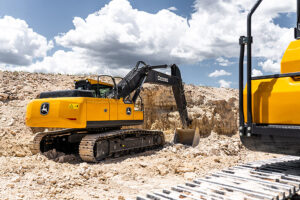
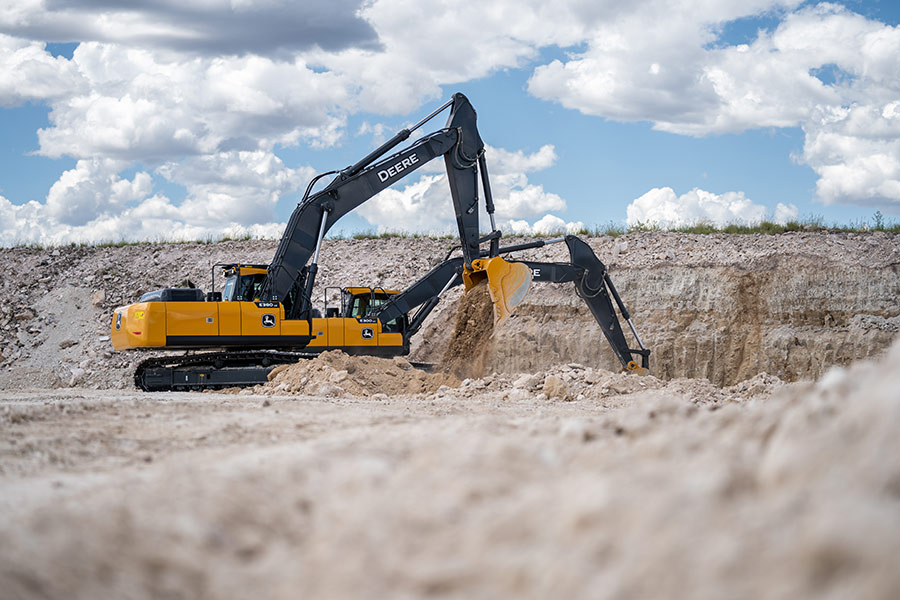
PGN Civils was among the first South African companies to buy one of the first machines that came into the country, a 38-tonne (t) E380-II excavator. Supplied by AFGRI Equipment, one of the major John Deere dealers, the machine quickly proved its mettle in a taxing magnetite operation, prompting PGN Civils to purchase three more E380-II excavators within a short space of time. Deployed to load trucks, two of these 38-t excavators have just clocked over 14 000 hours and counting.
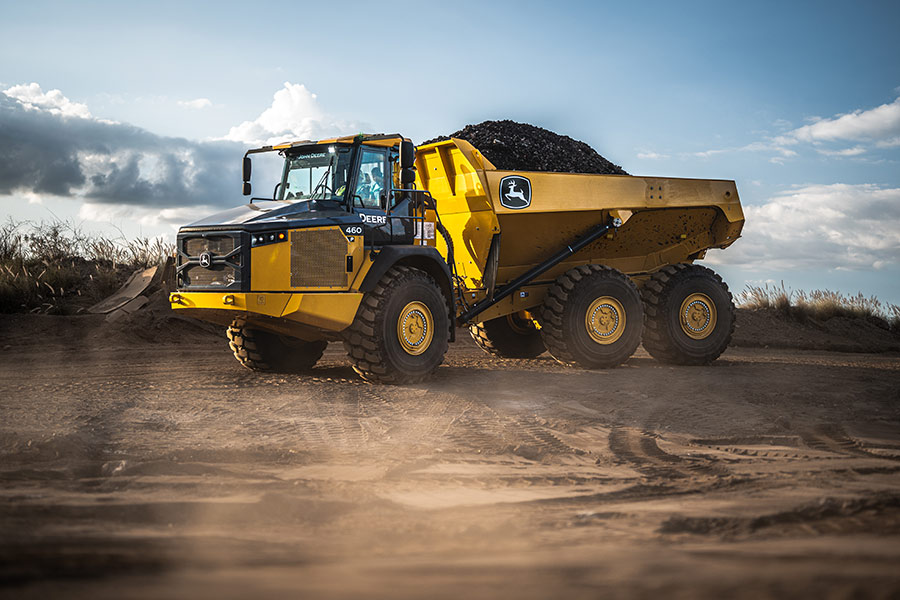
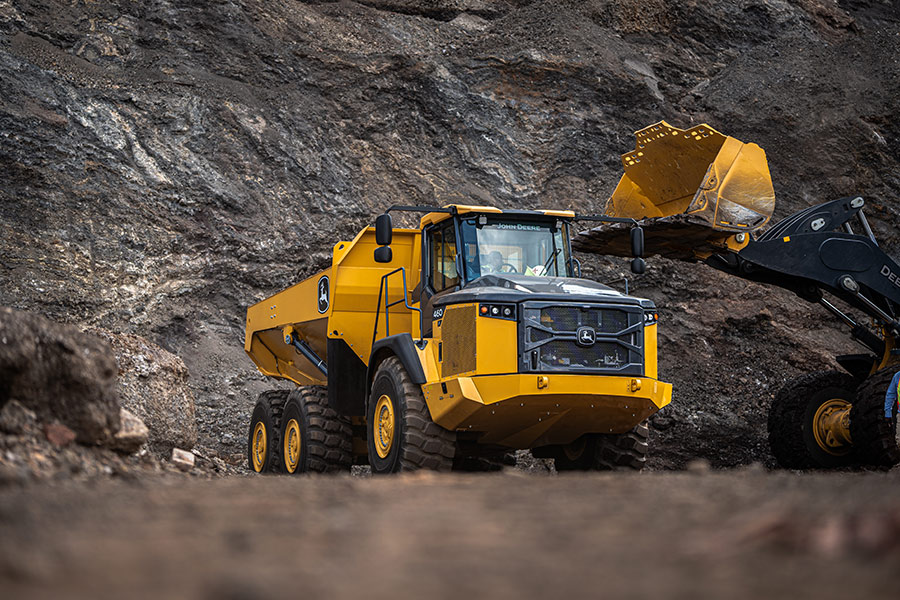
As part of the second phase of the construction equipment rollout, John Deere introduced its production-class equipment in July 2022. At the heart of this range was the 42-tonne class John Deere 460E-II articulated dump truck (ADT). PGN Civils again went on to be one of the first recipients of this range in South Africa, taking delivery of two 460E-II ADTs in December 2022. With just over 13 000 hours on the clock to date, these machines continue to perform in tough operating conditions, offering uninterrupted hours of efficient production.
In early 2025, PGN Civils went on to bolster its John Deere fleet with four 460P ADTs, one of the first model ranges to come to the local market under the John Deere Performance Tiering strategy in April 2024. The same year, the company also added two excavators – a 30-t E300-II and a 21-t E210-II. The 21-t unit has been deployed for pond maintenance at a magnetite mine, while the 30-t machine is used to load trucks at the very same ponds. In total, PGN Civils now runs 12 John Deere machines, with prospects to significantly bolster the fleet in the next few years, confirms Mnisi.
Why John Deere?
Commenting on why PGN Civils continues to grow its John Deere fleet, Mnisi says he has been impressed by the performance of the product in tough conditions. “At one of our sites, some of these machines are deployed to handle magnetite material, which is known for its abrasive and heavy nature. To provide context, the specific gravity (SG) of magnetite is approximately 5,2. Our John Deere machines have proven to be equal to the task, standing up to this arduous application,” says Mnisi.
In addition, the operating environment is challenging due to the extreme temperatures synonymous with Phalaborwa. Average daily maximum temperatures in the summer months (December to February) typically range from 33°C to 38 °C, but temperatures exceeding 40°C can occur. In fact, the highest recorded temperature in Phalaborwa was 50°C in December 2018.
In such a sweltering environment, running hydraulic machines is generally challenging primarily because heat degrades the hydraulic fluid’s properties and damages the system’s seals and components, leading to performance issues and potential system failure. However, John Deere products have proven their mettle, with machines continuing to perform well with no major mechanical issues in such taxing conditions.
“These environments challenge and push any product to the limits, but John Deere machines are standing up to these demanding operating conditions. We have given the product a proper testing ground and it is passing with flying colours,” says Mnisi.
“Durability is a key attribute in our buying decisions because we prefer running our machines for long periods. To provide context, we recently retired one of our wheel loaders with 34 000 hours on the clock. Because we prefer buying our equipment new, we know each piece of machinery’s history, which allows us to sweat these assets for extended periods,” he adds.
Some of the first John Deere excavators have to date clocked over 14 000 hours with no issues, while the first ADTs are pushing towards the 15 000-hour mark. Traditionally, PGN Civils has always shifted some of its excavators to the less demanding construction division when they reach high hours and start falling short of the mining performance requirements. However, says Mnisi, the company is now investigating the viability of giving its machines a ‘second life’ through OEM refurbishments. With John Deere machines, particularly ADTs, this will likely happen at 20 000 hours.
Apart from machine durability, PGN Civils places a high value on fuel consumption, and this is an area in which the John Deere product has proven itself. Despite hauling very heavy magnetite material, the 42-t John Deere ADTs are consuming about 19,05 litres of diesel per hour which, according to PGN’s benchmark, is within expectations.
As a company that also encourages data-driven decisions, Mnisi is impressed by the level of technology on the John Deere product. For example, the SmartWeigh load weighing system offers productivity-enhancing capabilities by letting operators achieve correct loads the first time without return trips to the pile. It also reduces the possibility of overloading, especially given that the haulers are moving heavy material with a high SG.
In addition, Mnisi makes special mention of John Deere’s Operations Centre fleet management system, powered by JD™Link hardware, which enhances efficiency through remote monitoring and data analysis, thus reducing costs by optimising machine performance and workflows. It also improves decision-making and provides tools for proactive maintenance to minimise equipment downtime.
Backup support
Apart from the John Deere product itself, Mnisi is impressed by the backup support behind it, both from AFGRI Equipment and John Deere. In a 24/7 operating environment where downtime is out of the question, Mnisi has been impressed by the two companies’ responsiveness to any issues, which maximises uptime for PGN Civils.
Mnisi is particularly happy with the direct communication channels within both AFGRI and John Deere, citing no bureaucracy within the two organisations. “At both AFGRI and John Deere, we have direct access to even the top management structures, which allows for quicker responses and decision-making. In such a fast-paced mining environment, excessive bureaucracy, which often involves multiple layers of approval and communication, slows down decision-making, which is counter-productive,” says Mnisi.
“While John Deere is now such a big organisation, we feel that the company still maintains family business values more than it does a corporate culture. As a family business ourselves, we share the same values. Based on these experiences, we have become a big John Deere proponent and we will definitely buy more John Deere machines in future,” concludes Mnisi.