Industrial plants often bring together equipment designed around different power requirements. This creates challenges in remote and wireless telemetry applications, where radio systems may operate on 12 V while conventional two-wire instrumentation is designed around 24 V supply.
Here, Ian Loudon, international sales and marketing manager at remote monitoring specialist Omniflex, explores how these systems can work together without requiring engineers to redesign the wider power architecture.
Bridging the voltage gap
The 4-20 mA signal remains a standard method of transmitting measurements such as temperature and pressure over long distances. The International Society of Automation describes it as an industrial instrumentation and communication standard, highlighting its suitability for long-distance signal transmission.
However, transmitting the signal is only part of the challenge. Two-wire transmitters are typically designed for 24 V supply, providing the voltage needed to power the device while allowing for resistance in the cable. As cable runs become longer, that resistance increases, making available voltage important to maintaining the loop.
This becomes particularly relevant where instrumentation is connected to wireless telemetry or radio equipment powered from 12 V. The problem for engineers is how to introduce 24 V instrumentation into a 12 V-based installation without creating a separate power system simply to accommodate different equipment types.
One option is to create a separate 24 V supply, but this can mean using two 12 V batteries in series and a dual charging arrangement. For remote and distributed installations, adding this extra infrastructure can increase the number of components, space requirements and maintenance considerations.
An alternative is to generate the required 24 V loop supply from the existing lower-voltage architecture. This approach can also become important as the distance between the transmitter and receiving equipment increases. Cable resistance can erode the available voltage, creating a balance between the supply, the loop resistance and the power required by the transmitter.
For longer cable runs, a stable 24 V loop supply helps ensure conventional two-wire instrumentation has sufficient voltage to operate, while allowing the wider installation to remain based around a lower-voltage power architecture.
Maintaining sufficient loop voltage
The importance of available voltage becomes clearer as the distance between the transmitter and receiving equipment increases. Cable resistance is one factor that can erode the available voltage, creating a balance between the supply, the loop resistance and the power required by the transmitter.
For longer cable runs, more voltage is needed to drive the signal. If the available voltage is insufficient, the loop can effectively run out of voltage for the distance it needs to cover.
Providing a stable 24 V loop supply therefore helps ensure that the conventional two-wire instrumentation has the voltage it needs, while allowing the wider installation to remain based around a lower-voltage power architecture.
Isolation adds another layer of protection
Voltage conversion is not the only consideration when connecting field instrumentation to remote equipment. Field-connected equipment can be exposed to electrical disturbances, including surges, ground loops and floating voltages between different parts of the plant.
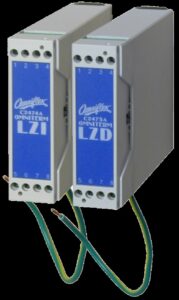
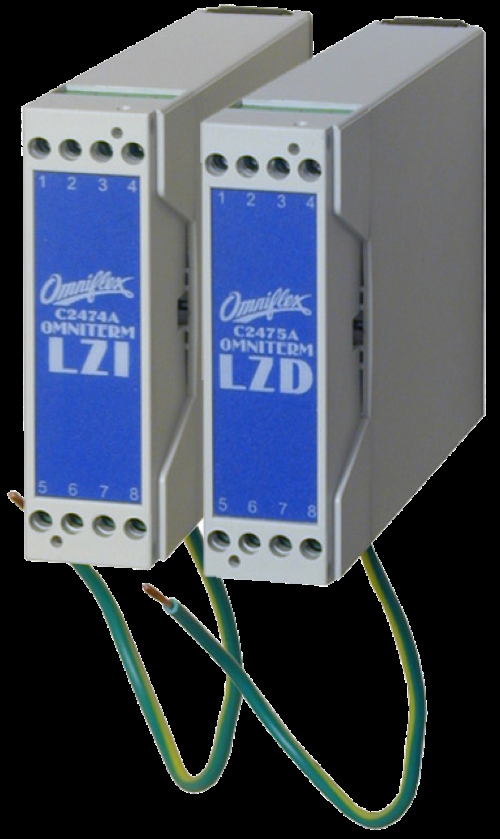
The Omniterm LZ series accepts supply voltages from 10-30 Vdc and provides a stabilised 24 V loop supply for field-mounted two-wire transmitters. This allows standard instrumentation to operate from a 12 V battery-powered RTU without requiring a separate 24 V battery and charger.
The LZ series combines signal isolation and surge protection, reducing the need for separate devices where both functions are required. Combining these functions can reduce space requirements, while the LZ’s electronic design also provides low power consumption and can save installation and commissioning time.
For engineers working with remote, battery-powered or distributed systems, the challenge is to enable equipment based around each standard, including 12 V and 24 V to work together without adding unnecessary infrastructure.
By converting voltage and providing isolation at the interface, the LZ can retain the simplicity of a 12 V power architecture while supporting standard 24 V instrumentation. This reduces the need for additional power infrastructure and makes better use of existing equipment.